CAS 116-31-4
:Retinal
Beschreibung:
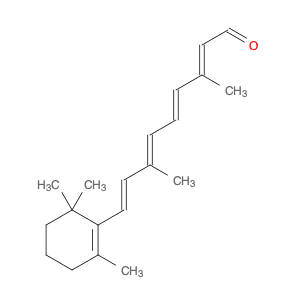
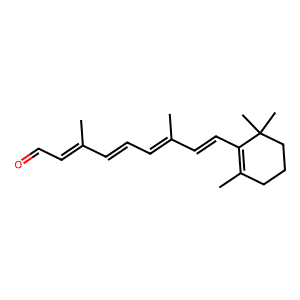
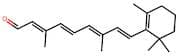
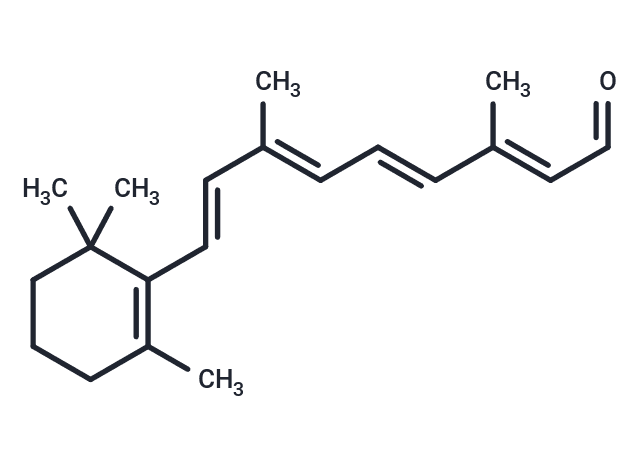
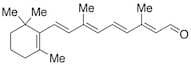
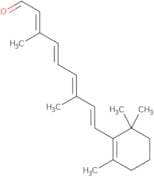
Retinal, auch bekannt als Vitamin A-Aldehyd, ist eine lebenswichtige organische Verbindung mit der chemischen Formel C20H28O. Es ist ein Derivat von Vitamin A und spielt eine entscheidende Rolle im visuellen Prozess, insbesondere in der Funktion der Photorezeptorzellen in der Netzhaut. Retinal existiert in zwei isomeren Formen: 11-cis-Retinal und all-trans-Retinal, wobei erstere für das Sehen unerlässlich ist, da sie an Opsin-Proteine bindet, um Rhodopsin zu bilden, einen lichtempfindlichen Rezeptor. Die Verbindung ist durch ihr konjugiertes Doppelbindungssystem gekennzeichnet, das zu ihren lichtabsorbierenden Eigenschaften beiträgt. Retinal ist typischerweise ein gelblich-orangefarbener Feststoff bei Raumtemperatur und in organischen Lösungsmitteln löslich, jedoch weniger in Wasser. Seine Stabilität kann durch Licht und Sauerstoff beeinträchtigt werden, was zu Isomerisierung oder Zersetzung führen kann. Neben seiner biologischen Bedeutung wird Retinal auch wegen seiner potenziellen Anwendungen in der Photonik und Materialwissenschaft aufgrund seiner einzigartigen optischen Eigenschaften untersucht.
Formel:C20H28O
InChl:InChI=1S/C20H28O/c1-16(8-6-9-17(2)13-15-21)11-12-19-18(3)10-7-14-20(19,4)5/h6,8-9,11-13,15H,7,10,14H2,1-5H3/b9-6+,12-11+,16-8+,17-13+
InChI Key:InChIKey=NCYCYZXNIZJOKI-OVSJKPMPSA-N
SMILES:C(=C/C(=C/C=C/C(=C/C=O)/C)/C)\C=1C(C)(C)CCCC1C
Synonyme:- (all-E)-15-Apo-β-caroten-15-al
- (all-E)-3,7-Dimethyl-9-(2,6,6-trimethyl-1-cyclohexen-1-yl)-2,4,6,8-nonatetraenal
- 15-Apo-β-caroten-15-al
- 15-Apo-β-carotenal
- 2,4,6,8-Nonatetraenal, 3,7-dimethyl-9-(2,6,6-trimethyl-1-cyclohexen-1-yl)-, (all-E)-
- Axerophthal
- E-Retinal
- Retinal, all-trans-
- Retinaldehido
- Retinaldehyd
- Retinaldehyde
- Retinene
- Retinene 1
- Vitamin A aldehyde
- Vitamin A1 aldehyde
- Vitamin A<sub>1</sub> aldehyde
- all-E-Retinal
- all-trans-Retinal
- all-trans-Retinaldehyde
- all-trans-Vitamin A aldehyde
- trans-Retinal
- trans-Vitamin A aldehyde
- Weitere Synonyme anzeigen
Sortieren nach
Reinheit (%)
0
100
|
0
|
50
|
90
|
95
|
100
12 Produkte.
All-trans-Retinal
CAS:Formel:C20H28OReinheit:≥ 98.0%Farbe und Form:Yellow, orange or brown powderMolekulargewicht:284.44All-trans-retinal
CAS:All-trans-retinal (Vitamin A aldehyde) is a one of the major vitamin A metabolites in the retina.Formel:C20H28OReinheit:98.56% - 98.70%Farbe und Form:SolidMolekulargewicht:284.44all-trans-Retinal-14,15-13C2
CAS:Kontrolliertes ProduktApplications Labelled Retinal. Corotenoid component of the visual pigments.
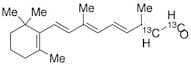
References Ball, et al.: Biochem. J., 42, 516 (1948), O’Brien, D.F., et al.: Science, 218, 961 (1982),Formel:C18C2H28OFarbe und Form:NeatMolekulargewicht:286.42all-trans-Retinal
CAS:Kontrolliertes ProduktStability Hygroscopic
Applications Corotenoid component of the visual pigments. All-trans retinal is converted to retinoic acid in vivo by the action of retinal dehydrogenase.
References Ball, et al.: Biochem. J., 42, 516 (1948), O’Brien, D.F., et al.: Science, 218, 961 (1982),Formel:C20H28OFarbe und Form:Yellow To Dark OrangeMolekulargewicht:284.44Retinylaldehyde
CAS:Retinylaldehyde is a derivative of vitamin A that is important for visual health. It is an inhibitor of the chloride channel, which may be due to its ability to inhibit alcohol dehydrogenase and polymerase chain reaction (PCR). Retinylaldehyde has been shown to have a high affinity for nuclear DNA and can bind to guanine nucleotide-binding protein (G protein) in neural cells. This activity leads to chronic cough in mice. Retinylaldehyde also has been shown as having significant up-regulation in human monocytes when exposed to toll-like receptor ligands. The role of retinylaldehyde in the immune system is not fully understood, but it may play a role in modulating the response to bacterial infection by altering the production of cytokines such as interleukin-1β (IL-1β) and tumor necrosis factor alpha (TNFα).Formel:C20H28OReinheit:Min. 98 Area-%Farbe und Form:PowderMolekulargewicht:284.44 g/mol