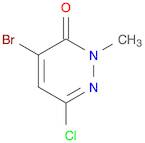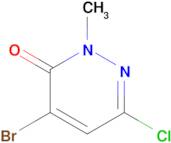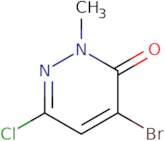
CAS 1178884-53-1
:Formel:C5H4BrClN2O
InChl:InChI=1S/C5H4BrClN2O/c1-9-5(10)3(6)2-4(7)8-9/h2H,1H3
InChI Key:HXCPMIRSWJJTGV-UHFFFAOYSA-N
SMILES:CN1C(=O)C(=CC(=N1)Cl)Br
Sortieren nach
Reinheit (%)
0
100
|
0
|
50
|
90
|
95
|
100
5 Produkte gefunden.
4-Bromo-6-chloro-2-methylpyridazin-3(2H)-one
CAS:Formel:C5H4BrClN2OReinheit:98%Farbe und Form:SolidMolekulargewicht:223.45514-Bromo-6-chloro-2-methylpyridazin-3(2H)-one
CAS:4-Bromo-6-chloro-2-methylpyridazin-3(2H)-oneFormel:C5H4BrClN2OReinheit:98%Molekulargewicht:223.464-Bromo-6-chloro-2-methylpyridazin-3(2H)-one
CAS:4-Bromo-6-chloro-2-methylpyridazin-3(2H)-oneFormel:C5H4BrClN2OReinheit:95%Molekulargewicht:223.464-BROMO-6-CHLORO-2-METHYLPYRIDAZIN-3(2H)-ONE
CAS:Formel:C5H4BrClN2OReinheit:95%Molekulargewicht:223.454-Bromo-6-chloro-2-methylpyridazin-3(2H)-one
CAS:4-Bromo-6-chloro-2-methylpyridazin-3(2H)-one is a research chemical that has shown potential for various applications. It has been studied for its intraocular properties and its ability to enhance the levels of carotenoids in the eye. This compound can be used in the form of dichloride for intravitreal injections, where it has demonstrated efficacy in reducing inflammation and inhibiting the production of tumor necrosis factor-alpha (TNF-α). Additionally, 4-Bromo-6-chloro-2-methylpyridazin-3(2H)-one has been found to have antioxidant properties, potentially due to its interaction with eugenol and endothelial growth factors. Furthermore, this compound has shown promise in promoting dopamine release and stimulating cellulose growth. It is also being explored as an anti-VEGF agent and has been investigated for its potential use in synthetic cannabinoids and biomass activation. Overall, 4-BFormel:C5H4N2OClBrReinheit:Min. 95%Molekulargewicht:223.46 g/mol