CAS 124123-15-5
:Hypophysen-Adenylatcyclase-aktivierendes Polypeptid (1-38) Amid (Mensch, Schaf, Ratte)
Beschreibung:
Das hypophysäre Adenylatcyclase-aktivierende Peptid (PACAP) ist ein Neuropeptid, das eine entscheidende Rolle in verschiedenen physiologischen Prozessen spielt, einschließlich Neuroprotektion, Neurotransmission und Hormonsekretion. Die spezifische Form, die als PACAP (1-38) Amid bekannt ist, bezieht sich auf ein 38-Aminosäure-Peptid, das an seinem C-Terminus amidiert ist, was seine Stabilität und biologische Aktivität erhöht. Dieses Peptid ist über Arten hinweg hochgradig konserviert, einschließlich Menschen, Schafen (ovin) und Ratten, was auf seine grundlegende biologische Bedeutung hinweist. PACAP entfaltet seine Wirkung hauptsächlich durch die Bindung an spezifische Rezeptoren, was zur Aktivierung der Adenylatcyclase und zu anschließenden Erhöhungen der intrazellulären cAMP-Spiegel führt. Es ist an zahlreichen Funktionen beteiligt, wie der Regulierung der zirkadianen Rhythmen, der Modulation von Stressreaktionen und der Beeinflussung der Fortpflanzungsfunktionen. Darüber hinaus wurde PACAP mit verschiedenen pathologischen Zuständen in Verbindung gebracht, einschließlich neurodegenerativer Erkrankungen und Stimmungserkrankungen, was es zu einem interessanten Thema sowohl in der Grundlagen- als auch in der klinischen Forschung macht. Seine CAS-Nummer, 124123-15-5, ist eine eindeutige Kennung, die für regulatorische und Forschungszwecke verwendet wird und das Verfolgen und Studieren dieses Peptids in der wissenschaftlichen Literatur erleichtert.
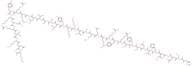
Formel:C203H331N63O53S
Synonyme:- H-His-Ser-Asp-Gly-Ile-Phe-Thr-Asp-Ser-Tyr-Ser-Arg-Tyr-Arg-Lys-Gln-Met-Ala-Val-Lys-Lys-Tyr-Leu-Ala-Ala-Val-Leu-Gly-Lys-Arg-Tyr-Lys-Gln-Arg-Val-Lys-Asn-Lys-NH2
Sortieren nach
Reinheit (%)
0
100
|
0
|
50
|
90
|
95
|
100
3 Produkte.
PACAP-38 (human, mouse, ovine, porcine, rat)
CAS:Kojro et al. observed that the PAC1 agonists PACAP-27 (H-1172) and PACAP-38 strongly increased the activity of α-secretase. Upregulation of this APP-degrading enzyme promotes the non-amyloidogenic processing of APP, i.e. reduces the production of Aβ40/42, and thus may help to prevent Alzheimer’s disease. Nasally applied PACAP-38 in APP[V717I]-transgenic mice additionally enhanced the production of the Aβ-degrading enzyme neprilysin via induction of somatostatin.Formel:C203H331N63O53SReinheit:97.6%Farbe und Form:WhiteMolekulargewicht:4534.32PACAP38 (Human)
CAS:PACAP38 is a ligand that belongs to the family of peptides. It binds to the PAC1 receptor and activates it. PACAP38 has been shown to inhibit ion channels, such as potassium channels and calcium channels, in neuronal cells. The protein interactions of PACAP38 are not yet fully understood.Formel:C203H331N63O53SReinheit:Min. 95%Molekulargewicht:4,534.3 g/molPACAP-38 (human, mouse, ovine, porcine, rat) trifluoroacetate salt
CAS:PACAP-38 is a peptide that has been shown to have a variety of physiological effects, including the regulation of brain functions and immunological responses. PACAP-38 has been found to bind to toll-like receptor 4 (TLR4) in macrophages and neutrophils, which stimulates the production of proinflammatory cytokines. It also interacts with adenylate cyclase, which leads to an increase in cAMP levels. This may be the mechanism by which PACAP-38 regulates brain functions. The biological function of PACAP-38 is not yet clear but it may act as a signal peptide, regulating protein synthesis and gene expression.Formel:C203H331N63O53SReinheit:Min. 95%Molekulargewicht:4,534.26 g/mol