CymitQuimica logo

CAS 1307-96-6

:

Kobaltoxid (CoO)

Beschreibung:
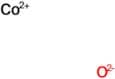
Kobaltoxid (CoO) ist eine anorganische Verbindung, die durch ihr schwarzes oder dunkelbraunes Aussehen gekennzeichnet ist und typischerweise als Feststoff bei Raumtemperatur existiert. Es handelt sich um ein Übergangsmetalloxid, bei dem Kobalt einen Oxidationszustand von +2 aufweist. CoO ist bekannt für seinen hohen Schmelzpunkt und seine Stabilität unter verschiedenen Bedingungen, was es in Hochtemperaturanwendungen nützlich macht. Die Verbindung ist in Wasser unlöslich, kann jedoch in Säuren gelöst werden, wobei Kobaltsalze entstehen. Kobaltoxid wird in verschiedenen industriellen Anwendungen eingesetzt, unter anderem als Pigment in Keramiken und Glas, als Katalysator in chemischen Reaktionen und in der Batterieproduktion. Darüber hinaus spielt es eine Rolle bei der Synthese anderer Kobaltverbindungen. CoO kann magnetische Eigenschaften aufweisen und ist in der Materialwissenschaft von Interesse für seine potenzielle Verwendung in elektronischen Geräten. Es ist jedoch wichtig, Kobaltoxid mit Vorsicht zu behandeln, da Kobaltverbindungen toxisch sein können und Gesundheitsrisiken bei Exposition darstellen. Es sollten angemessene Sicherheitsmaßnahmen getroffen werden, wenn mit dieser Substanz in Labor- oder Industrieumgebungen gearbeitet wird.
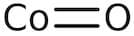
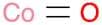
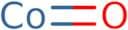
Formel:CoO
InChl:InChI=1S/Co.O
InChI Key:InChIKey=IVMYJDGYRUAWML-UHFFFAOYSA-N
SMILES:[Co]=O
Synonyme:
  • Cobalt Black
  • Cobalt monooxide
  • Cobalt monoxide
  • Cobalt oxide (CoO)
  • Cobalt(2+) oxide
  • Cobalt(II) oxide
  • Cobaltous Oxygen(-2) Anion
  • Cobaltous oxide
  • Cobaltous oxide (CoO)
  • Cobaltoxid
  • Weitere Synonyme anzeigen
Sortieren nach

Reinheit (%)
0
100
|
0
|
50
|
90
|
95
|
100
7 Produkte gefunden.
  • Cobalt(II) oxide, 95%

    CAS:
    Gallium(III) oxide is used in vacuum deposition. It is useful for making semiconductor devices, gallium-alumina catalyst, gas sensors, luminescent phosphors and dielectric coatings of solar cells. It shows potential for developing deep-ultraviolet TCOs (Transparent Conductive Oxides) and transparen
    Formel:CoO
    Reinheit:95%
    Molekulargewicht:74.93

    Ref: 02-023141

    25g
    114,00€
    100g
    356,00€
  • Cobalt(II) oxide, 99.995% (metals basis)

    CAS:
    Cobalt(II) oxide is widely used in the ceramic industry. It is an additive to create blue-colored glazes and enamels. It finds application in the manufacture of magnetic and electronic component materials. This Thermo Scientific Chemicals brand product was originally part of the Alfa Aesar product
    Formel:CoO
    Reinheit:99.995%
    Farbe und Form:Powder, Green-brown
    Molekulargewicht:74.93

    Ref: 02-044354

    100g
    Nachfragen
    5g
    197,00€
    25g
    697,00€
  • Cobalt oxide (CoO)

    CAS:
    Formel:CoO
    Reinheit:99%
    Farbe und Form:Solid
    Molekulargewicht:74.9326

    Ref: IN-DA000UUE

    25g
    31,00€
    100g
    59,00€
    500g
    140,00€
    1kg
    184,00€
  • Cobalt(II)oxide

    CAS:
    Cobalt(II)oxide
    Formel:CoO
    Reinheit:99.5%,500mesh
    Molekulargewicht:74.93

    Ref: 54-IN14046

    25g
    56,00€
    100g
    80,00€
    500g
    185,00€
    1kg
    279,00€
  • Cobalt(II) oxide

    CAS:
    Formel:CoO
    Reinheit:99.5%,500mesh
    Farbe und Form:Solid
    Molekulargewicht:74.932

    Ref: 10-F494144

    25g
    21,00€
  • Cobalt(II) oxide

    CAS:

    Cobalt is a transition metal with the atomic number 27. It has an oxidation state of +2 and belongs to group 8 on the periodic table. Cobalt(II) oxide (CoO) is a black solid that can be formed by heating cobalt metal at temperatures greater than 1400°C. The electrochemical impedance spectroscopy of CoO shows that it has high resistivity and good electrical conductivity, making it useful for corrosion protection. Cobalt oxide is also used as a catalyst in chemical reactions, such as oxidation and reduction, due to its redox potential. Cobalt oxide can be produced from the reaction between hydrochloric acid and zirconium oxide by electrolysis, which produces an electric current. This process can be done in two ways: either by using an electrochemical cell or by laser ablation. The latter method is more efficient because it requires less energy input than using an electrochemical cell. In addition, CoO particles are spherical in shape, have

    Formel:CoO
    Reinheit:75%Min
    Farbe und Form:Powder
    Molekulargewicht:74.93 g/mol

    Ref: 3D-FC55004

    50g
    225,00€
    100g
    339,00€
    250g
    547,00€
    500g
    776,00€
    1kg
    1.046,00€
  • Cobalt oxide-molybdenum oxide on alumina (3.5% CoO, 14% MoO₃)

    CAS:

    Cobalt oxide-molybdenum oxide on alumina (3.5% CoO, 14% MoO3)

    Formel:CoO/MoO3/Al2O3
    Farbe und Form:1/8'' extrusions
    Molekulargewicht:74.92811

    Ref: 08-27-0480

    100g
    86,00€
    500g
    327,00€