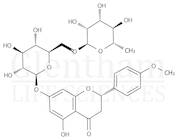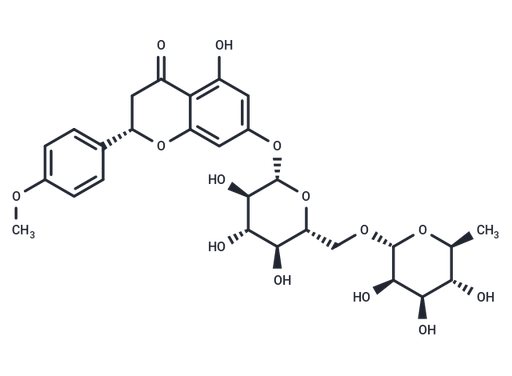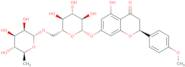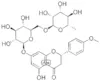
CAS 14259-47-3
:Didymin
Beschreibung:
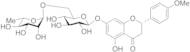
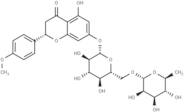
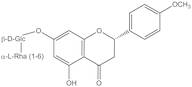
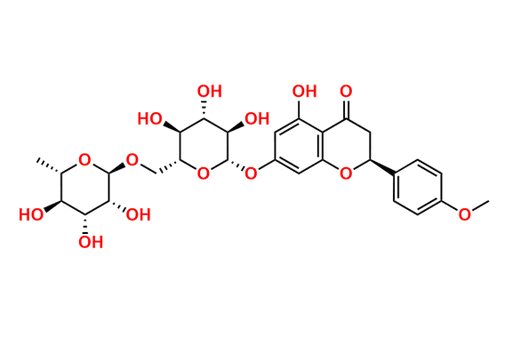
Didymin, mit der CAS-Nummer 14259-47-3, ist eine Flavonoidverbindung, die hauptsächlich in Zitrusfrüchten vorkommt. Es ist ein Glykosid des Flavonoids Diosmin, was bedeutet, dass es aus einem Flavonoidanteil besteht, der an ein Zuckermolekül gebunden ist. Didymin ist bekannt für seine potenziellen gesundheitlichen Vorteile, einschließlich antioxidativer Eigenschaften, die helfen, freie Radikale im Körper zu neutralisieren. Es kann auch entzündungshemmende Wirkungen zeigen und wurde auf seine potenzielle Rolle für die Herz-Kreislauf-Gesundheit untersucht. Die Verbindung ist in organischen Lösungsmitteln löslich, hat jedoch eine begrenzte Löslichkeit in Wasser, was ihre Bioverfügbarkeit beeinflussen kann. Didymin wird häufig auf seine pharmakologischen Eigenschaften untersucht, insbesondere im Kontext von Nahrungsergänzungsmitteln und natürlichen Gesundheitsprodukten. Sein Sicherheitsprofil wird im Allgemeinen als günstig angesehen, obwohl weitere Studien erforderlich sind, um seine Wirkungen und Wirkmechanismen auf die menschliche Gesundheit vollständig zu verstehen. Wie bei vielen Flavonoiden kann die Bioaktivität von Didymin durch Faktoren wie Dosierung, Formulierung und individuelle Stoffwechselunterschiede beeinflusst werden.
Formel:C28H34O14
InChl:InChI=1S/C28H34O14/c1-11-21(31)23(33)25(35)27(39-11)38-10-19-22(32)24(34)26(36)28(42-19)40-14-7-15(29)20-16(30)9-17(41-18(20)8-14)12-3-5-13(37-2)6-4-12/h3-8,11,17,19,21-29,31-36H,9-10H2,1-2H3/t11-,17-,19+,21-,22+,23+,24-,25+,26+,27+,28+/m0/s1
InChI Key:InChIKey=RMCRQBAILCLJGU-HIBKWJPLSA-N
SMILES:O=C1C=2C(O[C@@H](C1)C3=CC=C(OC)C=C3)=CC(O[C@@H]4O[C@H](CO[C@H]5[C@H](O)[C@H](O)[C@@H](O)[C@H](C)O5)[C@@H](O)[C@H](O)[C@H]4O)=CC2O
Synonyme:- (2S)-7-[[6-O-(6-Deoxy-α-<span class="text-smallcaps">L</smallcap>-mannopyranosyl)-β-<smallcap>D</span>-glucopyranosyl]oxy]-2,3-dihydro-5-hydroxy-2-(4-methoxyphenyl)-4H-1-benzopyran-4-one
- (S)-7-((6-O-(6-Deoxy-alpha-L-mannopyranosyl)-beta-D-glucopyranosyl)oxy)-2,3-dihydro-5-hydroxy-2-(4-methoxyphenyl)-4H-benzopyran-4-one
- 4H-1-Benzopyran-4-one, 7-[[6-O-(6-deoxy-α-<span class="text-smallcaps">L</smallcap>-mannopyranosyl)-β-<smallcap>D</span>-glucopyranosyl]oxy]-2,3-dihydro-5-hydroxy-2-(4-methoxyphenyl)-, (2S)-
- 4H-1-Benzopyran-4-one, 7-[[6-O-(6-deoxy-α-<span class="text-smallcaps">L</smallcap>-mannopyranosyl)-β-<smallcap>D</span>-glucopyranosyl]oxy]-2,3-dihydro-5-hydroxy-2-(4-methoxyphenyl)-, (S)-
- 4′-Methoxy-5,7-dihydroxyflavanone 7-O-rutinoside
- 5-hydroxy-2-(4-methoxyphenyl)-4-oxo-3,4-dihydro-2H-chromen-7-yl 6-O-(6-deoxy-L-mannopyranosyl)-beta-D-glucopyranoside
- 5-hydroxy-2-(4-methoxyphenyl)-4-oxo-3,4-dihydro-2H-chromen-7-yl 6-O-(6-deoxyhexopyranosyl)hexopyranoside
- Citrifoliol-7-O-rutinoside
- Didymine
- Flavanone, 5,7-dihydroxy-4′-methoxy-, 7β-rutinoside
- Isosakuranetin 7-rutinoside
- Isosakuranetin-7-O-rutinoside
- Isosakuranetin-7-beta-rutinoside
- Neoponcirin
- Didymin
- 4H-1-Benzopyran-4-one, 7-[[6-O-(6-deoxy-α-L-mannopyranosyl)-β-D-glucopyranosyl]oxy]-2,3-dihydro-5-hydroxy-2-(4-methoxyphenyl)-, (S)-
- (2S)-7-[[6-O-(6-Deoxy-α-L-mannopyranosyl)-β-D-glucopyranosyl]oxy]-2,3-dihydro-5-hydroxy-2-(4-methoxyphenyl)-4H-1-benzopyran-4-one
- Weitere Synonyme anzeigen
Filtern nach
Reinheitsanteil
0
100
|
0
|
50
|
90
|
95
|
100
15 Produkte gefunden.
- Niedrigster Preis
- Höchster Preis
- Niedrigste Reinheit
- Höchste Reinheit
- Schnellste Lieferung
Didymin
CAS:Formel:C28H34O14Reinheit:≥ 98.0%Farbe und Form:White to yellow powder to crystalline powderMolekulargewicht:594.57Didymin
CAS:Didymin analytical standard provided with w/w absolute assay, to be used for quantitative titration.Formel:C28H34O14Reinheit:(HPLC) ≥98%Farbe und Form:PowderMolekulargewicht:594.57Didymin (Standard)
CAS:Didymin (Standard) is a reference standard for research and analysis in studies involving Didymin. Didymin (Neoponcirin) has antioxidant property. Didymin induces apoptosis by inhibiting N-Myc and upregulating RKIP in neuroblastoma, may used for neuroblastoma therapy. Didymin may be a potential therapeutic molecule for the treatment of neurodegenerative disorders associated with oxidative stress.Formel:C28H34O14Farbe und Form:SolidMolekulargewicht:594.5612Didymin
CAS:Didymin is a citrus-derived natural compound that kills p53 wild-type as well as drug-resistant p53-mutant neuroblastoma cells in culture, it induces apoptosis by inhibiting N-Myc and upregulating RKIP in neuroblastoma. Didymin possesses antioxidant, anti-inflammation and anti-cancer properties.Formel:C28H34O14Reinheit:95%~99%Farbe und Form:PowderMolekulargewicht:594.566(S)-7-[[6-O-(6-Deoxy-α-L-mannopyranosyl)-β-D-glucopyranosyl]oxy]-2,3-dihydro-5-hydroxy-2-(4-methoxyphenyl)-4H-benzopyran-4-one
CAS:Formel:C28H34O14Reinheit:98%Farbe und Form:SolidMolekulargewicht:594.5612Neoponcirin
CAS:Kontrolliertes ProduktApplications Neoponcirin is a flavonoid that was shown to exhibit anticancer properties by inducing apoptosis by inhibiting N-Myc and upregulating RKIP in neuroblastoma.
References Singhai, J., et al.: Cancer. Prev. Res., 5, 473 (2012); Sdiri, S., et al.: Postharv. Biol. Techol., 65, 13, (2012);Formel:C28H34O14Farbe und Form:NeatMolekulargewicht:594.56Didymin
CAS:(S)-5-Hydroxy-2-(4-methoxyphenyl)-7-(((2S,3R,4S,5S,6R)-3,4,5-trihydroxy-6-((((2R,3R,4R,5R,6S)-3,4,5-trihydroxy-6-methyltetrahydro-2H-pyran-2-yl)oxy)methyl)tetrahydro-2H-pyran-2-yl)oxy)chroman-4-oneFormel:C28H34O14Reinheit:98%Molekulargewicht:594.56Didymin
CAS:Didymin, an antioxidant, may treat neuroblastoma and neurodegeneration by blocking N-Myc and boosting RKIP.Formel:C28H34O14Reinheit:99.12% - 99.87%Farbe und Form:SolidMolekulargewicht:594.5612Didymin
CAS:Natural glycosideFormel:C28H34O14Reinheit:≥ 95.0 % (HPLC)Farbe und Form:PowderMolekulargewicht:594.57Didymin
CAS:Didymin is a flavonoid compound, which is a type of polyphenolic molecule. It occurs naturally in certain citrus fruits and plants, representing a secondary metabolite with bioactive properties. Didymin exhibits antioxidative activity by neutralizing free radicals and reducing oxidative stress, primarily through the modulation of cellular signaling pathways. This mechanism involves the enhancement of endogenous antioxidant defenses and the inhibition of pro-inflammatory mediators.Formel:C28H34O14Reinheit:Min. 98 Area-%Farbe und Form:PowderMolekulargewicht:594.56 g/mol