CymitQuimica logo

CAS 15450-76-7

:

8-Hydroxy-1H-chinolin-2-on

Beschreibung:
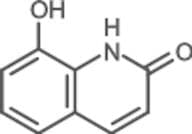
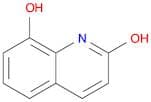
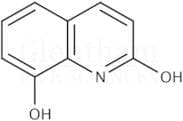
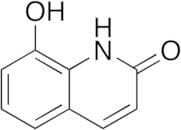
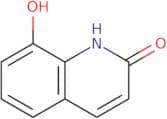
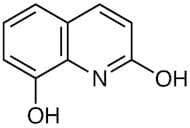
8-Hydroxy-1H-chinolin-2-on, auch bekannt als Oxin, ist eine organische Verbindung, die durch ihre Chinolinstruktur gekennzeichnet ist, die eine Hydroxylgruppe an der Position 8 und eine Carbonylgruppe an der Position 2 aufweist. Diese Verbindung ist bekannt für ihre chelatbildenden Eigenschaften, die es ihr ermöglichen, stabile Komplexe mit verschiedenen Metallionen zu bilden, was sie in der analytischen Chemie und Biochemie nützlich macht für die Detektion und Extraktion von Metallionen. Oxin ist typischerweise ein blassgelbes kristallines Feststoff, das in organischen Lösungsmitteln löslich ist, aber eine begrenzte Löslichkeit in Wasser hat. Es zeigt Fluoreszenz, die in verschiedenen Anwendungen, einschließlich der Fluoreszenzmikroskopie, genutzt werden kann. Darüber hinaus wurde Oxin auf seine potenziellen biologischen Aktivitäten untersucht, einschließlich antimikrobieller und krebsbekämpfender Eigenschaften. Seine Fähigkeit, Komplexe mit Metallen zu bilden, macht es auch in der Umweltchemie relevant für die Analyse von Schwermetallen in Proben. Sicherheitsüberlegungen sollten berücksichtigt werden, da es Gesundheitsrisiken bei Exposition oder Einnahme darstellen kann.
Formel:C9H7NO2
InChl:InChI=1S/C9H7NO2/c11-7-3-1-2-6-4-5-8(12)10-9(6)7/h1-5,11H,(H,10,12)
InChI Key:InChIKey=ZXZKYYHTWHJHFT-UHFFFAOYSA-N
SMILES:OC1=C2C(C=CC(=O)N2)=CC=C1
Synonyme:
  • 2(1H)-Quinolinone, 8-hydroxy-
  • 2,8-Dihydroxylquinoline
  • 2,8-Dihydroxyquinoleine
  • 2,8-Dihydroxyquinoline
  • 8-Hydroxy-1H-quinolin-2-one
  • 8-Hydroxy-2(1H)-quinolinone
  • 8-Hydroxy-2-oxo-1,2-dihydroquinoline
  • 8-Hydroxycarbostyril
  • 8-Hydroxycarbostyryl
  • 8-Hydroxyquinolin-2-one
  • Weitere Synonyme anzeigen
Sortieren nach

Reinheit (%)
0
100
|
0
|
50
|
90
|
95
|
100
12 Produkte gefunden.
  • 2,8-Quinolinediol

    CAS:
    2,8-Dihydroxyquinoline
    Formel:C9H7NO2
    Reinheit:98%
    Molekulargewicht:161.16

    Ref: IN-DG11586

    1g
    15,00€
    5g
    18,00€
    10g
    28,00€
    25g
    35,00€
    100g
    93,00€
    500g
    403,00€
  • 2,8-Quinolinediol

    CAS:
    2,8-Quinolinediol is a useful organic compound for research related to life sciences. The catalog number is T2291 and the CAS number is 15450-76-7.
    Formel:C9H7NO2
    Reinheit:99.62% - 99.77%
    Farbe und Form:Solid
    Molekulargewicht:161.16

    Ref: TM-T2291

    100mg
    33,00€
  • 2,8-Quinolinediol

    CAS:
    Formel:C9H7NO2
    Reinheit:98%
    Farbe und Form:Solid
    Molekulargewicht:161.1574

    Ref: IN-DA00332D

    5g
    20,00€
    1g
    21,00€
    10g
    25,00€
    25g
    50,00€
    100g
    116,00€
    500g
    288,00€
    1kg
    541,00€
  • Quinoline-2,8-diol

    CAS:
    Quinoline-2,8-diol
    Formel:C9H7NO2
    Reinheit:98%
    Farbe und Form:Solid-Powder
    Molekulargewicht:161.15737

    Ref: 54-OR8256

    5g
    30,00€
    25g
    38,00€
    100g
    95,00€
    500g
    409,00€
    2500g
    1.725,00€
  • 2,8-Quinolinediol

    CAS:
    2,8-Quinolinediol
    Formel:C9H7NO2
    Reinheit:≥98%
    Molekulargewicht:161.16

    Ref: 54-BUP14000

    100mg
    52,00€
  • Procaterol Impurity 1

    CAS:
    Formel:C9H7NO2
    Farbe und Form:Light Yellowish Solid
    Molekulargewicht:161.16

    Ref: 4Z-P-188004

    5mg
    Nachfragen
    100mg
    Nachfragen
    10mg
    436,00€
    25mg
    623,00€
    50mg
    810,00€
  • 2,8-Dihydroxyquinoline

    CAS:
    Formel:C9H7NO2
    Reinheit:>98.0%(GC)(T)
    Farbe und Form:White to Light yellow powder to crystal
    Molekulargewicht:161.16

    Ref: 3B-D3819

    5g
    47,00€
    25g
    129,00€
  • 8-Hydroxy-2(1H)-quinolinone

    CAS:

    Applications 8-Hydroxy-2(1H)-quinolinone is a substituted quinolinone derivative used in the preparation of pharmaceutical compounds.
    References Li, F. et al.: J. Proteome. Res., 12, 1369 (2013)

    Formel:C9H7NO2
    Farbe und Form:Neat
    Molekulargewicht:161.16

    Ref: TR-H953185

    100mg
    83,00€
    250mg
    89,00€
  • Quinoline-2,8-diol

    CAS:

    Quinoline-2,8-diol is a bacterial strain that can be used to remove fatty acids from wastewater. The recombinant cytochrome P450 in this strain can degrade fatty acids, which are carcinogenic and have been shown to cause hepatic steatosis. In addition, the quinoline-2,8-diol strain has shown an ability to inhibit xenograft tumor growth in mice by activating cytochrome P450 and inducing apoptosis. This bacterial strain also has the potential to produce xanthurenic acid from tyrosine. Xanthurenic acid is toxic and has been shown to inhibit polymerase chain reaction (PCR) amplification of DNA. Quinoline-2,8-diol may be used as a model for experimental studies of xanthurenic acid's effects on energy metabolism and DNA synthesis.

    Formel:C9H7NO2
    Reinheit:Min. 95 Area-%
    Farbe und Form:Powder
    Molekulargewicht:161.16 g/mol
    Ref: 3D-FQ37177

    10g
    276,00€
    25g
    415,00€
    50g
    590,00€
    100g
    896,00€
  • Quinoline-2,8-diol

    CAS:
    Formel:C9H7NO2
    Reinheit:97%
    Farbe und Form:Solid
    Molekulargewicht:161.16

    Ref: 10-F040217

    1g
    9,00€
    5g
    12,00€
    10g
    18,00€
    25g
    34,00€
    100g
    94,00€
    500g
    381,00€
  • Procaterol Impurity 1

    CAS:
    Formel:C9H7NO2
    Molekulargewicht:161.16

    Ref: ST-EA-CP-P193039

    10mg
    Nachfragen
    25mg
    Nachfragen
    50mg
    Nachfragen
    100mg
    Nachfragen