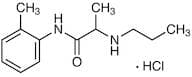
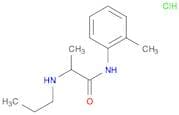
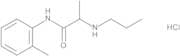
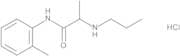
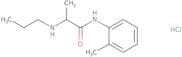
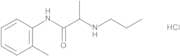
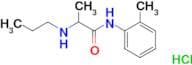
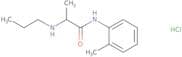
CAS 1786-81-8
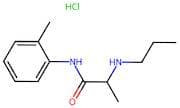
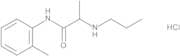
:Prilocainhydrochlorid
- 2-(Propylamino)-N-(o-tolyl)propanamide hydrochloride
- 2-(Propylamino)-o-propionotoluidide hydrochloride
- Alpha-Propylamino-2'-Methylpropionanilide Hydrochloride
- Citanest
- Citanest Plain
- Citanest hydrochloride
- L 67 hydrochloride
- N-(2-Methylphenyl)-2-(propylamino)-propanamide hydrochloride
- N-(2-methylphenyl)-N~2~-propylalaninamide hydrochloride (1:1)
- N-(a-propylaminopropionyl)-o-toluidine hydrochloride
- Prilocaine HCl
- Prilocaine chloride
- Prilocaine hydrochloride
- Propanamide, N-(2-methylphenyl)-2-(propylamino)-, hydrochloride (1:1)
- Propanamide, N-(2-methylphenyl)-2-(propylamino)-, monohydrochloride
- Propitocaine HCL
- Xylonest
- o-Propionotoluidide, 2-(propylamino)-, monohydrochloride
- Weitere Synonyme anzeigen
Prilocaine Hydrochloride
CAS:Formel:C13H20N2O·HClReinheit:>98.0%(HPLC)Farbe und Form:White to Almost white powder to crystalMolekulargewicht:256.77Prilocaine hydrochloride, 98%
CAS:A local anesthetic
Formel:C13H20N2O•HClReinheit:98%Molekulargewicht:256.77PRILOCAINE HYDROCHLORIDE CRS
CAS:PRILOCAINE HYDROCHLORIDE CRSFormel:C13H21ClN2OFarbe und Form:Crystalline Powder. White. Powder.Molekulargewicht:256.7716PRILOCAINE FOR PEAK IDENTIFICATION CRS
CAS:PRILOCAINE FOR PEAK IDENTIFICATION CRSFormel:C13H21ClN2OFarbe und Form:Crystalline Powder. White. Powder.Molekulargewicht:256.7716Prilocaine hydrochloride
CAS:Prilocaine hydrochlorideFormel:C13H20N2OHClReinheit:99.5%Farbe und Form:WhiteMolekulargewicht:256.13424Prilocaine Hydrochloride
CAS:Aromatic cyclic amides (including cyclic carbamates) and their derivatives; salts thereofFormel:C13H20N2O·HClFarbe und Form:White Crystalline PowderMolekulargewicht:220.157562-(Propylamino)-o-propionotoluidide hydrochloride
CAS:Formel:C13H21ClN2OReinheit:98%Farbe und Form:SolidMolekulargewicht:256.7716Prilocaine hydrochloride
CAS:Prilocaine HCl: local amino amide anesthetic, blocks voltage-gated sodium channels in neurons, inhibits Na+ permeability.Formel:C13H21ClN2OReinheit:99.97%Farbe und Form:Needles White Or Off White Crystalline PowderMolekulargewicht:256.77Prilocaine hydrochloride
CAS:Formel:C13H20N2O·HClReinheit:99.0 - 101.0 %Farbe und Form:White to off-white powderMolekulargewicht:256.77Prilocaine HCl (Propitocaine HCl)
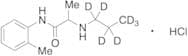
CAS:Formel:C13H20N2O·HClFarbe und Form:White To Off-White SolidMolekulargewicht:220.32 36.46Prilocaine-d7 HCl
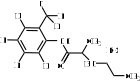
CAS:Formel:C13H13D7N2O·HClFarbe und Form:White To Off-White SolidMolekulargewicht:227.36 36.46Prilocaine-d7 Hydrochloride
CAS:Kontrolliertes ProduktApplications Labelled Prilocaine (P725000). Prilocaine is a local anesthetic of the amino amide type. Prilocaine is often used in dentistry. Prilocaine is also often combined with lidocaine as a preparation for dermal anesthesia (lidocaine/prilocaine or EMLA), for treatment of conditions like paresthesia.
References Caliaro, G., et al.: J. Pharm. Biomed. Anal., 26, 427 (2001), Ulmeanu, S., et al.: Pharm. Res., 20, 1317 (2003),Formel:C13H14D7ClN2OFarbe und Form:NeatMolekulargewicht:263.81Prilocaine Hydrochloride
CAS:Kontrolliertes ProduktApplications Prilocaine is a local anesthetic of the amino amide type. Prilocaine is often used in dentistry. Prilocaine is also often combined with lidocaine as a preparation for dermal anesthesia (lidocaine/prilocaine or EMLA), for treatment of conditions like paresthesia.
References Caliaro, G., et al.: J. Pharm. Biomed. Anal., 26, 427 (2001), Ulmeanu, S., et al.: Pharm. Res., 20, 1317 (2003),Formel:C13H20N2O·ClHFarbe und Form:WhiteMolekulargewicht:256.77Prilocaine HCl - Bio-X ™
CAS:Prilocaine is a drug used as a local anaesthetic in dental procedures. It has been shown to reduce the incidence of pain caused. This drug is also a sodium channel blocker that blocks the influx of sodium into cells.Formel:C13H20N2O•HClReinheit:Min. 95%Farbe und Form:PowderMolekulargewicht:256.77 g/molPrilocaine hydrochloride
CAS:Sodium channel blocker
Formel:C13H20N2O•HClReinheit:Min. 95%Farbe und Form:PowderMolekulargewicht:256.77 g/mol