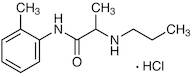
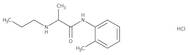
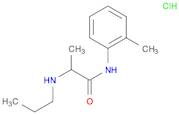
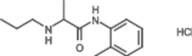
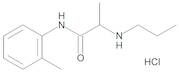
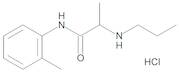
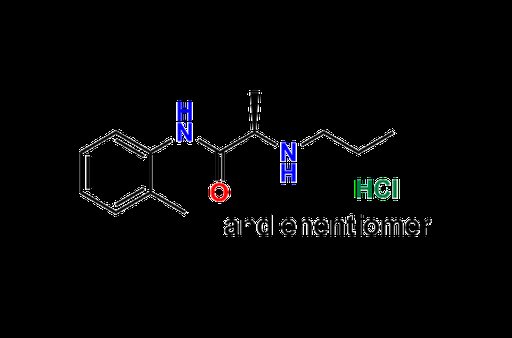
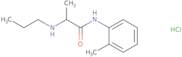
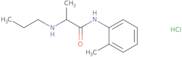
CAS 1786-81-8
:Prilocainhydrochlorid
Beschreibung:
Prilocainhydrochlorid ist ein Lokalanästhetikum, das zur Klasse der Amide gehört und hauptsächlich wegen seiner schmerzlindernden Eigenschaften in medizinischen und zahnmedizinischen Verfahren verwendet wird. Es handelt sich um ein weißes bis off-white kristallines Pulver, das in Wasser löslich ist, was seine Verwendung in injizierbaren Formulierungen erleichtert. Die chemische Formel von Prilocainhydrochlorid lautet C13H18ClN, und es hat ein Molekulargewicht von etwa 235,75 g/mol. Prilocain wirkt, indem es Natriumkanäle in Nervenzellen blockiert und somit die Übertragung von Schmerzsignalen hemmt. Es wird oft wegen seines geringeren Risikos systemischer Toxizität im Vergleich zu anderen Lokalanästhetika bevorzugt, obwohl es dennoch Nebenwirkungen wie Methämoglobinämie bei empfindlichen Personen verursachen kann. Die Substanz wird typischerweise durch Infiltration oder Nervenblocktechniken verabreicht und ist bekannt für ihren schnellen Wirkungseintritt und die mittlere Wirkungsdauer. Wie bei allen Medikamenten sind eine angemessene Dosierung und Überwachung unerlässlich, um potenzielle Nebenwirkungen zu minimieren.
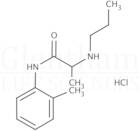
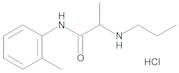
Formel:C13H20N2O·ClH
InChl:InChI=1S/C13H20N2O.ClH/c1-4-9-14-11(3)13(16)15-12-8-6-5-7-10(12)2;/h5-8,11,14H,4,9H2,1-3H3,(H,15,16);1H
InChI Key:InChIKey=BJPJNTKRKALCPP-UHFFFAOYSA-N
SMILES:N(C(C(NCCC)C)=O)C1=C(C)C=CC=C1.Cl
Synonyme:- 2-(Propylamino)-N-(o-tolyl)propanamide hydrochloride
- 2-(Propylamino)-o-propionotoluidide hydrochloride
- Alpha-Propylamino-2'-Methylpropionanilide Hydrochloride
- Citanest
- Citanest Plain
- Citanest hydrochloride
- L 67 hydrochloride
- N-(2-Methylphenyl)-2-(propylamino)-propanamide hydrochloride
- N-(2-methylphenyl)-N~2~-propylalaninamide hydrochloride (1:1)
- N-(a-propylaminopropionyl)-o-toluidine hydrochloride
- Prilocaine HCl
- Prilocaine chloride
- Prilocaine hydrochloride
- Propanamide, N-(2-methylphenyl)-2-(propylamino)-, hydrochloride (1:1)
- Propanamide, N-(2-methylphenyl)-2-(propylamino)-, monohydrochloride
- Propitocaine HCL
- Xylonest
- o-Propionotoluidide, 2-(propylamino)-, monohydrochloride
- Weitere Synonyme anzeigen
Filtern nach
Reinheitsanteil
0
100
|
0
|
50
|
90
|
95
|
100
- Niedrigster Preis
- Höchster Preis
- Niedrigste Reinheit
- Höchste Reinheit
- Schnellste Lieferung
Prilocaine Hydrochloride
CAS:Formel:C13H20N2O·HClReinheit:>98.0%(HPLC)Farbe und Form:White to Almost white powder to crystalMolekulargewicht:256.77Prilocaine hydrochloride, 98%
CAS:A local anestheticFormel:C13H20N2O•HClReinheit:98%Molekulargewicht:256.77PRILOCAINE FOR PEAK IDENTIFICATION CRS
CAS:PRILOCAINE FOR PEAK IDENTIFICATION CRSFormel:C13H21ClN2OFarbe und Form:Crystalline Powder. White. Powder.Molekulargewicht:256.7716Prilocaine hydrochloride
CAS:Prilocaine hydrochlorideFormel:C13H20N2OHClReinheit:99.5%Farbe und Form:WhiteMolekulargewicht:256.13424PRILOCAINE HYDROCHLORIDE CRS
CAS:PRILOCAINE HYDROCHLORIDE CRSFormel:C13H21ClN2OFarbe und Form:Crystalline Powder. White. Powder.Molekulargewicht:256.7716Prilocaine Hydrochloride
CAS:Aromatic cyclic amides (including cyclic carbamates) and their derivatives; salts thereof, nesoiFormel:C13H20N2O·HClFarbe und Form:White Crystalline PowderMolekulargewicht:220.157562-(Propylamino)-o-propionotoluidide hydrochloride
CAS:Formel:C13H21ClN2OReinheit:98%Farbe und Form:SolidMolekulargewicht:256.7716Prilocaine hydrochloride
CAS:Prilocaine HCl: local amino amide anesthetic, blocks voltage-gated sodium channels in neurons, inhibits Na+ permeability.Formel:C13H21ClN2OReinheit:99.97%Farbe und Form:SolidMolekulargewicht:256.77Prilocaine hydrochloride
CAS:Prilocaine hydrochlorideFormel:C13H21ClN2OReinheit:99.5%Molekulargewicht:256.77Prilocaine-d7 HCl (Propitocaine-d7 HCl)
CAS:Formel:C13H13D7N2O·HClFarbe und Form:White To Off-White SolidMolekulargewicht:227.36 36.46Prilocaine hydrochloride
CAS:Formel:C13H20N2O·HClReinheit:99.0 - 101.0 %Farbe und Form:White to off-white powderMolekulargewicht:256.77Prilocaine HCl (Propitocaine HCl)
CAS:Formel:C13H20N2O·HClFarbe und Form:White To Off-White SolidMolekulargewicht:220.32 36.46Prilocaine Hydrochloride
CAS:Kontrolliertes ProduktApplications Prilocaine is a local anesthetic of the amino amide type. Prilocaine is often used in dentistry. Prilocaine is also often combined with lidocaine as a preparation for dermal anesthesia (lidocaine/prilocaine or EMLA), for treatment of conditions like paresthesia.
References Caliaro, G., et al.: J. Pharm. Biomed. Anal., 26, 427 (2001), Ulmeanu, S., et al.: Pharm. Res., 20, 1317 (2003),Formel:C13H20N2O·ClHFarbe und Form:NeatMolekulargewicht:256.77Prilocaine HCl
CAS:2-(Propylamino)-N-(o-tolyl)propanamide hydrochlorideFormel:C13H21ClN2OReinheit:99%Molekulargewicht:256.77Prilocaine hydrochloride
CAS:Sodium channel blocker
Formel:C13H20N2O•HClReinheit:Min. 95%Farbe und Form:PowderMolekulargewicht:256.77 g/molPrilocaine HCl - Bio-X ™
CAS:Prilocaine is a drug used as a local anaesthetic in dental procedures. It has been shown to reduce the incidence of pain caused. This drug is also a sodium channel blocker that blocks the influx of sodium into cells.Formel:C13H20N2O•HClReinheit:Min. 95%Farbe und Form:PowderMolekulargewicht:256.77 g/mol