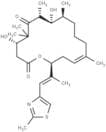
CAS 189453-10-9
:Epothilon D
Beschreibung:
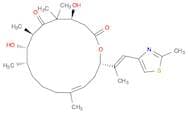
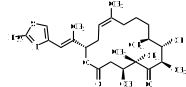
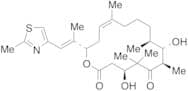
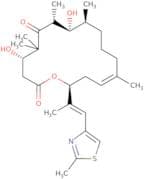
Epothilon D ist ein Naturprodukt und ein Mitglied der Epothilon-Familie, die makrocyclische Verbindungen sind, die für ihre Fähigkeit bekannt sind, Mikrotubuli zu stabilisieren, ähnlich dem Wirkmechanismus von Taxanen wie Paclitaxel. Es ist durch seine komplexe Struktur gekennzeichnet, die einen 16-gliedrigen Makrolidring und mehrere Stereozentren umfasst, was zu seiner biologischen Aktivität beiträgt. Epothilon D zeigt potente antitumorale Eigenschaften und ist ein interessantes Thema in der Krebsforschung und der Arzneimittelentwicklung. Es hat Wirksamkeit gegen verschiedene Krebszelllinien gezeigt und wird auf sein potenzielles Einsatzgebiet bei der Behandlung von resistenten Tumoren untersucht. Die Verbindung ist in organischen Lösungsmitteln löslich und hat eine relativ geringe Löslichkeit in Wasser, was ihre Bioverfügbarkeit und Formulierung in therapeutischen Anwendungen beeinflussen kann. Sein Mechanismus beinhaltet die Bindung an die β-Tubulin-Untereinheit der Mikrotubuli, was zu einer Zellzyklus-Arrestierung und Apoptose in Krebszellen führt. Insgesamt stellt Epothilon D einen vielversprechenden Ansatz zur Entwicklung neuer Krebstherapien dar, insbesondere für Tumoren, die resistent gegen konventionelle Behandlungen sind.
Formel:C27H41NO5S
InChl:InChI=1/C27H41NO5S/c1-16-9-8-10-17(2)25(31)19(4)26(32)27(6,7)23(29)14-24(30)33-22(12-11-16)18(3)13-21-15-34-20(5)28-21/h11,13,15,17,19,22-23,25,29,31H,8-10,12,14H2,1-7H3/b16-11-,18-13+/t17-,19+,22?,23-,25-/m0/s1
InChI Key:InChIKey=XOZIUKBZLSUILX-GIQCAXHBSA-N
SMILES:C(=C\C=1N=C(C)SC1)(\C)/[C@H]2OC(=O)C[C@H](O)C(C)(C)C(=O)[C@H](C)[C@@H](O)[C@@H](C)CCC/C(/C)=C\C2
Synonyme:- (-)-Desoxyepothilone B
- (4R,7S,8S,9S,13Z,16S)-4,8-dihydroxy-5,5,7,9,13-pentamethyl-16-[(1E)-1-(2-methyl-1,3-thiazol-4-yl)prop-1-en-2-yl]oxacyclohexadec-13-ene-2,6-dione
- (4S,7R,8S,9S,13Z)-4,8-dihydroxy-5,5,7,9,13-pentamethyl-16-[(E)-1-methyl-2-(2-methyl-1,3-thiazol-4-yl)ethenyl]oxacyclohexadec-13-ene-2,6-dione
- (4S,7R,8S,9S,13Z,16S)-4,8-Dihydroxy-5,5,7,9,13-pentamethyl-16-[(1E)-1-methyl-2-(2-methyl-4-thiazolyl)ethenyl]oxacyclohexadec-13-ene-2,6-dione
- 12,13-Deoxyepothilone B
- 12,13-Desoxyepothilone B
- Epo D
- Epothilone D
- Kos 862
- NSC 703147
- Oxacyclohexadec-13-ene-2,6-dione, 4,8-dihydroxy-5,5,7,9,13-pentamethyl -16-(1-methyl-2-(2-methyl-4-thiazolyl)ethenyl)-, (4S-(4R*,7S,8R*,9R*,1 3Z,16R*(E)))-
- Oxacyclohexadec-13-ene-2,6-dione, 4,8-dihydroxy-5,5,7,9,13-pentamethyl-16-[1-methyl-2-(2-methyl-4-thiazolyl)ethenyl]-, [4S-[4R*,7S*,8R*,9R*,13Z,16R*(E)]]-
- Weitere Synonyme anzeigen
Sortieren nach
Reinheit (%)
0
100
|
0
|
50
|
90
|
95
|
100
6 Produkte.
Oxacyclohexadec-13-ene-2,6-dione, 4,8-dihydroxy-5,5,7,9,13-pentamethyl-16-[(1E)-1-methyl-2-(2-methyl-4-thiazolyl)ethenyl]-, (4S,7R,8S,9S,13Z,16S)-
CAS:Formel:C27H41NO5SReinheit:97%Farbe und Form:SolidMolekulargewicht:491.6831Epothilone D (synthetic)
CAS:Kontrolliertes ProduktApplications Epothilones are polyketide natural products that inhibit cancer cells by a mechanism similar to paclitaxel, and also are effective against paclitaxel-resistant tumours. Epothilone D is in phase I clinical testing of in patients with advanced solid tumours. Epothilone D is a cytotoxic macrolide that stabilises malignant cells' microtubules and arrests mitosis, a characteristic it shares with other epothilones. They bind to the same hepatic sites as does paclitaxel (Taxol) in a 1:1 stoichiometric ratio of a, b-tubulin heterodimers.
References Bollag, D.M., et al.: Cancer. Res., 55, 2325 (1995), Hardt, I.H., et al.: J. Nat. Prod., 64, 847 (2001), Gerth, K., et al.: J. Antibiot., 55, 41, 45 (2002)Formel:C26H39NO5SFarbe und Form:NeatMolekulargewicht:477.66Epothilone D (synthetic)
CAS:Microtubule stabilizer; natural polyketide compound; antineoplasticFormel:C27H41NO5SReinheit:Min. 95%Farbe und Form:PowderMolekulargewicht:491.69 g/molEpothilone D
CAS:Epothilone D (KOS 862) is a potent microtubule stabilizer.Formel:C28H43NO4SFarbe und Form:SolidMolekulargewicht:489.72