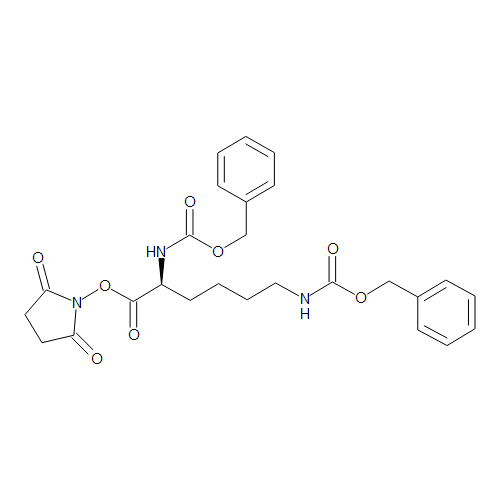
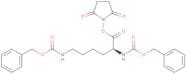
![N2,N6-Bis[(phenylmethoxy)carbonyl]-L-lysine 2,5-dioxo-1-pyrrolidinyl ester](/_next/image/?url=https%3A%2Fstatic.cymitquimica.com%2Fcas-image%2Fthumb-webp%2F104921-z-lys-z-osu.webp&w=3840&q=75)
CAS 21160-83-8
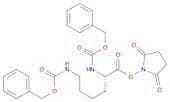
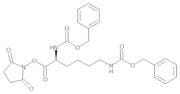
:N2,N6-Bis[(phenylmethoxy)carbonyl]-L-lysin-2,5-dioxo-1-pyrrolidinylester
Beschreibung:
N2,N6-Bis[(phenylmethoxy)carbonyl]-L-lysin-2,5-dioxo-1-pyrrolidinylester, mit der CAS-Nummer 21160-83-8, ist eine synthetische Verbindung, die zur Klasse der Aminosäurederivate gehört. Diese Substanz weist ein modifiziertes Lysin-Gerüst mit zwei Phenylmethoxycarbonylgruppen auf, was ihre Lipophilie und potenziell ihre Bioverfügbarkeit erhöht. Das Vorhandensein der pyrrolidinylester-Gruppe deutet darauf hin, dass sie einzigartige Reaktivitäts- und Stabilitätseigenschaften aufweisen könnte, was sie für pharmazeutische Anwendungen von Interesse macht. Die Verbindung ist wahrscheinlich in organischen Lösungsmitteln löslich, während ihre Löslichkeit in Wasser aufgrund der voluminösen Phenylgruppen eingeschränkt sein könnte. Ihre Struktur weist auf ein Potenzial für Wechselwirkungen mit biologischen Zielen hin, die für therapeutische Zwecke untersucht werden könnten. Wie bei vielen synthetischen Verbindungen sollten Sicherheits- und Handhabungsvorkehrungen beachtet werden, da die spezifische Toxizität und die Umweltauswirkungen dieser Verbindung durch geeignete Studien bewertet werden müssen. Insgesamt veranschaulicht diese Verbindung die Komplexität und Vielseitigkeit von Aminosäurederivaten in der medizinischen Chemie.
Formel:C26H29N3O8
InChl:InChI=1/C26H29N3O8/c30-22-14-15-23(31)29(22)37-24(32)21(28-26(34)36-18-20-11-5-2-6-12-20)13-7-8-16-27-25(33)35-17-19-9-3-1-4-10-19/h1-6,9-12,21H,7-8,13-18H2,(H,27,33)(H,28,34)
InChI Key:InChIKey=LHOAUCZIIQFZMI-NRFANRHFSA-N
SMILES:O(C([C@@H](NC(OCC1=CC=CC=C1)=O)CCCCNC(OCC2=CC=CC=C2)=O)=O)N3C(=O)CCC3=O
Synonyme:- (2,5-Dioxopyrrolidin-1-yl) (2S)-2,6-bis(phenylmethoxycarbonylamino)hexanoate
- 2,5-dioxopyrrolidin-1-yl N~2~,N~6~-bis[(benzyloxy)carbonyl]lysinate
- <span class="text-smallcaps">L</span>-Lysine, N<sup>2</sup>,N<sup>6</sup>-bis[(phenylmethoxy)carbonyl]-, 2,5-dioxo-1-pyrrolidinyl ester
- Carbamic acid, [(1S)-1-[[(2,5-dioxo-1-pyrrolidinyl)oxy]carbonyl]-1,5-pentanediyl]bis-, bis(phenylmethyl) ester
- Carbamic acid, [1-[[(2,5-dioxo-1-pyrrolidinyl)oxy]carbonyl]-1,5-pentanediyl]bis-, bis(phenylmethyl) ester, (S)-
- N<sup>2</sup>,N<sup>6</sup>-Bis[(phenylmethoxy)carbonyl]-<span class="text-smallcaps">L</span>-lysine 2,5-dioxo-1-pyrrolidinyl ester
- N<sup>α</sup>,N<sup>ε</sup>-Dibenzyloxycarbonyl-<span class="text-smallcaps">L</span>-lysine N-hydroxysuccinimide ester
- NSC 250409
- Succinimide, N-[(N<sup>2</sup>,N<sup>6</sup>-dicarboxy-<span class="text-smallcaps">L</span>-lysyl)oxy]-, dibenzyl ester
- Z-Lys(Z)-OSu
- na,N-epsilon-di-cbz-L-lysine N-*hydroxysuccinimid
- Succinimide, N-[(N2,N6-dicarboxy-L-lysyl)oxy]-, dibenzyl ester
- N2,N6-Bis[(phenylmethoxy)carbonyl]-L-lysine 2,5-dioxo-1-pyrrolidinyl ester
- L-Lysine, N2,N6-bis[(phenylmethoxy)carbonyl]-, 2,5-dioxo-1-pyrrolidinyl ester
- 2,5-Dioxopyrrolidin-1-yl (2S)-2,6-Bis(benzyloxycarbonylamino)hexanoate (N,N'-Bis(benzyloxycarbonyl)-L-lysine N-Succinimidyl Ester)
- Nα,ε-Bis-Z-L-lysineN-hydroxysuccinimide ester99%
- N-ALPHA,EPSILON-BIS-Z-L-LYSINE N-HYDROXYSUCCINIMIDE ESTER
- Z-LYS-OSU
- Z-LYSINE(Z)-OSU
- Z-LYL(Z)-OSU
- N-ALPHA,N-EPSILON-DI-Z-L-LYSINE HYDROXYSUCCINIMIDE ESTER
- N-ALPHA, N-EPSILON-DIBENZYLOXYCARBONYL-L-LYSINE N-HYDROXYSUCCINIMIDE ESTER
- Nα,ε-Bis-Z-L-lysine N-hydroxysuccinimide ester
- Z-L-LYSINE N-HYDROXYSUCCINIMIDE ESTER
- nα,nε-di-z-l-lysine hydroxysuccinimide ester
- Cbz-lys(z)-osu
- Weitere Synonyme anzeigen
Sortieren nach
Reinheit (%)
0
100
|
0
|
50
|
90
|
95
|
100
8 Produkte.
Nα,ε-Bis-Z-L-lysine N-hydroxysuccinimide ester
CAS:Formel:C26H29N3O8Reinheit:95%Farbe und Form:SolidMolekulargewicht:511.5238Z-Lys(z)-osu
CAS:Kontrolliertes ProduktApplications Z-Lys(z)-osu
Formel:C26H29N3O8Farbe und Form:NeatMolekulargewicht:511.52N-alpha,epsilon-bis-Z-L-Lysine N-hydroxysuccinimide ester
CAS:N-alpha,epsilon-bis-Z-L-Lysine N-hydroxysuccinimide ester is a methyl ester of the amino acid Lysine. This drug has been shown to have antinociceptive effects in animal models and may be useful for the treatment of inflammatory pain. The active conformation of this drug is dependent on the presence of hydroxybenzimidazole (HOBt). In the absence of HOBt, the compound does not have any activity. Acetylation or amidation may also affect its activity. The reaction with nitric acid yields a nitro derivative, which can be reduced back to the original compound by catalytic hydrogenation using palladium on carbon. A carboxylic acid group at the amino terminus can be converted to an amide or amido group by treatment with an appropriate reagent such as acetonitrile. This drug binds to a catalytic site onFormel:C26H29N3O8Reinheit:Min. 95%Farbe und Form:White Off-White PowderMolekulargewicht:511.52 g/molZ-Lys(Z)-OSu
CAS:Bachem ID: 4000136.
Formel:C26H29N3O8Reinheit:> 98%Farbe und Form:White PowderMolekulargewicht:511.53