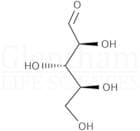
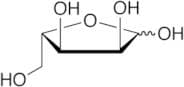
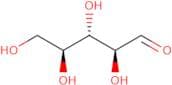
CAS 24259-59-4
:L-Ribose
- L-(+)-Ribose
- Ribose, L-
- L-Ribose
L-Ribose
CAS:Formel:C5H10O5Reinheit:>98.0%(HPLC)Farbe und Form:White to Almost white powder to crystalMolekulargewicht:150.13L-(+)-Ribose, 99%
CAS:L-Ribose is a potential starting material for the synthesis of many L-nucleoside-based pharmaceutical compounds. This Thermo Scientific Chemicals brand product was originally part of the Alfa Aesar product portfolio. Some documentation and label information may refer to the legacy brand. The originaFormel:C5H10O5Reinheit:99%Molekulargewicht:150.13L-(+)-Ribose
CAS:Formel:C5H10O5Reinheit:≥ 98.0%Farbe und Form:White or almost white crystalline powderMolekulargewicht:150.13L-Ribose
CAS:Kontrolliertes ProduktApplications It is produced by microorganism fermentation of glucose in a fermentation culture medium without adding calcium carbonate.
References Ostrowski, S., et al.: Science, 305, 71 (2004), Vavilin, D., et al.: Biochim. Biophys. Acta, 1708, 91 (2005), Fletcher, J., et al.: Anal. Chem., 79, 2199 (2007), Weissleder, R., et al.: Nature, 452, 580 (2008),Formel:C5H10O5Farbe und Form:NeatMolekulargewicht:150.13L-Ribose
CAS:Constituent of RNA; important resource for RNA- and DNA-related syntheses
Formel:C5H10O5Reinheit:Min. 98 Area-%Farbe und Form:White PowderMolekulargewicht:150.13 g/molL-(+)-Ribose
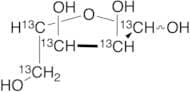
CAS:Formel:C5H10O5Reinheit:97%Farbe und Form:Solid, White to almost white almostMolekulargewicht:150.13L-Ribose-13C5
CAS:Kontrolliertes ProduktApplications Labelled analogue of L-Ribose. L-Ribose is produced by microorganism fermentation of glucose in a fermentation culture medium without adding calcium carbonate.
References Ostrowski, S. et al.: Science, 305, 71 (2004); Vavilin, D. et al.: Biochim. Biophys. Acta, 1708, 91 (2005); Fletcher, J., et al.: Anal. Chem., 79, 2199 (2007); Weissleder, R. et al.: Nature, 452, 580 (2008);Formel:C5H10O5Farbe und Form:NeatMolekulargewicht:155.093L-Ribose
CAS:L-Ribose is a monosaccharide that is a constituent of ribonucleic acid, deoxyribonucleic acid and other compounds. It can be found in small quantities in most living organisms. L-Ribose has been modified to include fluorine atoms at the C2 position. The addition of fluorine atoms increases the stability of the molecule and its resistance to hydrolysis by esterases. L-Ribose has also been modified with methyl groups at the C3 position and glycosylation at the C4 position. This modification preserves the biological activity of L-Ribose and increases its water solubility. L-Ribose is used as a building block for custom synthesis, such as peptides or oligosaccharides.>>END>>
Formel:C5H10O5Molekulargewicht:150.13 g/mol