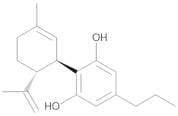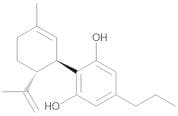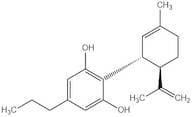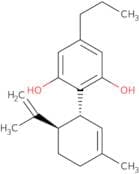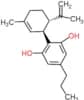
CAS 24274-48-4
:Cannabidivarin
Beschreibung:
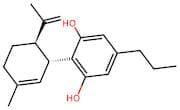
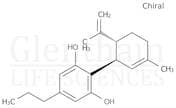
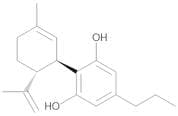
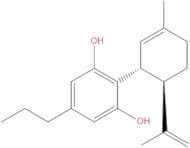
Cannabidivarin (CBDV) ist ein nicht psychoaktives Cannabinoid, das in Cannabis-Pflanzen vorkommt, insbesondere in bestimmten Hanfsorten. Es ist strukturell ähnlich wie Cannabidiol (CBD), unterscheidet sich jedoch dadurch, dass es eine Propyl-Seitenkette anstelle einer Pentyl-Seitenkette hat. CBDV ist bekannt für seine potenziellen therapeutischen Eigenschaften, insbesondere im Kontext neurologischer Störungen. Forschungen deuten darauf hin, dass es antikonvulsive Wirkungen haben könnte, was es zu einem Kandidaten für die Behandlung von Epilepsie und anderen krampfbezogenen Erkrankungen macht. Darüber hinaus wurde CBDV auf sein Potenzial untersucht, Symptome zu lindern, die mit Autismus-Spektrum-Störungen und anderen neurodevelopmentalen Bedingungen verbunden sind. Die Verbindung interagiert mit dem Endocannabinoid-System und beeinflusst verschiedene Rezeptoren, obwohl die genauen Wirkmechanismen noch untersucht werden. CBDV kommt typischerweise in niedrigeren Konzentrationen im Vergleich zu anderen Cannabinoiden wie THC und CBD vor, und sein rechtlicher Status variiert je nach Region, oft unterliegt es denselben Vorschriften wie andere cannabisbasierte Substanzen. Während die Forschung fortschreitet, könnte CBDV neue Einblicke in cannabinoidbasierte Therapien und deren Anwendungen in der Medizin bieten.
Formel:C19H26O2
InChl:InChI=1/C19H26O2/c1-5-6-14-10-17(20)19(18(21)11-14)16-9-13(4)7-8-15(16)12(2)3/h9-11,15-16,20-21H,2,5-8H2,1,3-4H3/t15-,16+/m1/s1
InChI Key:InChIKey=REOZWEGFPHTFEI-JKSUJKDBSA-N
SMILES:OC1=C(C(O)=CC(CCC)=C1)[C@H]2[C@H](C(C)=C)CCC(C)=C2
Synonyme:- (-)-Cannabidivarin
- 1,3-Benzenediol, 2-[(1R,6R)-3-methyl-6-(1-methylethenyl)-2-cyclohexen-1-yl]-5-propyl-
- 1,3-Benzenediol, 2-[3-methyl-6-(1-methylethenyl)-2-cyclohexen-1-yl]-5-propyl-, (1R-trans)-
- 2-[(1R,6R)-3-Methyl-6-(1-methylethenyl)-2-cyclohexen-1-yl]-5-propyl-1,3-benzenediol
- Cannabidivarine
- Cannabidivarol
- Cbd-V
- Resorcinol, 2-p-mentha-1,8-dien-3-yl-5-propyl-
- Cannabidivarol USP/EP/BP
- Cannabidivarin (1.0 mg/mL in Methanol)
- Cannabidivarin (CBDV)
- Cannabidivarin solution
- cannabidvarin
- Cannabidivarin (CRM)
- Weitere Synonyme anzeigen
Sortieren nach
Reinheit (%)
0
100
|
0
|
50
|
90
|
95
|
100
Cannabinoids Mixture 255 500 µg/mL in Acetonitrile
CAS:Kontrolliertes Produkt- 1244-58-2
- 13956-29-1
- 1972-08-3
- 20675-51-8
- 23978-85-0
- 24274-48-4
- 25555-57-1
- 25654-31-3
- 31262-37-0
- 521-35-7
- 5957-75-5
Farbe und Form:MixtureCannabinoids Mixture 254 250 µg/mL in Acetonitrile
CAS:Kontrolliertes Produkt- 1244-58-2
- 13956-29-1
- 1972-08-3
- 20675-51-8
- 23978-85-0
- 24274-48-4
- 25555-57-1
- 25654-31-3
- 31262-37-0
- 521-35-7
- 5957-75-5
Farbe und Form:MixtureCannabinoids Neutrals Mixture 181 1000 µg/mL in Acetonitrile
CAS:Kontrolliertes ProduktFarbe und Form:MixtureCannabidivarin (CBDV)
CAS:Kontrolliertes ProduktFormel:C19H26O2Farbe und Form:NeatMolekulargewicht:286.41Cannabidivarin (CBDV) 1000 µg/mL in Methanol
CAS:Kontrolliertes ProduktFormel:C19H26O2Farbe und Form:Single SolutionMolekulargewicht:286.41Cannabidivarin (CBDV) 100 µg/mL in Methanol
CAS:Kontrolliertes ProduktFormel:C19H26O2Farbe und Form:Single SolutionMolekulargewicht:286.41Cannabidivarin
CAS:Cannabidivarin (GWP42006) inhibits GABAA receptors, potentially controlling childhood absence epilepsy.Formel:C19H26O2Reinheit:98.06% - 98.51%Farbe und Form:SolidMolekulargewicht:286.41Ref: TM-T8162
1mg50,00€2mg71,00€5mg93,00€1mL*10mM (DMSO)105,00€10mg133,00€25mg250,00€50mg394,00€100mg582,00€Cannabidivarin
CAS:PolyphenolFormel:C19H26O2Reinheit:≥ 90.0 % (HPLC)Farbe und Form:PowderMolekulargewicht:286.41Cannabidivarin
CAS:Kontrolliertes ProduktCannabidivarin is a non-psychoactive phytocannabinoid thought to exert its functions through its interactions on the TRV1 capsaicin receptor of the ion channel family (Iannotti, 2014). Both in animal and human models, cannabidivarin has shown anticonvulsant properties by dosage-dependently desensitizing TRPV1, TRPV2 and TRPA1 ion channels (Iannotti, 2014; De Petrocellis, 2011). It has also been shown to inhibit endocannabinoid product enzyme Sn1-specific diacylglycerol lipase alpha, although the consequences of this interaction have not yet been elucidated (Bisogno, 2003).
Reinheit:Min. 95%