CAS 24730-31-2
:Surfactin von Bacillus subtilis
Beschreibung:
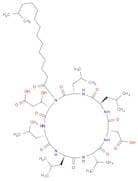
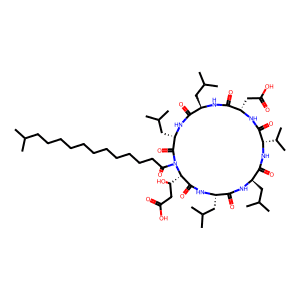
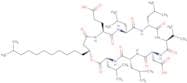
Surfactin ist ein lipopeptidischer Biosurfaktant, der von dem Bakterium Bacillus subtilis produziert wird und für seine einzigartige amphiphile Struktur bekannt ist, die aus einem zyklischen Peptid besteht, das an eine lange Fettsäurekette gebunden ist. Diese Struktur ermöglicht es der Surfactin, die Oberflächenspannung und die Grenzflächenspannung erheblich zu reduzieren, was sie zu einem effektiven Emulgator macht. Surfactin zeigt eine Reihe biologischer Aktivitäten, einschließlich antimikrobieller, antiviraler und fungizider Eigenschaften, die zu ihren potenziellen Anwendungen in der Pharmazie, Landwirtschaft und Umweltremediation beitragen. Die Verbindung zeichnet sich durch ihre Fähigkeit aus, Mizellen zu bilden und Emulsionen zu stabilisieren, wodurch die Löslichkeit hydrophober Verbindungen erhöht wird. Darüber hinaus ist Surfactin biologisch abbaubar und umweltfreundlich, was sie zu einer nachhaltigen Alternative zu synthetischen Tensiden macht. Ihre Produktion kann von verschiedenen Faktoren beeinflusst werden, einschließlich der Verfügbarkeit von Nährstoffen und der Fermentationsbedingungen, die den Ertrag und die Aktivität beeinflussen können. Insgesamt positionieren die multifunktionalen Eigenschaften von Surfactin und ihre umweltfreundliche Natur sie als wertvolle Verbindung in verschiedenen industriellen und biotechnologischen Anwendungen.
Formel:C53H93N7O13
InChl:InChI=1/C53H93N7O13/c1-30(2)20-18-16-14-13-15-17-19-21-36-28-43(61)54-37(22-23-44(62)63)47(66)55-38(24-31(3)4)48(67)57-40(26-33(7)8)51(70)60-46(35(11)12)52(71)58-41(29-45(64)65)50(69)56-39(25-32(5)6)49(68)59-42(27-34(9)10)53(72)73-36/h30-42,46H,13-29H2,1-12H3,(H,54,61)(H,55,66)(H,56,69)(H,57,67)(H,58,71)(H,59,68)(H,60,70)(H,62,63)(H,64,65)/t36-,37+,38+,39-,40-,41+,42+,46+/m1/s1
Synonyme:- Surfactin
- 3-[(9S,12S,15R,18S,21R)-9-(carboxymethyl)-3,6,15,18-tetrakis(2-methylpropyl)-25-(10-methylundecyl)-2,5,8,11,14,17,20,23-octaoxo-12-(propan-2-yl)-1-oxa-4,7,10,13,16,19,22-heptaazacyclopentacosan-21-yl]propanoic acid
- 3-[(3S,6R,9S,12S,15R,18S,21S,25R)-9-(carboxymethyl)-3,6,15,18-tetrakis(2-methylpropyl)-25-(10-methylundecyl)-2,5,8,11,14,17,20,23-octaoxo-12-(propan-2-yl)-1-oxa-4,7,10,13,16,19,22-heptaazacyclopentacosan-21-yl]propanoic acid
- surfactin C
- surfactin from bacillus subtilis
- Surfactin peptide
Sortieren nach
Reinheit (%)
0
100
|
0
|
50
|
90
|
95
|
100
6 Produkte gefunden.
Surfactin
CAS:Surfactin is a potent cyclic lipopeptide biosurfactants that mediates flux of mono-and divalent cations, such as calcium, across lipid bilayer membranes, withFormel:C53H93N7O13Reinheit:mixture - mixtureFarbe und Form:SolidMolekulargewicht:1036.34Ref: TM-T13041
1mg39,00€5mg84,00€10mg114,00€1mL*10mM (DMSO)133,00€25mg178,00€50mg268,00€100mg408,00€500mg888,00€Surfactin
CAS:Formel:C53H93N7O13Reinheit:≥ 98.0%Farbe und Form:White to faint-yellow powderMolekulargewicht:1036.34Surfactin
CAS:Applications Surfactin is a lipopeptide antibiotic and biosurfactant.
Formel:C53H93N7O13Farbe und Form:NeatMolekulargewicht:1036.34Surfactin
CAS:Surfactin is a cyclic lipopeptide that belongs to the group of antimicrobial agents. It has been shown to have anti-bacterial, antifungal, and antiviral properties. Surfactin can also be used as a surfactant in wastewater treatment and biosurfactant production. Surfactin also has an inhibitory effect on the growth of wild-type strains of bacteria. The biological properties of suractin are associated with its ability to disrupt the outer membrane of mitochondria, which may lead to cell death. This drug also inhibits polymerase chain reaction (PCR) activity and enzyme activities by binding to DNA or proteins that are required for their synthesis.Formel:C53H93N7O13Reinheit:Min. 95%Farbe und Form:White To Light (Or Pale) Yellow SolidMolekulargewicht:1,036.34 g/mol