CAS 2521-07-5
:9-Methyl-9H-beta-Carbolin
Beschreibung:
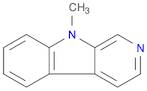
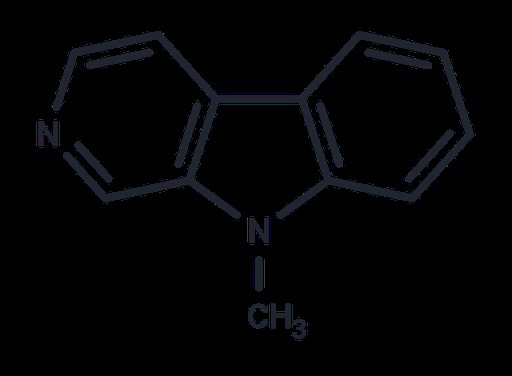
9-Methyl-9H-beta-Carbolin ist eine organische Verbindung, die zur Familie der Beta-Carboline gehört und durch eine fusionierte bicyclische Struktur gekennzeichnet ist, die ein Pyridin- und ein Indol-Moiety enthält. Diese Verbindung weist eine Methylgruppe an der Position 9 des Beta-Carbolin-Rahmens auf, was ihre biologische Aktivität und chemischen Eigenschaften beeinflussen kann. 9-Methyl-9H-beta-Carbolin ist bekannt für seine potenziellen neuropharmakologischen Effekte, einschließlich Wechselwirkungen mit Neurotransmittersystemen, und wurde hinsichtlich seiner Rolle in verschiedenen biologischen Prozessen untersucht. Es zeigt fluoreszierende Eigenschaften, was es in bestimmten analytischen Anwendungen nützlich macht. Die Verbindung ist typischerweise in organischen Lösungsmitteln löslich, und ihre Stabilität kann durch Umweltbedingungen wie pH und Temperatur beeinflusst werden. Darüber hinaus sind Beta-Carboline, einschließlich 9-Methyl-9H-beta-Carbolin, in der medizinischen Chemie von Interesse aufgrund ihrer vielfältigen pharmakologischen Aktivitäten, einschließlich antioxidativer, entzündungshemmender und potenzieller krebsbekämpfender Eigenschaften. Wie bei vielen chemischen Substanzen sollten Sicherheits- und Handhabungsvorschriften beachtet werden, da Beta-Carboline in bestimmten Konzentrationen toxisch sein können.
Formel:C12H10N2
InChl:InChI=1/C12H10N2/c1-14-11-5-3-2-4-9(11)10-6-7-13-8-12(10)14/h2-8H,1H3
InChI Key:MABOIYXDALNSES-UHFFFAOYSA-N
SMILES:Cn1c2ccccc2c2ccncc12
Synonyme:- 9H-Pyrido(3,4-b)indole, 9-methyl-
- 9-Methyl-9H-pyrido(3,4-b)indole
- 9-Methyl-Beta-Carboline
Filtern nach
Reinheitsanteil
0
100
|
0
|
50
|
90
|
95
|
100
7 Produkte gefunden.
- Niedrigster Preis
- Höchster Preis
- Niedrigste Reinheit
- Höchste Reinheit
- Schnellste Lieferung
9-Methyl-9H-pyrido[3,4-b]indole
CAS:Formel:C12H10N2Reinheit:>98.0%(GC)(T)Farbe und Form:White to Yellow to Green powder to crystalMolekulargewicht:182.239-Methyl-9H-Pyrido[3,4-b]Indole
CAS:9-Methyl-9H-Pyrido[3,4-b]IndoleFormel:C12H10N2Reinheit:98%Molekulargewicht:182.229-Methyl-9H-pyrido[3,4-b]indole
CAS:Formel:C12H10N2Reinheit:97%Farbe und Form:SolidMolekulargewicht:182.22129-Methyl-β-carboline
CAS:9-Methyl-9H-pyrido[3,4-b]indoleFormel:C12H10N2Reinheit:98%Molekulargewicht:182.229-Methyl-β-carboline
CAS:9-Methyl-β-carboline is a monoamine oxidase inhibitor and dopaminergic modulator with IC₅₀ values of 1 μM and 15.5 μM for human MAO-A and MAO-B, respectively. 9-Methyl-β-carboline crosses the blood-brain barrier and exerts neuroprotective-related effects by inhibiting monoamine oxidase activity, regulating neurotrophic-factor expression, and affecting mitochondrial function. 9-Methyl-β-carboline also regulates PKA/PKC- and PI3K-related signaling and inhibits glial-cell proliferation. 9-Methyl-β-carboline is suitable for research on Parkinson's disease, dopaminergic neuronal injury, and neurodegenerative diseases.Formel:C12H10N2Reinheit:99.92%Farbe und Form:SolidMolekulargewicht:182.229-Methyl-b-carboline
CAS:9-Methyl-b-carboline is a phytochemical that belongs to the class of protonated carbon disulphide. It has been shown to inhibit monoamine oxidase and is used in some medications. 9-Methyl-b-carboline has been shown to have physiological function, including growth factor activity and epidermal growth properties. It also inhibits hydroxylase, which is an enzyme that catalyzes the stepwise oxidation of tyrosine and phenylalanine. This compound can be found in plants belonging to the families of Fabaceae, Lamiaceae, and Solanaceae. The compound has been found to act as a secondary messenger in mitochondria by transferring electrons from NADH to coenzyme Q10.Formel:C12H10N2Reinheit:Min. 98%Farbe und Form:Off-White PowderMolekulargewicht:182.22 g/molRef: 3D-FM153440
Ausgelaufenes produkt