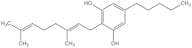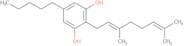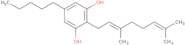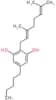
CAS 25654-31-3
:Cannabigerol
Beschreibung:
Cannabigerol (CBG) ist ein nicht psychoaktives Cannabinoid, das in der Cannabispflanze vorkommt und für seine potenziellen therapeutischen Eigenschaften bekannt ist. Es wird oft als "Mutter-Cannabinoid" bezeichnet, da es als Vorläufer für andere Cannabinoide wie THC und CBD dient. CBG ist typischerweise in niedrigeren Konzentrationen vorhanden im Vergleich zu seinen berühmteren Gegenstücken. Die Verbindung zeigt eine Reihe potenzieller gesundheitlicher Vorteile, einschließlich entzündungshemmender, schmerzlindernder und neuroprotektiver Wirkungen, was sie zu einem interessanten Thema in der medizinischen Forschung macht. CBG interagiert mit dem Endocannabinoid-System und beeinflusst verschiedene physiologische Prozesse. Seine chemische Struktur weist einen phenolischen Ring und einen langen Kohlenwasserstoffschwanz auf, was zu seinen einzigartigen Eigenschaften beiträgt. CBG wird im Allgemeinen als sicher angesehen, mit einem günstigen Sicherheitsprofil, obwohl weitere Forschungen erforderlich sind, um seine Wirkungen und potenziellen Anwendungen vollständig zu verstehen. Mit dem wachsenden Interesse an Cannabinoiden gewinnt CBG an Aufmerksamkeit für seine potenzielle Rolle in therapeutischen Formulierungen und als natürliche Alternative für verschiedene Gesundheitszustände.
Formel:C21H32O2
InChl:InChI=1S/C21H32O2/c1-5-6-7-11-18-14-20(22)19(21(23)15-18)13-12-17(4)10-8-9-16(2)3/h9,12,14-15,22-23H,5-8,10-11,13H2,1-4H3/b17-12+
InChI Key:InChIKey=QXACEHWTBCFNSA-SFQUDFHCSA-N
SMILES:C(CCCC)C1=CC(O)=C(C/C=C(/CCC=C(C)C)\C)C(O)=C1
Synonyme:- (E)-2-(3,7-Dimethylocta-2,6-dien-1-yl)-5-pentylbenzene-1,3-diol
- 1,3-Benzenediol, 2-(3,7-dimethyl-2,6-octadienyl)-5-pentyl-
- 1,3-Benzenediol, 2-(3,7-dimethyl-2,6-octadienyl)-5-pentyl-, (E)-
- 1,3-Benzenediol, 2-[(2E)-3,7-dimethyl-2,6-octadien-1-yl]-5-pentyl-
- 1,3-Benzenediol, 2-[(2E)-3,7-dimethyl-2,6-octadienyl]-5-pentyl-
- 2-((2E)-3,7-Dimethylocta-2,6-dienyl)-5-pentylbenzene-1,3-diol
- 2-[(2E)-3,7-Dimethyl-2,6-octadien-1-yl]-5-pentyl-1,3-benzenediol
- Cannabigerol
- Resorcinol, 2-(3,7-dimethyl-2,6-octadienyl)-5-pentyl-
- Resorcinol, 2-(3,7-dimethyl-2,6-octadienyl)-5-pentyl-, (E)-
Sortieren nach
Reinheit (%)
0
100
|
0
|
50
|
90
|
95
|
100
Cannabigerol
CAS:PolyphenolFormel:C21H32O2Reinheit:≥ 95.0 % (HPLC)Farbe und Form:PowderMolekulargewicht:316.48Cannabigerol - 20 mg/ml solution in methanol
CAS:Kontrolliertes ProduktCannabigerol is a non-psychotropic phytocannabinoid which has a low affinity for the CB1 and CB2 receptors but affects the endocannabinoid system by inhibiting anandamide uptake (Morales, 2017). It also acts as a potent alpha2+adrenoceptor agonist (EC50= 0.2 nM) (Cascio, 2010). In vitro, cannabigerol was shown to reduce cell loss viability and inhibit apoptosis in motor neurons as well as reducing inflammatory cytokine levels in neural cultures. In in vivo experimental animal models it was shown to antagonize the 5-HT1A receptor (Kb= 51.9 nM) (Cascio, 2010), inhibit vas deferens contractions via a2 adrenoceptor mediation as well as improve motor deficits and prevent neurotoxicity and the upregulation of proinflammatory markers on striatal neurons in mice models (Valdeolivas, 2015).Formel:C21H32O2Reinheit:Min. 95%Farbe und Form:Clear LiquidMolekulargewicht:316.48 g/molCannabigerol
CAS:Kontrolliertes Produkt<p>Solid. A non-psychotropic phytocannabinoids present in Cannabis sativa L.</p>Formel:C21H32O2Reinheit:Min. 95%Molekulargewicht:316.48 g/molCannabinoids Neutrals Mixture 182 500 µg/mL in Acetonitrile
CAS:Kontrolliertes ProduktFarbe und Form:Mixture