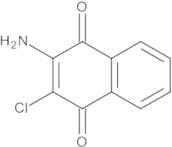
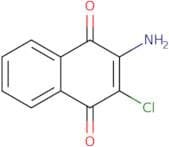
CAS 2797-51-5
:Quinoclamin
Beschreibung:
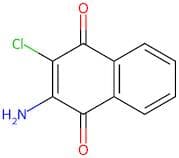
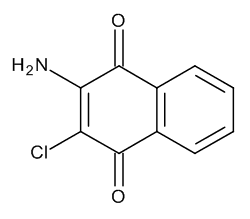
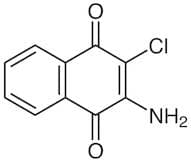
Quinoclamin, mit der CAS-Nummer 2797-51-5, ist eine chemische Verbindung, die zur Klasse der Chinolinderivate gehört. Sie zeichnet sich durch ihre heterocyclische Struktur aus, die ein Chinolinsystem umfasst. Quinoclamin wird hauptsächlich für seine pharmakologischen Eigenschaften anerkannt, insbesondere für seine Verwendung als Antimalariamittel. Die Verbindung zeigt eine Reihe biologischer Aktivitäten, einschließlich potenzieller antimikrobieller und entzündungshemmender Wirkungen. Man geht davon aus, dass ihr Wirkmechanismus die Beeinträchtigung der Nukleinsäuresynthese in Krankheitserregern umfasst. Quinoclamin wird typischerweise als kristalliner Feststoff präsentiert und ist in organischen Lösungsmitteln löslich, obwohl seine Löslichkeit in Wasser begrenzt ist. Sicherheitsdaten zeigen, dass, wie bei vielen chemischen Substanzen, Vorsicht geboten ist, da sie Gesundheitsrisiken darstellen kann, wenn sie eingenommen oder eingeatmet wird. Insgesamt stellt Quinoclamin eine bedeutende Verbindung in der medizinischen Chemie dar, mit laufender Forschung zu seinen therapeutischen Anwendungen und Wirkmechanismen.
Formel:C10H6ClNO2
InChl:InChI=1S/C10H6ClNO2/c11-7-8(12)10(14)6-4-2-1-3-5(6)9(7)13/h1-4H,12H2
InChI Key:InChIKey=OBLNWSCLAYSJJR-UHFFFAOYSA-N
SMILES:O=C1C=2C(C(=O)C(N)=C1Cl)=CC=CC2
Synonyme:- 06K-Quinone
- 06K50W
- 1,4-Naphthalenedione, 2-amino-3-chloro-
- 1,4-Naphthoquinone, 2-Amino-3-Chloro-
- 2-Amino-3-Chloro-1,4-Naphtoquinone
- 2-Amino-3-Chloro-4-Naphthalenedione
- 2-Amino-3-Chloro-4-Naphthoquinone
- 2-Amino-3-Chloronaphthalene-1,4-Dione
- 2-Amino-3-Chloronaphthoquinone
- 2-Amino-3-chloro-1,4-dihydronaphthalene-1,4-dione
- 2-Amino-3-chloro-1,4-naphthalenedione
- 2-Chloro-3-Amino-1,4-Naphthoquinone
- 3-Chloro-2-Amino-1,4-Naphthoquinone
- Acnq
- Mogeton
- Mogeton G
- Mogeton Granule
- Mogetong
- Mogetongranule
- NSC 3910
- NSC 642009
- O 6K-Quinone
- Quinoclamin
- Quinoclamine
- Timtec-Bb Sbb008204
- Weitere Synonyme anzeigen
Sortieren nach
Reinheit (%)
0
100
|
0
|
50
|
90
|
95
|
100
9 Produkte gefunden.
Quinoclamine 100 µg/mL in Acetone
CAS:Kontrolliertes ProduktFormel:C10H6ClNO2Farbe und Form:Single SolutionMolekulargewicht:207.612-Amino-3-chloro-1,4-naphthoquinone
CAS:Formel:C10H6ClNO2Reinheit:>98.0%(HPLC)(N)Farbe und Form:Orange to Amber to Dark red powder to crystalMolekulargewicht:207.61LC PestiMix 6 10 µg/mL in Acetonitrile
CAS:- 1007-28-9
- 1114-71-2
- 113036-88-7
- 113136-77-9
- 114420-56-3
- 115086-54-9
- 115852-48-7
- 116255-48-2
- 119791-41-2
- 121776-33-8
- 126535-15-7
- 130000-40-7
- 136849-15-5
- 138164-12-2
- 139528-85-1
- 147150-35-4
- 149508-90-7
- 180409-60-3
- 181274-17-9
- 1929-88-0
- 199119-58-9
- 2008-41-5
- 210631-68-8
- 211867-47-9
- 221667-31-8
- 223580-51-6
- 23576-24-1
- 239110-15-7
- 2439-10-3
- 25606-41-1
- 27314-13-2
- 27605-76-1
- 2797-51-5
- 302-27-2
- 321-54-0
- 32889-48-8
- 3337-71-1
- 335104-84-2
- 33820-53-0
- 35367-31-8
- 37019-18-4
- 372137-35-4
- 4151-50-2
- 422556-08-9
- 42609-52-9
- 4849-32-5
- 55861-78-4
- 57160-47-1
- 58011-68-0
- 6119-70-6
- 61432-55-1
- 64-10-8
- 66-81-9
- 69335-91-7
- 69806-50-4
- 74051-80-2
- 74222-97-2
- 76578-12-6
- 8065-36-9
- 81103-11-9
- 81335-77-5
- 82211-24-3
- 838-85-7
- 86811-58-7
- 88678-67-5
- 90982-32-4
- 91-22-5
- 93697-74-6
- 944-22-9
- 951659-40-8
- 96182-53-5
- 96525-23-4
- 97780-06-8
- 97886-45-8
- 99105-77-8
Farbe und Form:MixtureQuinoclamine
CAS:Quinoclamine is a naphthoquinone derivative and is an NF-κB inhibitor.Formel:C10H6ClNO2Reinheit:99.13% - 99.28%Farbe und Form:Orange PowderMolekulargewicht:207.612-Amino-3-chloronaphthalene-1,4-dione
CAS:Formel:C10H6ClNO2Reinheit:95.0%Farbe und Form:SolidMolekulargewicht:207.612-Amino-3-chloro-1,4-naphthoquinone
CAS:Kontrolliertes ProduktFormel:C10H6ClNO2Farbe und Form:NeatMolekulargewicht:207.61Quinoclamine
CAS:Quinoclamine is a redox-active film-forming polymer that has been shown to be effective against bacterial strains such as S. aureus, E. coli and B. subtilis. Quinoclamine inhibits the growth of bacteria by targeting their respiratory electron transport chain and reducing its activity. This leads to an accumulation of reactive oxygen species (ROS) in the cells which can cause oxidative stress, leading to cell death. Quinoclamine has also been shown to have antibacterial efficacy against Hl-60 cells and prevents the formation of carbonyl groups in mitochondria, which are toxic to cells. Quinoclamine is metabolized by cytochrome P450 enzymes into quinolinic acid, which is then converted into nicotinamide adenine dinucleotide phosphate (NADP+).Formel:C10H6ClNO2Reinheit:Min. 95%Molekulargewicht:207.61 g/mol