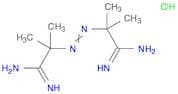
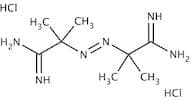
CAS 2997-92-4
:2,2'-Azobis(2-amidinopropan) dihydrochlorid
- 2,2'-Azobis(2-methylpropionamide)dihydrochloride
- 2,2'-Azobis(isobutyramidine hydrochloride)
- 2,2'-Azobis(propane-2-carboxamidine) dihydrochloride
- 2,2'-Azobis-(2-amidinopropane) dihydrochloride
- 2,2'-Azobis[2-Metilpropionamidina], Diclorhidrato
- 2,2'-Azobis[2-methylpropionamidin]dihydrochlorid
- 2,2'-Azobis[2-methylpropionamidine], dichlorhydrate
- 2,2'-Azobisamidinopropane dihydrochloride
- 2,2'-Azobisisobutyramidinium chloride
- 2,2-Azobis(2-Methylpropionamidine)Dihydrochlorid
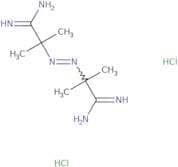
- 2,2′-(Diazene-1,2-diyl)bis(2-methylpropanimidamide) dihydrochloride
- 2,2′-Azobis(isobutyramidine) dihydrochloride
- 2,2′-Azodiisobutylamidine dihydrochloride
- 2,2′-Azodiisobutyramidine dihydrochloride
- 2-(2-Amino-2-Imino-1,1-Dimethyl-Ethyl)Azo-2-Methyl-Propanamidine Dihydrochloride
- Aaph
- Aiba
- Azo two isobutyl Acetamiprid hydrochloride
- Azobis(isobutyl)amidine hydrochloride
- Azobis(isobutyramidine) dihydrochloride
- Azobisisobutyramidinium dichloride
- Azostarter V 50
- Dn 55549
- MS 1 (catalyst)
- Ms 1
- Nc 32P
- Propanimidamide, 2,2'-(1,2-diazenediyl)bis[2-methyl-, hydrochloride (1:2)
- Propanimidamide, 2,2'-azobis[2-methyl-, dihydrochloride
- Propionamidine, 2,2'-azobis[2-methyl-, dihydrochloride
- TB 2000 (initiator)
- Tb 2000
- V 50
- V 50 initiator
- V50
- VA 50 (catalyst)
- Va 050
- Va 50
- Vazo 55
- Vazo 56
- Vazo 56WSP
- Vazo 56WSW
- Weitere Synonyme anzeigen
Raltegravir Impurity 9 DiHCl
CAS:Formel:C8H18N6·2HClFarbe und Form:White To Off-White SolidMolekulargewicht:198.27 2*36.46AAPH
CAS:AAPH: water-soluble azo, generates free radicals, used in lipid peroxidation studies, and antioxidation tests. Half-life ~175h at 37°C, pH neutral.Formel:C8H20Cl2N6Farbe und Form:SolidMolekulargewicht:271.192,2′-(Diazene-1,2-diyl)bis(2-methylpropanimidamide) dihydrochloride
CAS:Formel:C8H20Cl2N6Reinheit:98.0%Farbe und Form:SolidMolekulargewicht:271.192,2'-Azobis[2-methyl-propanimidamide] Dihydrochloride
CAS:Kontrolliertes ProduktStability Hygroscopic, Light Sensitive
Applications 2,2'-Azobis[2-methyl-propanimidamide Dihydrochloride is used to prepare Resveratrol and its analogues for use as antioxidants. Also acts as an antioxidant.Also an impurity found in Colesevelam.
E0
References Fang, J. et al.: Chem. Eur. J., 8, 4191 (2002); Prior, R. et al.: J. Agri. Food Chem., 51, 3273 (2003);Formel:C8H20Cl2N6Farbe und Form:NeatMolekulargewicht:271.192,2'-(Diazene-1,2-diyl)bis(2-methylpropanimidamide) dihydrochloride
CAS:2,2'-(Diazene-1,2-diyl)bis(2-methylpropanimidamide) dihydrochloride (BPDC) is a synthetic compound that is used as an analytical reagent and a model system for oxidative injury. It has significant cytotoxicity on human cells in cell culture. BPDC induces oxidative damage to proteins and DNA by increasing the production of reactive oxygen species such as hydrogen peroxide, superoxide, and hydroxyl radicals. The mechanism of action is not well understood but may be due to Toll-like receptor signalling pathways. This compound has been shown to inhibit the activity of antioxidant enzymes such as glutathione peroxidase and catalase. It also inhibits the activity of proinflammatory cytokines such as IL-6 and IL-8. BPDC is being investigated for its potential use in bowel disease treatment.
Formel:C8H20Cl2N6Reinheit:Min. 95%Farbe und Form:PowderMolekulargewicht:271.19 g/mol2,2\'-Azobis[2-methyl-propanimidamide] Dihydrochloride
CAS:Formel:C8H18N6(HCl)Molekulargewicht:198.27 : 2(36.5)2,2'-Azobis(2-amidinopropane) dihydrochloride
CAS:Formel:C8H20Cl2N6Reinheit:97%Farbe und Form:SolidMolekulargewicht:271.19062,2-Azobis(2-Methylpropionamidine) Dihydrochloride (AAPH) extrapure, 98%
CAS:Formel:C8H18N6·2HClReinheit:min. 98%Farbe und Form:White to off-white, Powder, ClearMolekulargewicht:271.19

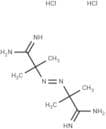


![2,2'-Azobis[2-methyl-propanimidamide] Dihydrochloride](/_next/image/?url=https%3A%2Fstatic.cymitquimica.com%2Fproducts%2FTR%2Fthumb%2FA932650.jpg&w=3840&q=75)



![2,2\'-Azobis[2-methyl-propanimidamide] Dihydrochloride](/_next/image/?url=https%3A%2Fstatic.cymitquimica.com%2Fproducts%2FST-EA%2Fthumb%2FEA-CP-C34018.jpg&w=3840&q=75)