CAS 30045-16-0
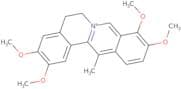
:Dehydrocorydalin
Beschreibung:
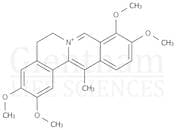
Dehydrocorydalin ist ein Alkaloid, das aus der Pflanze Corydalis gewonnen wird, die für ihre traditionellen medizinischen Anwendungen bekannt ist. Es ist durch seine komplexe Struktur gekennzeichnet, die ein tetracyclisches Gerüst aufweist, das für viele Alkaloide typisch ist. Diese Verbindung zeigt eine Reihe biologischer Aktivitäten, einschließlich schmerzlindernder, entzündungshemmender und neuroprotektiver Wirkungen, was sie für die pharmakologische Forschung von Interesse macht. Dehydrocorydalin interagiert mit verschiedenen Neurotransmittersystemen, was zu ihrem therapeutischen Potenzial beitragen kann. Es wird typischerweise in Form eines weißen bis off-white kristallinen Pulvers gefunden und ist in organischen Lösungsmitteln löslich. Das Sicherheitsprofil und die Pharmakokinetik der Verbindung sind noch in Untersuchung, aber sie wird allgemein als in vorläufigen Studien von geringer Toxizität angesehen. Wie bei vielen Naturprodukten können die Extraktions- und Reinigungsprozesse ihren Ertrag und ihre Reinheit beeinflussen, die sowohl für die Forschung als auch für potenzielle therapeutische Anwendungen entscheidend sind. Insgesamt stellt Dehydrocorydalin ein vielversprechendes Forschungsfeld innerhalb der Naturstoffchemie und Pharmakologie dar.
Formel:C22H24NO4
InChl:InChI=1S/C22H24NO4/c1-13-15-6-7-18(24-2)22(27-5)17(15)12-23-9-8-14-10-19(25-3)20(26-4)11-16(14)21(13)23/h6-7,10-12H,8-9H2,1-5H3/q+1
InChI Key:InChIKey=RFKQJTRWODZPHF-UHFFFAOYSA-N
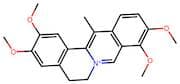
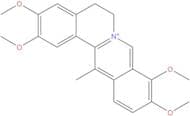
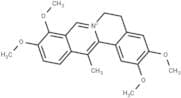
SMILES:CC1=C2C=3C(=CC(OC)=C(OC)C3)CC[N+]2=CC=4C1=CC=C(OC)C4OC
Synonyme:- 13-Methylpalmatine
- 2,3,9,10-Tetramethoxy-13-Methyl-5,6-Dihydroisoquino[3,2-A]Isoquinolinium
- 2,3,9,10-Tetramethoxy-13-Methyl-5,6-Dihydroisoquino[3,2-A]Isoquinolinium Chloride
- 2,3,9,10-Tetramethoxy-13-methyl-5,6-dihydroisoquinolino[2,1-b]isoquinolin-7-ium
- 5,6-Dihydro-2,3,9,10-tetramethoxy-13-methyldibenzo[a,g]quinolizinium
- 7,8,13,13a-Tetradehydro-2,3,9,10-tetramethoxy-13-methylberbinium
- Berbinium, 7,8,13,13a-tetradehydro-2,3,9,10-tetramethoxy-13-methyl-
- Brn 1556798
- Corydaline, dehydro-
- Dehydrocorydalin
- Dibenzo(a,g)quinolizinium, 5,6-dihydro-2,3,9,10-tetramethoxy-13-methyl- (9CI)
- Dibenzo[a,g]quinolizinium, 5,6-dihydro-2,3,9,10-tetramethoxy-13-methyl-
- Weitere Synonyme anzeigen
Sortieren nach
Reinheit (%)
0
100
|
0
|
50
|
90
|
95
|
100
7 Produkte.
Dibenzo[a,g]quinolizinium,5,6-dihydro-2,3,9,10-tetramethoxy-13-methyl-
CAS:Formel:C22H24NO4Reinheit:99%Molekulargewicht:366.4303Dehydrocorydalin
CAS:Dehydrocorydalin has anti-inflammatory,antinociceptive,antiplatelet,and anti-tumor effects and can protect the cardiovascular system. Dehydrocorydaline stimulates p38 MAPK activation, which can enhance heterodimerization of MyoD and E proteins, thus resulting in MyoD activation and myoblast differentiation. Dehydrocorydaline inhibits MCF-7 cell proliferation by inducing apoptosis mediated by regulating Bax/Bcl-2, activating caspases as well as cleaving PARP.Formel:C22H24NO4Reinheit:95%~99%Molekulargewicht:366.436Ref: TM-T5S2358
1mg49,00€2mg69,00€5mg105,00€1mL*10mM (DMSO)116,00€10mg137,00€25mg197,00€50mg295,00€100mg447,00€Dehydrocorydaline
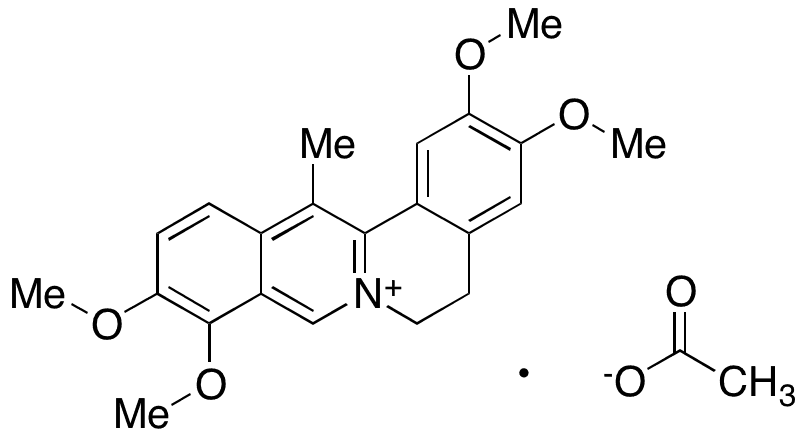
CAS:Dehydrocorydaline is a naturally occurring alkaloid, which is derived from the roots of Corydalis species, specifically from plants in the Papaveraceae family. Its mode of action primarily involves the modulation of neurotransmitter systems, including dopaminergic and serotonergic pathways, which contributes to its analgesic properties. Additionally, dehydrocorydaline affects calcium channels and can inhibit smooth muscle contractions, highlighting its ability to exert an anti-inflammatory effect as well.Formel:C22H24NO4Reinheit:Min. 95%Farbe und Form:PowderMolekulargewicht:366.43 g/molDehydrocorydaline Acetate
CAS:Kontrolliertes ProduktStability Hygroscopic
Applications Dehydrocorydaline Acetate inhibits breast cancer cells proliferation, through induction of apoptosis.
References Xu, Z. et al.: Am. J. Chin. Med., 40, 177 (2012); Li, B. et al.: Int. J. Mol. Sci., 13, 13501 (2012);Formel:C22H24NO4•C2H3O2Farbe und Form:NeatMolekulargewicht:425.47
![Dibenzo[a,g]quinolizinium,5,6-dihydro-2,3,9,10-tetramethoxy-13-methyl-](/_next/image/?url=https%3A%2Fstatic.cymitquimica.com%2Fproducts%2FIN%2Fthumb%2FDA007JUL.jpg&w=3840&q=75)