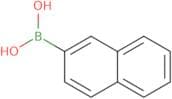
CAS 32316-92-0
:2-Naphthylborsäure
Beschreibung:
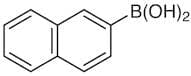
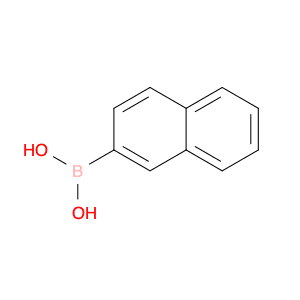
2-Naphthylborsäure ist eine Organoborverbindung, die durch das Vorhandensein einer boronsäurefunktionellen Gruppe, die an einen Naphthalenring gebunden ist, gekennzeichnet ist. Sie erscheint typischerweise als weißer bis cremefarbener Feststoff und ist in polaren organischen Lösungsmitteln wie Ethanol und Methanol löslich, jedoch weniger löslich in unpolaren Lösungsmitteln. Die Verbindung ist bekannt für ihre Fähigkeit, reversible kovalente Bindungen mit Diolen zu bilden, was sie in verschiedenen Anwendungen nützlich macht, einschließlich der organischen Synthese und als Reagenz in Suzuki-Miyaura-Kreuzkupplungsreaktionen. Ihre Boronsäurefunktionalität ermöglicht es ihr, an der Bildung von Boronatestern teilzunehmen, die wichtige Zwischenprodukte in der organischen Chemie sind. Darüber hinaus wurde 2-Naphthylborsäure auf seine potenziellen Anwendungen in der medizinischen Chemie untersucht, insbesondere bei der Entwicklung von Arzneimitteln, die auf spezifische biologische Wege abzielen. Sicherheitsüberlegungen umfassen den vorsichtigen Umgang, da Boronsäuren reizend sein können. Insgesamt ist 2-Naphthylborsäure eine vielseitige Verbindung mit erheblichem Nutzen sowohl in der akademischen als auch in der industriellen Chemie.
Formel:C10H9BO2
InChl:InChI=1/C10H9BO2/c12-11(13)10-6-5-8-3-1-2-4-9(8)7-10/h1-7,12-13H
InChI Key:InChIKey=KPTRDYONBVUWPD-UHFFFAOYSA-N
SMILES:B(O)(O)C1=CC2=C(C=C1)C=CC=C2
Synonyme:- (2-Naphthalenyl)boronic acid
- (Naphthalene-2-yl)boronic acid
- 2-Naphthalene Boric Acid
- 2-Naphthaleneboronic acid
- 2-Naphthaleneylboronic acid
- 2-Naphthylbenzoic acid
- 2-Naphthylboric acid
- 2-Naphthylboronic acid
- 2-Naphthylboronic caid
- Akos Brn-0020
- Akos Brn-0041
- Alpha-Naphthylboric Acid
- B-2-Naphthalenylboronic acid
- Boronic acid, 2-naphthalenyl-
- Boronic acid, B-2-naphthalenyl-
- Naphthalen-2-Yl-2-Boronic Acid
- Naphthalen-2-Ylboronic Acid
- Naphthalenyl-2-Boronic Acid
- NAPHTHALENE-2-BORONIC ACID
- NAPHTHALEN-1-YLBORONIC ACID
- 1-NAPHTHALENEBORONIC ACID
- 1-NAPHTHYLBORONIC ACID
- RARECHEM AH PB 0126
- 1-NAPHTHYLENEBORONIC ACID
- NAPHTHALENE-1-BORONIC ACID
- 2-NAPHTHENEBORONIC ACID
- NAPHTHALENYL-1-BORONIC ACID
- Weitere Synonyme anzeigen
Sortieren nach
Reinheit (%)
0
100
|
0
|
50
|
90
|
95
|
100
8 Produkte.
2-Naphthaleneboronic Acid (contains varying amounts of Anhydride)
CAS:Formel:C10H9BO2Farbe und Form:White to Light yellow powder to crystalMolekulargewicht:171.992-Naphthaleneboronic acid, 97%
CAS:This Thermo Scientific Chemicals brand product was originally part of the Alfa Aesar product portfolio. Some documentation and label information may refer to the legacy brand. The original Alfa Aesar product / item code or SKU reference has not changed as a part of the brand transition to Thermo SciFormel:C10H9BO2Reinheit:97%Farbe und Form:White to cream to pale brown, Powder or crystalline powder and/or chunksMolekulargewicht:171.99Naphthalene-2-boronic acid
CAS:Naphthalene-2-boronic acidFormel:C10H9BO2Reinheit:≥95%Farbe und Form: white crystalline powderMolekulargewicht:171.99g/mol2-Naphthaleneboronic acid
CAS:Formel:C10H9BO2Reinheit:97%Farbe und Form:Chunks,Crystalline PowderMolekulargewicht:171.992-Naphthaleneboronic acid
CAS:2-Naphthaleneboronic acid is an organic compound that has been used as a model system for studying the binding of organic molecules to metal ions. It has been shown to bind with high affinity and specificity to sodium, potassium, and lithium ions. 2-Naphthaleneboronic acid binds to the metal ion by forming a boronate ester linkage with one of its hydroxyl groups. The other two hydroxyl groups are involved in hydrogen bonding interactions with the metal ion. This process is reversible, which allows it to be used as a model system for studying the binding of organic molecules to metal ions. 2-Naphthaleneboronic acid is also used in the synthesis of various compounds, including diphenyl ethers and anhydrous sodium carbonate. It can be prepared by reacting naphthalene with anhydrous sodium carbonate in hydrochloric acid or sodium carbonate solution at temperatures ranging from 50 °C to 150 °CFormel:C10H9BO2Reinheit:Min. 95%Molekulargewicht:171.99 g/mol