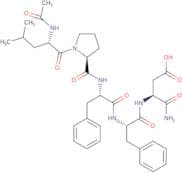
CAS 339990-02-2
:L-a-Asparagin, N-acetyl-L-leucyl-L-prolyl-L-phenylalanil-L-phenylalanil-
Beschreibung:
Die L-a-Asparagin, N-Acetyl-L-Leucin-L-Prolin-L-Phenylalanin-L-Phenylalanin, identifiziert durch die CAS-Nummer 339990-02-2, ist ein synthetisches Peptid, das aus einer Sequenz von Aminosäuren besteht, einschließlich Asparagin, Leucin, Prolin und Phenylalanin. Diese Verbindung zeichnet sich durch ihre spezifische Anordnung dieser Aminosäuren aus, die zu ihren einzigartigen Eigenschaften und potenziellen biologischen Aktivitäten beiträgt. Peptide wie dieses zeigen oft verschiedene Funktionen in biologischen Systemen, einschließlich Rollen in der Signalübertragung, enzymatischer Aktivität und struktureller Unterstützung. Die N-Acetyl-Modifikation verbessert typischerweise die Stabilität und Löslichkeit des Peptids, wodurch es für verschiedene Anwendungen in der Forschung und Pharmazie geeigneter wird. Darüber hinaus kann die Anwesenheit von aromatischen Aminosäuren, wie Phenylalanin, die Wechselwirkungen des Peptids mit anderen Biomolekülen beeinflussen. Insgesamt stellt diese Verbindung eine komplexe Struktur dar, die von Interesse in Studien zur Biochemie, Pharmakologie und Peptidsynthese sein könnte.
Formel:C35H46N6O8
Synonyme:- 10:PN: WO03050139 SEQID: 15 claimed protein
- 3: PN: WO0134631 PAGE: 35 claimedprotein
- As 602704
- Ac-Leu-Pro-Phe-Phe-Asp-Nh2
Sortieren nach
Reinheit (%)
0
100
|
0
|
50
|
90
|
95
|
100
3 Produkte.
Acetyl-(Pro¹⁸,Asp²¹)-Amyloid β-Protein (17-21) amide
CAS:The pentapeptide Ac-LPFFD-NH₂ (iAβ5p) is an analog of product H-4876 with small chemical modifications which enhance its stability against proteolytic degradation. iAβ5p acts as a β-sheet breaker peptide and crosses the blood-brain barrier at a higher rate than most proteins and peptides known to be selectively taken up by the brain so that it is assumed that the peptide is being specifically transported to the brain. A significant increase in neuronal survival and decrease in brain inflammation associated with the reduction of amyloid plaques in two different transgenic Alzheimer`s disease (AD) models is additionally reported for iAβ5p.Formel:C35H46N6O8Reinheit:> 95%Farbe und Form:White PowderMolekulargewicht:678.79Acetyl-(Pro18,Asp21)-Amyloid b-Protein (17-21) amide
CAS:Acetyl-(Pro18,Asp21)-Amyloid b-Protein (17-21) amide is a peptide that was generated by incubating β-amyloid with the protease papain. This peptide has been shown to induce population and biochemical changes in cells, including focusing of β-amyloid aggregates. It also induces reactive oxygen species and promotes extracellular protofibril formation. Acetyl-(Pro18,Asp21)-Amyloid b-Protein (17-21) amide is a conjugate of acetylated lysine residues and amyloid β-protein that can be used as an anti-amyloid therapeutic. The peptide is characterized by dichroism spectroscopy, which has revealed its specific binding to the fibrils' surface.Formel:C35H46N6O8Reinheit:Min. 95%Molekulargewicht:678.78 g/molAc-Leu-Pro-Phe-Phe-Asp-NH2
CAS:Ac-Leu-Pro-Phe-Phe-Asp-NH2 is a potential therapeutic for Alzheimer's disease. It has been shown to reduce the production of reactive oxygen species and inhibit the formation of amyloid beta oligomers. Ac-Leu-Pro-Phe-Phe-Asp-NH2 also reduces the frequency of protofibrils, which are aggregates that may play a role in Alzheimer's disease pathology. This peptide has been shown to have a protective effect on cell populations, which may lead to therapeutics that can delay or prevent Alzheimer's disease. Ac-Leu-Pro-Phe-Phe-Asp NH2 is an inhibitor of amyloid beta peptides and modulates their aggregation into protofibrils.
Formel:C35H46N6O8Reinheit:Min. 95%Molekulargewicht:678.89 g/mol