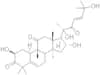
CAS 3877-86-9
:Kukurbitacin D
Beschreibung:
Kukurbitacin D ist eine triterpenoide Verbindung, die hauptsächlich aus verschiedenen Pflanzen der Familie Cucurbitaceae, wie Gurken und Kürbissen, gewonnen wird. Sie ist bekannt für ihren bitteren Geschmack und wurde auf ihre potenziellen pharmakologischen Eigenschaften untersucht, einschließlich anti-krebs-, entzündungshemmender und antidiabetischer Wirkungen. Die molekulare Struktur von Kukurbitacin D weist eine komplexe Anordnung von Kohlenstoffringen auf, die zu ihrer biologischen Aktivität beiträgt. Sie kommt typischerweise in niedrigen Konzentrationen in pflanzlichen Geweben vor und kann mit organischen Lösungsmitteln extrahiert werden. Die Verbindung zeigt Zytotoxizität gegen verschiedene Krebszelllinien, was sie zu einem interessanten Thema in der medizinischen Chemie macht. Darüber hinaus wurde gezeigt, dass Kukurbitacin D bestimmte Signalwege hemmt, die an der Zellproliferation und -überlebensfähigkeit beteiligt sind, was ihre potenziellen therapeutischen Anwendungen weiter hervorhebt. Aufgrund ihrer Toxizität in höheren Konzentrationen ist jedoch eine sorgfältige Abwägung erforderlich, wenn es um ihre Verwendung in klinischen Umgebungen geht. Insgesamt stellt Kukurbitacin D ein faszinierendes Forschungsfeld innerhalb der Naturprodukte und ihrer potenziellen gesundheitlichen Vorteile dar.
Formel:C30H44O7
InChl:InChI=1S/C30H44O7/c1-25(2,36)12-11-21(33)30(8,37)23-19(32)14-27(5)20-10-9-16-17(13-18(31)24(35)26(16,3)4)29(20,7)22(34)15-28(23,27)6/h9,11-12,17-20,23,31-32,36-37H,10,13-15H2,1-8H3/b12-11+/t17-,18+,19-,20+,23+,27+,28-,29+,30+/m1/s1
InChI Key:InChIKey=SRPHMISUTWFFKJ-QJNWWGCFSA-N
SMILES:C[C@]12[C@@](C)([C@@]([C@@](C(/C=C/C(C)(C)O)=O)(C)O)([C@H](O)C1)[H])CC(=O)[C@]3(C)[C@]2(CC=C4[C@]3(C[C@H](O)C(=O)C4(C)C)[H])[H]
Synonyme:- (2S,4R,9beta,16alpha,23E)-2,16,20,25-tetrahydroxy-9,10,14-trimethyl-4,9-cyclo-9,10-secocholesta-5,23-diene-1,11,22-trione
- (2β,9β,10α,16α,23E)-2,16,20,25-Tetrahydroxy-9-methyl-19-norlanosta-5,23-diene-3,11,22-trione
- 17-[(3E)-1,5-Dihydroxy-1,5-dimethyl-2-oxohex-3-en-1-yl]-2,16-dihydroxy-4,4,9,14-tetramethylestr-5-ene-3,11-dione
- 19-Nor-9β,10α-lanosta-5,23-diene-3,11,22-trione, 2β,16α,20,25-tetrahydroxy-9-methyl-
- 19-Norlanosta-5,23-diene-3,11,22-trione, 2,16,20,25-tetrahydroxy-9-methyl-, (2β,9β,10α,16α,23E)-
- Cucurbitacine D
- Elatericin A
- Elatericine A
- NSC 308606
- NSC 521776
- Cucurbitacin D
Sortieren nach
Reinheit (%)
0
100
|
0
|
50
|
90
|
95
|
100
11 Produkte gefunden.
Cucurbitacin D
CAS:Cucurbitacin D analytical standard provided with w/w absolute assay, to be used for quantitative titration.Formel:C30H44O7Reinheit:(HPLC) ≥95%Farbe und Form:PowderMolekulargewicht:516.6819-Norlanosta-5,23-diene-3,11,22-trione,2,16,20,25-tetrahydroxy-9-methyl-, (2b,9b,10a,16a,23E)-
CAS:Formel:C30H44O7Reinheit:97%Farbe und Form:SolidMolekulargewicht:516.6662Cucurbitacin D
CAS:Cucurbitacin D is a triterpenoid isolated from Ecballium elaterium (L.) with anticancer and antitumor activity and is used in the study of cervical cancer.Formel:C30H44O7Reinheit:97.69% - 99.10%Farbe und Form:SolidMolekulargewicht:516.67Cucurbitacin D (Standard)
CAS:Cucurbitacin D (Standard) is a reference standard for research and analysis in studies involving Cucurbitacin D. Cucurbitacin D, a triterpenoid isolated from Ecballium elaterium (L.), exhibits anticancer and antitumor activity, inhibits glucose uptake and lactate production in metastatic PrC, and induces inflammasome activation independent of ERK1/2 activation. Cucurbitacin D, a novel inflammasome activator in macrophages, inhibits HepG2 cell proliferation and induces apoptosis by modulating the JAK/STAT3, PI3K/Akt/mTOR and MAPK signaling pathways, and can be used in the study of cervical cancer, leukemia, and prostate cancer.Formel:C30H44O7Farbe und Form:SolidMolekulargewicht:516.67Cucurbitacin D
CAS:Ketone alcoholFormel:C30H44O7Reinheit:≥ 98.0 % (HPLC)Farbe und Form:PowderMolekulargewicht:516.67Cucurbitacin D
CAS:Kontrolliertes ProduktCucurbitacin D is a natural compound that is found in the seeds of cucurbits. It has been shown to be cytotoxic to cancer cell lines and inhibitory proteins. Cucurbitacin D binds to the response element and inhibits protein synthesis, leading to cell death by inhibiting the production of proteins vital for cell division. This compound also induces apoptosis through intracellular calcium levels. Cucurbitacin D has been shown to have significant cytotoxicity against human leukemia cells, suggesting that it could be used as a chemotherapeutic agent.Formel:C30H44O7Reinheit:Min. 95%Molekulargewicht:516.3087