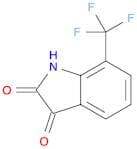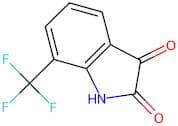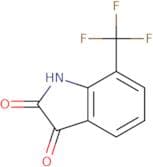
CAS 391-12-8
:7-Trifluoroisatin
- Buttpark 24\07-40
- 7-(Trifluoromethyl)Indoline-2,3-Dione
- 7-(Trifluoromethyl)Isatin
- 7-(Trifluoromethyl)-1H-Indole-2,3-Dione
- 7-(Trifluoromethyl)Indole-2,3-Dione
7-(Trifluoromethyl)isatin
CAS:Formel:C9H4F3NO2Reinheit:>98.0%(GC)(T)Farbe und Form:Light yellow to Brown powder to crystalMolekulargewicht:215.137-(Trifluoromethyl)indoline-2,3-dione
CAS:Formel:C9H4F3NO2Reinheit:95%Farbe und Form:SolidMolekulargewicht:215.12887-(Trifluoromethyl)isatin
CAS:7-(Trifluoromethyl)isatin
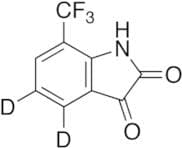
Reinheit:98%Farbe und Form:SolidMolekulargewicht:215.13g/mol7-(Trifluoromethyl)-1H-indole-2,3-dione-d2
CAS:Kontrolliertes ProduktApplications 7-(Trifluoromethyl)1H-indole-2,3-dione-d2 is a labelled 7-(Trifluoromethyl)1H-indole-2,3-dione (T791300), an inhibitor of COX-1, COX-2, and β-catenin. Useful in the treatment of diseases such as: lung cancer, diabetes and Alzheimer's disease.
References Medwid, J., et al.: J. Med. Chem., 33, 1230 (1990), Collins, L., et al.: Antimicrob. Agents Chemother., 41, 1004 (1997), Dandia, A., et al.: Bioorg. Med. Chem., 14, 2409 (2006)Formel:C9D2H2F3NO2Farbe und Form:NeatMolekulargewicht:217.1417-(Trifluoromethyl)1H-indole-2,3-dione
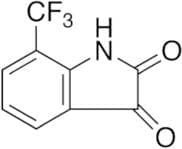
CAS:Kontrolliertes ProduktApplications An indole derivative as inhibitor of COX-1, COX-2, and β-catenin. Useful in the treatment of diseases such as: lung cancer, diabetes and Alzheimer's disease.
References Medwid, J., et al.: J. Med. Chem., 33, 1230 (1990), Collins, L., et al.: Antimicrob. Agents Chemother., 41, 1004 (1997), Dandia, A., et al.: Bioorg. Med. Chem., 14, 2409 (2006),Formel:C9H4F3NO2Farbe und Form:NeatMolekulargewicht:215.137-(Trifluoromethyl)1H-indole-2,3-dione
CAS:Trifluoromethyl-substituted 7-(trifluoromethyl)1H-indole-2,3-dione is a trifluoromethyl analogue of indole-2,3-dione that has been shown to have antimalarial activity. It has been shown to be active against plasmodium and cancer cells in vitro. Trifluoromethyl group can be replaced by other substituents such as methoxy, ethoxy, or nitro groups. The compound has centrosymmetric structures and an elemental composition of C8H4F3N.
Formel:C9H4F3NO2Reinheit:Min. 95%Farbe und Form:PowderMolekulargewicht:215.13 g/molRef: 3D-FT28468
Ausgelaufenes produkt