CAS 3922-90-5
:Oleandomycin
Beschreibung:
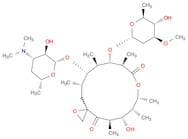
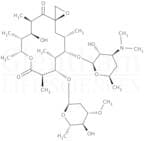
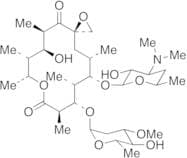
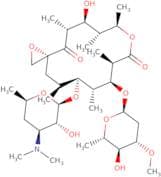
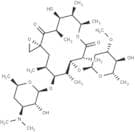
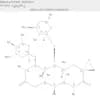
Oleandomycin ist ein Makrolid-Antibiotikum, das strukturell mit Erythromycin verwandt ist. Es wird durch die Fermentation bestimmter Stämme von Streptomyces, insbesondere Streptomyces antibioticus, hergestellt. Oleandomycin zeigt antibakterielle Aktivität hauptsächlich gegen grampositive Bakterien und einige gramnegative Organismen, was es wirksam bei der Behandlung verschiedener bakterieller Infektionen macht. Die Verbindung wirkt, indem sie die bakterielle Proteinsynthese hemmt, indem sie an die 50S-Ribosomenuntereinheit bindet, was die Elongation der Polypeptidkette während der Translation verhindert. Oleandomycin wird typischerweise oral verabreicht und ist bekannt für seine relativ geringe Toxizität. Es kann jedoch Nebenwirkungen wie gastrointestinale Störungen und allergische Reaktionen bei einigen Personen verursachen. Seine Verwendung ist mit dem Aufkommen neuerer Antibiotika zurückgegangen, bleibt jedoch in bestimmten klinischen Szenarien von Interesse. Die chemische Struktur von Oleandomycin umfasst einen großen Laktonring, der charakteristisch für Makrolid-Antibiotika ist und zu seinem Wirkmechanismus und seinen pharmakologischen Eigenschaften beiträgt.
Formel:C35H61NO12
InChl:InChI=1S/C35H61NO12/c1-16-14-35(15-43-35)32(40)19(4)27(37)18(3)22(7)46-33(41)21(6)31(47-26-13-25(42-11)28(38)23(8)45-26)20(5)30(16)48-34-29(39)24(36(9)10)12-17(2)44-34/h16-31,34,37-39H,12-15H2,1-11H3/t16-,17+,18-,19+,20+,21+,22+,23-,24-,25-,26-,27-,28-,29+,30-,31-,34-,35+/m0/s1
InChI Key:InChIKey=RZPAKFUAFGMUPI-QESOVKLGSA-N
SMILES:O=C1[C@]2(CO2)C[C@H](C)[C@H](O[C@H]3[C@H](O)[C@@H](N(C)C)C[C@@H](C)O3)[C@@H](C)[C@H](O[C@H]4C[C@H](OC)[C@@H](O)[C@H](C)O4)[C@@H](C)C(=O)O[C@H](C)[C@H](C)[C@H](O)[C@H]1C
Synonyme:- 1,9-Dioxaspiro[2.13]hexadecane, oleandomycin deriv.
- 1,9-Dioxaspiro[2.13]hexadecane-4,10-dione, 12-[(2,6-dideoxy-3-O-methyl-α-<span class="text-smallcaps">L</smallcap>-arabino-hexopyranosyl)oxy]-6-hydroxy-5,7,8,11,13,15-hexamethyl-14-[[3,4,6-trideoxy-3-(dimethylamino)-β-<smallcap>D</span>-xylo-hexopyranosyl]oxy]-, [3R-(3R*,5R*,6S*,7R*,8R*,11R*,12S*,13R*,14S*,15S*)]-
- 1,9-Dioxaspiro[2.13]hexadecane-4,10-dione, 12-[(2,6-dideoxy-3-O-methyl-α-L-arabino-hexopyranosyl)oxy]-6-hydroxy-5,7,8,11,13,15-hexamethyl-14-[[3,4,6-trideoxy-3-(dimethylamino)-β-D-xylo-hexopyranosyl]oxy]-, [3R-(3R*,5R*,6S*,7R*,8R*,11R*,12S*,13R*,14S*,15S*)]-
- Amimycin
- Antibiotic PA 105
- Landomycin
- Nonanoic acid, 8-(3,5-dihydroxy-2,4-dimethylhexanoyl)-5-(4-dimethylaminotetrahydro-3-hydroxy-6-methylpyran-2-yloxy)-8,9-epoxy-2,4,6-trimethyl-3-(tetrahydro-5-hydroxy-4-methoxy-6-methylpyran-2-yloxy)-, μ-lactone
- Oleandomicina
- Oleandomycin A
- Oleandomycine
- Pa 105
- Pa 775
- Romicil
- [3R-(3R*,5R*,6S*,7R*,8R*,11R*,12S*,13R*,14S*,15S*)]-12-[(2,6-Dideoxy-3-O-methyl-α-<span class="text-smallcaps">L</smallcap>-arabino-hexopyranosyl)oxy]-6-hydroxy-5,7,8,11,13,15-hexamethyl-14-[[3,4,6-trideoxy-3-(dimethylamino)-β-<smallcap>D</span>-xylo-hexopyranosyl]oxy]-1,9-dioxaspiro[2.13]hexadecane-4,10-dione
- [3R-(3R*,5R*,6S*,7R*,8R*,11R*,12S*,13R*,14S*,15S*)]-12-[(2,6-Dideoxy-3-O-methyl-α-L-arabino-hexopyranosyl)oxy]-6-hydroxy-5,7,8,11,13,15-hexamethyl-14-[[3,4,6-trideoxy-3-(dimethylamino)-β-D-xylo-hexopyranosyl]oxy]-1,9-dioxaspiro[2.13]hexadecane-4,10-dione
- (3S,5R,6S,7R,8R,11R,12S,13R,14S,15S)-12-[(2,6-dideoxy-3-O-methylhexopyranosyl)oxy]-6-hydroxy-5,7,8,11,13,15-hexamethyl-4,10-dioxo-1,9-dioxaspiro[2.13]hexadec-14-yl 3,4,6-trideoxy-3-(dimethylamino)hexopyranoside
- Oleandomycin
- 12-((2,6-Didesoxy-3-O-methyl-alpha-K-arabino-hexopyranosyl)oxy)-8-hydroxy-5,7,8,11,13,15-hexamethyl-14-((3,4,6-tridesoxy-3-dimethylamino-beta-D-xylo-hexopyranosyl)oxy)-1,9-dioxaspiro(2.13)hexadecan-4,10-dion
- Oleandomycinum [INN-Latin]
- (3R,5R,6S,7R,8R,11S,12S,13R,14S,15S)-6-hydroxy-5,7,8,11,13,15-hexamethyl-4,10-dioxo-14-{[3,4,6-trideoxy-3-(dimethylamino)-beta-D-xylo-hexopyranosyl]oxy}-1,9-dioxaspiro[2.13]hexadec-12-yl 2,6-dideoxy-3-O-methyl-alpha-L-arabino-hexopyranoside
- AI3-50163
- HSDB 7442
- (3R,5R,6S,7R,8R,11R,12S,13R,14S,15S)-6-hydroxy-5,7,8,11,13,15-hexamethyl-4,10-dioxo-14-{[3,4,6-trideoxy-3-(dimethylamino)-beta-D-xylo-hexopyranosyl]oxy}-1,9-dioxaspiro[2.13]hexadec-12-yl 2,6-dideoxy-3-O-methyl-alpha-L-arabino-hexopyranoside
- Oleandomycin (chloroform solvate)
- Oleandomycine [INN-French]
- (3S,5R,6S,7R,8R,11R,12S,13R,14S,15S)-6-hydroxy-5,7,8,11,13,15-hexamethyl-4,10-dioxo-14-{[3,4,6-trideoxy-3-(dimethylamino)-D-xylo-hexopyranosyl]oxy}-1,9-dioxaspiro[2.13]hexadec-12-yl 2,6-dideoxy-3-O-methyl-alpha-L-arabino-hexopyranoside phosphate (salt)
- (3S,5R,6S,7R,8R,11R,12S,13R,14S,15S)-6-hydroxy-5,7,8,11,13,15-hexamethyl-4,10-dioxo-14-{[3,4,6-trideoxy-3-(dimethylamino)-beta-D-xylo-hexopyranosyl]oxy}-1,9-dioxaspiro[2.13]hexadec-12-yl 2,6-dideoxy-3-O-methyl-alpha-L-arabino-hexopyranoside
- Oleandomycine [French]
- UNII-P8ZQ646136
- Oleandomicina [INN-Spanish]
- Matromycin
- Weitere Synonyme anzeigen
Sortieren nach
Reinheit (%)
0
100
|
0
|
50
|
90
|
95
|
100
8 Produkte.
Oleandomycin 1000 µg/mL in Acetonitrile
CAS:Kontrolliertes ProduktFormel:C35H61NO12Farbe und Form:Single SolutionMolekulargewicht:687.86Oleandomycin
CAS:Applications Antibiotic substance produced by Streptomyces antibioticus no. ATCC 11891. Antibacterial.
References Sous, H., et al.: Arzneim.-Forsch., 8, 386 (1958), Hahn, et al.: Antibiotics, 1, 378 (1967),Formel:C35H61NO12Farbe und Form:NeatMolekulargewicht:687.86Oleandomycin
CAS:Oleandomycin is a macrolide antibiotic, which is derived from the bacterium *Streptomyces antibioticus*. This antibiotic functions by binding to the 50S subunit of the bacterial ribosome, thereby inhibiting protein synthesis. The interruption of this essential process ultimately leads to the cessation of bacterial growth and replication.
Formel:C35H61NO12Reinheit:Min. 95%Farbe und Form:White PowderMolekulargewicht:687.86 g/molOleandomycin
CAS:Oleandomycin, a macrolide antibiotic structurally similar to Erythromycin, exhibits antimicrobial activity.Formel:C35H61NO12Reinheit:98%Farbe und Form:White Amorphous Powder SolidMolekulargewicht:687.86