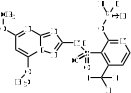
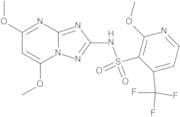
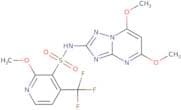
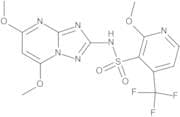
![3-Pyridinesulfonamide, N-(5,7-dimethoxy[1,2,4]triazolo[1,5-a]pyrimidin-2-yl)-2-methoxy-4-(trifluor…](/_next/image/?url=https%3A%2Fstatic.cymitquimica.com%2Fcas-image%2Fthumb-webp%2F392775-pyroxsulam.webp&w=3840&q=75)
CAS 422556-08-9
:3-Pyridinsulfonamid, N-(5,7-dimethoxy[1,2,4]triazolo[1,5-a]pyrimidin-2-yl)-2-methoxy-4-(trifluormethyl)-
Beschreibung:
3-Pyridinsulfonamid, N-(5,7-dimethoxy[1,2,4]triazolo[1,5-a]pyrimidin-2-yl)-2-methoxy-4-(trifluormethyl)- ist eine chemische Verbindung, die durch ihre komplexe Struktur gekennzeichnet ist, die einen Pyridinring, eine Sulfonamidgruppe und eine Triazolopyrimidin-Einheit umfasst. Diese Verbindung weist mehrere funktionelle Gruppen auf, darunter Methoxy- und Trifluormethylsubstituenten, die ihre Löslichkeit, Reaktivität und biologische Aktivität beeinflussen können. Das Vorhandensein der Sulfonamidgruppe deutet auf potenzielle Anwendungen in der medizinischen Chemie hin, insbesondere als Pharmakophor in der Arzneimittelentwicklung. Die Trifluormethylgruppe ist bekannt dafür, die Lipophilie und die metabolische Stabilität zu erhöhen, was solche Verbindungen im Design von Arzneimitteln interessant macht. Darüber hinaus können die strukturellen Merkmale der Verbindung zu ihren Wechselwirkungen mit biologischen Zielen beitragen, was potenziell zu therapeutischen Effekten führen kann. Insgesamt veranschaulicht diese Verbindung die komplexe Beziehung zwischen molekularer Struktur und biologischer Funktion, was sie zu einem interessanten Thema in verschiedenen Bereichen macht, einschließlich der medizinischen Chemie und der Arzneimittelentdeckung.
Formel:C14H13F3N6O5S
InChl:InChI=1/C14H13F3N6O5S/c1-26-8-6-9(27-2)23-13(19-8)20-12(21-23)22-29(24,25)10-7(14(15,16)17)4-5-18-11(10)28-3/h4-6H,1-3H3,(H,21,22)
InChI Key:InChIKey=GLBLPMUBLHYFCW-UHFFFAOYSA-N
SMILES:S(NC1=NN2C(=N1)N=C(OC)C=C2OC)(=O)(=O)C=3C(C(F)(F)F)=CC=NC3OC
Synonyme:- 3-Pyridinesulfonamide, N-(5,7-dimethoxy[1,2,4]triazolo[1,5-a]pyrimidin-2-yl)-2-methoxy-4-(trifluoromethyl)-
- 422556-08-9
- De 742
- N-(5,7-Dimethoxy[1,2,4]triazolo[1,5-a]pyrimidin-2-yl)-2-methoxy-4-(trifluoromethyl)-3-pyridinesulfonamide
- Palace
- Pyroxsulam
- Pyroxsulam [iso]
Sortieren nach
Reinheit (%)
0
100
|
0
|
50
|
90
|
95
|
100
7 Produkte.
LC PestiMix 6 10 µg/mL in Acetonitrile
CAS:- 1007-28-9
- 1114-71-2
- 113036-88-7
- 113136-77-9
- 114420-56-3
- 115086-54-9
- 115852-48-7
- 116255-48-2
- 119791-41-2
- 121776-33-8
- 126535-15-7
- 130000-40-7
- 136849-15-5
- 138164-12-2
- 139528-85-1
- 147150-35-4
- 149508-90-7
- 180409-60-3
- 181274-17-9
- 1929-88-0
- 199119-58-9
- 2008-41-5
- 210631-68-8
- 211867-47-9
- 221667-31-8
- 223580-51-6
- 23576-24-1
- 239110-15-7
- 2439-10-3
- 25606-41-1
- 27314-13-2
- 27605-76-1
- 2797-51-5
- 302-27-2
- 321-54-0
- 32889-48-8
- 3337-71-1
- 335104-84-2
- 33820-53-0
- 35367-31-8
- 37019-18-4
- 372137-35-4
- 4151-50-2
- 422556-08-9
- 42609-52-9
- 4849-32-5
- 55861-78-4
- 57160-47-1
- 58011-68-0
- 6119-70-6
- 61432-55-1
- 64-10-8
- 66-81-9
- 69335-91-7
- 69806-50-4
- 74051-80-2
- 74222-97-2
- 76578-12-6
- 8065-36-9
- 81103-11-9
- 81335-77-5
- 82211-24-3
- 838-85-7
- 86811-58-7
- 88678-67-5
- 90982-32-4
- 91-22-5
- 93697-74-6
- 944-22-9
- 951659-40-8
- 96182-53-5
- 96525-23-4
- 97780-06-8
- 97886-45-8
- 99105-77-8
Farbe und Form:MixturePyroxsulam 100 µg/mL in Acetonitrile
CAS:Formel:C14H13F3N6O5SFarbe und Form:Single SolutionMolekulargewicht:434.35Pyroxsulam
CAS:Pyroxsulam is a selective post-emergence herbicide, which is synthetically derived from the triazolopyrimidine family. It functions by inhibiting the acetolactate synthase (ALS) enzyme in plants, a critical enzyme in the biosynthesis pathway of branched-chain amino acids such as valine, leucine, and isoleucine. This inhibition disrupts protein synthesis, ultimately leading to plant death.Pyroxsulam is primarily used in agricultural settings to manage a variety of grass and broadleaf weeds in cereal crops like wheat and barley. It is highly effective at low application rates and can offer broad-spectrum control across a range of climatic conditions. Its selectivity allows for the protection of desirable cereal plants while targeting problematic weed species. The use of pyroxsulam aids in enhancing crop yield and quality by minimizing competition from weeds for nutrients, light, and water. Its activity at the enzymatic level underscores the importance of precise application timing to maximize efficacy while minimizing environmental impact.Formel:C14H13F3N6O5SReinheit:Min. 95%Farbe und Form:PowderMolekulargewicht:434.35 g/mol