CAS 4370-59-6
:2,5-Dibrom-3,6-dihydroxy-2,5-cyclohexadien-1,4-dion
Beschreibung:
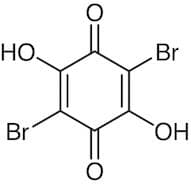
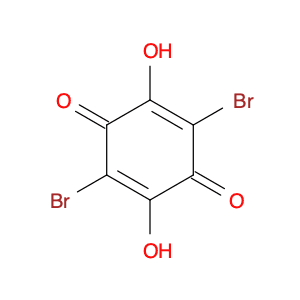
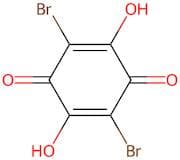
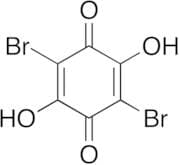
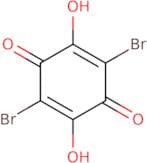
2,5-Dibrom-3,6-dihydroxy-2,5-cyclohexadien-1,4-dion, mit der CAS-Nummer 4370-59-6, ist eine chemische Verbindung, die durch ihre einzigartige Struktur gekennzeichnet ist, die zwei Bromatome und zwei Hydroxylgruppen enthält, die an einen Cyclohexadienring gebunden sind. Diese Verbindung ist ein Derivat der 1,4-Dione, was auf das Vorhandensein von zwei Carbonylgruppen in ihrer Struktur hinweist, die zu ihrer Reaktivität und potenziellen Anwendungen in der organischen Synthese beitragen. Das Vorhandensein von Bromatomen verstärkt ihren elektrophilen Charakter, was sie in verschiedenen chemischen Reaktionen, einschließlich Substitutions- und Kupplungsreaktionen, nützlich macht. Die Hydroxylgruppen bieten Stellen für Wasserstoffbrückenbindungen, die ihre Löslichkeit und Wechselwirkung mit anderen Molekülen beeinflussen. Typischerweise können Verbindungen wie diese biologische Aktivität aufweisen, was sie in der medizinischen Chemie von Interesse macht. Ihre physikalischen Eigenschaften, wie Schmelzpunkt und Löslichkeit, können je nach spezifischen Bedingungen und Reinheit der Probe variieren. Insgesamt ist 2,5-Dibrom-3,6-dihydroxy-2,5-cyclohexadien-1,4-dion eine vielseitige Verbindung mit potenziellen Anwendungen in Forschung und Industrie.
Formel:C6H2Br2O4
InChl:InChI=1/C6H2Br2O4/c7-1-3(9)5(11)2(8)6(12)4(1)10/h9,12H
InChI Key:InChIKey=GMZWPTALVQRAFV-UHFFFAOYSA-N
SMILES:BrC=1C(=O)C(O)=C(Br)C(=O)C1O
Synonyme:- 2,5-Cyclohexadiene-1,4-dione, 2,5-dibromo-3,6-dihydroxy-
- 2,5-Dibromo-3,6-Dihydroxycyclohexa-2,5-Diene-1,4-Dione
- 2,5-Dibromo-3,6-dihydroxy-1,4-benzoquinone
- 2,5-Dibromo-3,6-dihydroxy-2,5-cyclohexadiene-1,4-dione
- 2,5-Dibromo-3,6-dihydroxyquinone
- 2,5-Dihydroxy-3,6-dibromo-1,4-benzoquinone
- Bromanilic acid
- NSC 36928
- p-Benzoquinone, 2,5-dibromo-3,6-dihydroxy-
- 2,5-DibroMo-3,6-dihydroxy-p-quino
- 4-dione,2,5-dibromo-3,6-dihydroxy-5-cyclohexadiene-1
- 2,5-DIBROMO-3,6-DIHYDROXY-P-QUINONE
- 1,4-Dibromo-3,6-dioxo-1,4-cyclohexadiene-2,5-diol
- 2,5-Dihydroxy-3,6-dibromo-p-benzoquinone
- 2,5-Dibromo-3,6-dihydroxybenzo-1,4-quinone
- Weitere Synonyme anzeigen
Sortieren nach
Reinheit (%)
0
100
|
0
|
50
|
90
|
95
|
100
7 Produkte.
Bromanilic Acid
CAS:Formel:C6H2Br2O4Reinheit:>98.0%(T)Farbe und Form:Light yellow to Brown powder to crystalMolekulargewicht:297.892,5-Dibromo-3,6-dihydroxycyclohexa-2,5-diene-1,4-dione
CAS:Formel:C6H2Br2O4Reinheit:98%Farbe und Form:SolidMolekulargewicht:297.88572,5-Dibromo-3,6-dihydroxycyclohexa-2,5-diene-1,4-dione
CAS:2,5-Dibromo-3,6-dihydroxycyclohexa-2,5-diene-1,4-dioneReinheit:98%Molekulargewicht:297.89g/molBromanilic Acid
CAS:Kontrolliertes ProduktApplications A benzoquinone derivative that acts as an electron acceptor in cationic polymerization.
References Heublein, G, et al.: Acta Polymerica, 33, 509 (1982);Formel:C6H2Br2O4Farbe und Form:NeatMolekulargewicht:297.89Bromanilic acid
CAS:Bromanilic acid is a ferroelectric material that contains nitrogen atoms. It is an active chemical that can be used to create holograms and light-emitting diodes. Bromanilic acid has been shown to have vibrational and structural properties, which are important for the development of new technology. Bromanilic acid has been studied in relation to its hydrogen bonding capabilities, proton transfer, and light emission. The constant of bromanilic acid was determined by structural analysis.Formel:C6H2Br2O4Reinheit:Min. 95%Farbe und Form:PowderMolekulargewicht:297.89 g/mol