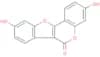
CAS 479-13-0
:Coumestrol
Beschreibung:
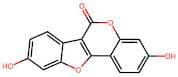
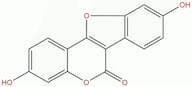
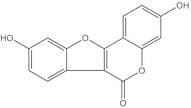
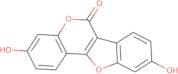
Coumestrol ist ein natürlich vorkommendes Phytoöstrogen, das als Coumestan klassifiziert wird, eine Art von Flavonoid. Es kommt hauptsächlich in verschiedenen Hülsenfrüchten vor, insbesondere in Luzerne und Klee. Coumestrol zeigt östrogene Aktivität, was bedeutet, dass es an Östrogenrezeptoren binden und die Wirkungen von Östrogen im Körper nachahmen kann, was sowohl für die Pflanzenbiologie als auch für potenzielle gesundheitliche Auswirkungen beim Menschen von Bedeutung ist. Die chemische Struktur von Coumestrol weist ein fusioniertes Benzopyran-Ringsystem auf, das zu seiner biologischen Aktivität beiträgt. Es wird oft auf seine potenzielle Rolle bei der Modulation der hormonellen Aktivität und seinen Auswirkungen auf die reproduktive Gesundheit untersucht. Darüber hinaus wurde Coumestrol auf seine antioxidativen Eigenschaften und potenziellen schützenden Wirkungen gegen bestimmte Krankheiten untersucht. Seine Löslichkeitseigenschaften deuten typischerweise darauf hin, dass es in organischen Lösungsmitteln besser löslich ist als in Wasser, was seine Bioverfügbarkeit und Interaktion innerhalb biologischer Systeme beeinflusst. Insgesamt stellt Coumestrol eine interessante Verbindung sowohl in der Ernährungswissenschaft als auch in der Pharmakologie dar, aufgrund seiner vielfältigen biologischen Aktivitäten.
Formel:C15H8O5
InChl:InChI=1S/C15H8O5/c16-7-1-3-9-11(5-7)19-14-10-4-2-8(17)6-12(10)20-15(18)13(9)14/h1-6,16-17H
InChI Key:InChIKey=ZZIALNLLNHEQPJ-UHFFFAOYSA-N
SMILES:O=C1C2=C(C=3C(O1)=CC(O)=CC3)OC=4C2=CC=C(O)C4
Synonyme:- 2-(2,4-Dihydroxyphenyl)-6-hydroxy-3-benzofurancarboxylic acid δ-lactone
- 3,9-Dihydroxy-6H-benzofuro(3,2-c)(1)benzopyran-6-one
- 3,9-Dihydroxy-[1]benzofuro[3,2-c]chromen-6-one
- 3,9-dihydroxy-6H-[1]benzofuro[3,2-c]chromen-6-one
- 3-Benzofurancarboxylic acid, 2-(2,4-dihydroxyphenyl)-6-hydroxy-, delta-lactone (6CI)
- 3-Benzofurancarboxylic acid, 2-(2,4-dihydroxyphenyl)-6-hydroxy-, δ-lactone
- 6H-Benzofuro(3,2-c)(1)benzopyran-6-one, 3,9-dihydroxy-
- Brn 0266702
- Ccris 7311
- Coumesterol
- Cumoesterol
- Cumoestrol
- Cumostrol
- Nsc 22842
- Weitere Synonyme anzeigen
Sortieren nach
Reinheit (%)
0
100
|
0
|
50
|
90
|
95
|
100
10 Produkte.
Coumestrol
CAS:Coumestrol analytical standard provided with w/w absolute assay, to be used for quantitative titration.Formel:C15H8O5Reinheit:(HPLC) ≥98%Farbe und Form:PowderMolekulargewicht:268.233,9-Dihydroxy-6H-[1]benzofuro[3,2-c]chromen-6-one
CAS:Formel:C15H8O5Reinheit:98%Farbe und Form:SolidMolekulargewicht:268.2210Coumestrol
CAS:Coumestrol in soybeans inhibits ES2 cell growth (IC50: 50 μM) and combats neurological issues, cancer, and autoimmunity.Formel:C15H8O5Reinheit:96.23% - 99.23%Farbe und Form:SolidMolekulargewicht:268.22Coumestrol
CAS:LactoneFormel:C15H8O5Reinheit:≥ 90.0 % (HPLC)Farbe und Form:PowderMolekulargewicht:268.22Coumestrol
CAS:Kontrolliertes ProduktApplications This compound has estrogenic activity. It exhibits bright blue fluorescence in neutral or acid solution, and greenish-yellow fluorescence in strong alkali solution.
References Wolfbeis, O.S. & K. Schaffner: Photochem. Photobiol., 32, 143(1980), Bickoff et al.: J.Am. Chem Soc. 80, 3969 (1958)Formel:C15H8O5Farbe und Form:NeatMolekulargewicht:268.22Coumestrol
CAS:Coumestrol is a phytoestrogen compound, which is a naturally occurring compound found in a variety of plants, such as soybeans, clover, and alfalfa. It is derived from the metabolic processes within these plants. Coumestrol exhibits estrogenic activity, acting as an agonist for estrogen receptors. This biological activity enables coumestrol to mimic the action of endogenous estrogens, thereby influencing estrogen-responsive pathways.Formel:C15H8O5Reinheit:Min. 95%Farbe und Form:PowderMolekulargewicht:268.22 g/mol

![3,9-Dihydroxy-6H-[1]benzofuro[3,2-c]chromen-6-one](/_next/image/?url=https%3A%2Fstatic.cymitquimica.com%2Fproducts%2FIN%2Fthumb%2FDA003IR8.jpg&w=3840&q=75)