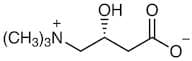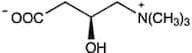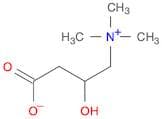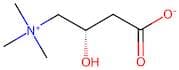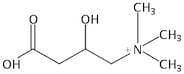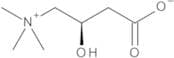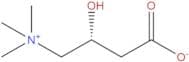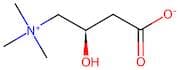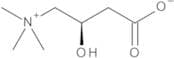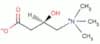
CAS 541-15-1
:(-)-Carnitin
- (-)-<span class="text-smallcaps">L</span>-Carnitine
- (-)-Carnitine
- (3R)-3-Hydroxy-4-(trimethylazaniumyl)butanoate
- (D)L-Carnitine
- (R)-(3-Carboxy-2-hydroxypropyl)trimethylammoniumhydroxid
- (R)-(3-carboxy-2-hydroxypropyl)trimethylammonium hydroxide
- (R)-Carnitine
- 1-Butanaminium, 2,4-dihydroxy-N,N,N-trimethyl-4-oxo-, inner salt, (2R)-
- 1-Propanaminium, 3-carboxy-2-hydroxy-N,N,N-trimethyl-, hydroxide, inner salt, (R)-
- 1-Propanaminium, 3-carboxy-2-hydroxy-N,N,N-trimethyl-, inner salt, (2R)-
- 1-Propanaminium, 3-carboxy-2-hydroxy-N,N,N-trimethyl-, inner salt, (R)-
- 3-Hydroxy-4-(trimethylammonio)butanoate
- <span class="text-smallcaps">L</span>-Carnipure
- Aminocarnifarm
- Ammonium Hydroxide Inner Salt, 1-(3-Carboxy-2-Hydroxypropyl)Trimethyl-2R-
- Ammonium, (3-carboxy-2-hydroxypropyl)trimethyl-, hydroxide, inner salt, <span class="text-smallcaps">L</span>-
- Ammonium, (3-carboxy-2-hydroxypropyl)trimethyl-, hydroxide, inner salt, L-
- Carniking
- Carniking 50
- Carnil
- Carnilean
- Carnipass
- Carnipass 20
- Carnitene
- Carnitor
- Carnivit
- Coaxel
- L-Carnipure
- L-Carnitine Base
- Levocarnitine
- Levocarnitinep
- Natrulon RC
- St 198
- Vitamin B<sub>T</sub>
- Vitamin BT
- hidroxido de (R)-(3-carboxi-2-hidroxipropil)trimetilamonio
- Weitere Synonyme anzeigen
L-Carnitine
CAS:Formel:C7H15NO3Reinheit:>98.0%(T)(HPLC)Farbe und Form:White to Almost white powder to crystalMolekulargewicht:161.20L-Carnitine, 98+%
CAS:L-Carnitine is widely used as a nutritional supplement in food and beverage industries. It is used as a food additive. It acts as a cyanide antidote. It is also used in reversing and preventing hyperthyroid symptoms. It is a vitamin-like nutrient, which plays an important role in human metabolism.Formel:C7H15NO3Reinheit:98+%Farbe und Form:White, Crystals or powder or crystalline powderMolekulargewicht:161.20Levocarnitine
CAS:Quaternary ammonium salts and hydroxides, whether or not chemically defined, otherFormel:C7H15NO3Farbe und Form:White PowderMolekulargewicht:161.10519(3R)-3-hydroxy-4-(trimethylazaniumyl)butanoate
CAS:Formel:C7H15NO3Reinheit:%Farbe und Form:SolidMolekulargewicht:161.1989L-Carnitine
CAS:L-Carnitine aids fatty acid oxidation in mitochondria for energy, excluding the brain.Formel:C7H15NO3Reinheit:99.29% - 99.94%Farbe und Form:White Crystalline Hygroscopic Powder SolidMolekulargewicht:161.20L-Carnitin 100 µg/mL in Acetonitrile
CAS:Formel:C7H15NO3Farbe und Form:Single SolutionMolekulargewicht:161.20Carnitine Chloride Impurity 6
CAS:Formel:C7H14ClN2·ClFarbe und Form:White To Off-White SolidMolekulargewicht:161.65 35.45L-Carnitine, USP grade
CAS:Formel:C7H15NO3Reinheit:D-carnitine: ≤ 0.2%Farbe und Form:White crystalline powderMolekulargewicht:161.20(3R)-(-)-3-Hydroxy-4-(trimethylammonio)butanoate
CAS:(3R)-(-)-3-Hydroxy-4-(trimethylammonio)butanoateFormel:C7H15NO3Reinheit:98%Farbe und Form: white solidMolekulargewicht:161.1989g/molL-Carnitine
CAS:Stability Hygroscopic
Applications Essential cofactor of fatty acid metabolism; required for the transport of fatty acids through the inner mitochondrial membrane. Synthetized primarily in the liver and kidney; highest concentrations found in heart and skeletal muscle. Dietary sources include red meat, dairy products, beans, avocado.
References Mitchell, M.E., et al.: Am. J. Clin. Nutr., 31, 293 (1978), Lango, R., et al.: Cardiovasc. Res., 51, 21 (2001), Vaz, F.M., et al.: Biochem. J., et al.: 361, 417 (2002), Karlic, H., et al.: Nutrition, 20, 709 (2004),Formel:C7H15NO3Farbe und Form:NeatMolekulargewicht:161.2L-Carnitine
CAS:Formel:C7H15NO3Reinheit:95+%Farbe und Form:Solid, CrystallineMolekulargewicht:161.201Carnitine Methoxymethyl Ester Chloride Salt
CAS:Kontrolliertes ProduktApplications Carnitine Methoxymethyl Ester Chloride Salt is an analog of Carnitine (C184110), an essential cofactor for the metabolism of fatty acids.
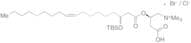
Formel:C9H20NO4·ClFarbe und Form:NeatMolekulargewicht:241.7123-tert-Butyldimethylsilyloxyoleyl Carnitine Ester (Mixture of Chloride and Bromide Salts)
CAS:Kontrolliertes ProduktApplications 3-tert-Butyldimethylsilyloxyoleyl Carnitine Ester (Mixture of Chloride and Bromide Salts) is an analog of Carnitine (C184110), an essential cofactor for the metabolism of fatty acids.
Formel:C31H62NO5SiBrorClFarbe und Form:NeatMolekulargewicht:670.32692