CAS 57-44-3
:Barbital
Beschreibung:
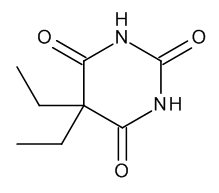
Barbital, mit der CAS-Nummer 57-44-3, ist ein Barbiturat, das historisch als Sedativum und hypnotisches Mittel verwendet wurde. Es handelt sich um ein weißes kristallines Pulver, das in Wasser und Alkohol löslich ist, was es für verschiedene pharmazeutische Formulierungen geeignet macht. Chemisch wird Barbital als Derivat der 5-Ethyl-5-isobutylbarbitursäure klassifiziert, was zu seinen pharmakologischen Eigenschaften beiträgt. Die Substanz wirkt hauptsächlich als Depressivum des zentralen Nervensystems, indem sie die Wirkung des Neurotransmitters Gamma-Aminobuttersäure (GABA) am GABA-A-Rezeptor verstärkt, was zu sedierenden und anxiolytischen Effekten führt. Während Barbital einst weit verbreitet verschrieben wurde, ist die Verwendung aufgrund der Entwicklung sichererer Alternativen und Bedenken hinsichtlich Abhängigkeit und Überdosierung zurückgegangen. Es ist wichtig zu beachten, dass Barbital in vielen Jurisdiktionen eine kontrollierte Substanz ist, was auf ihr Missbrauchspotenzial und die Notwendigkeit einer sorgfältigen Regulierung im medizinischen Kontext hinweist.
Formel:C8H12N2O3
InChl:InChI=1S/C8H12N2O3/c1-3-8(4-2)5(11)9-7(13)10-6(8)12/h3-4H2,1-2H3,(H2,9,10,11,12,13)
InChI Key:InChIKey=FTOAOBMCPZCFFF-UHFFFAOYSA-N
SMILES:C(C)C1(CC)C(=O)NC(=O)NC1=O
Synonyme:- 5,5-DiEthylpyrimidine-2,4,6-trione
- 5,5-Diethyl-2,4,6(1H,3H,5H)-pyrimidinetrione
- 5,5-Diethylbarbituric acid
- 5,5-Diethylhexahydropyrimidine-2,4,6-trione
- Barbital
- Barbitone
- Barbiturate Acid, Diethyl-
- Barbituric acid, 5,5-diethyl-
- Deba
- Diemal
- Diethylbarbitone
- Diethylbarbituric acid
- Diethylmalonylurea
- Dormonal
- Ethylbarbital
- Hypnogene
- Malonal
- Nsc 31352
- Sedeval
- Uronal
- Veroletten
- Veronal
- Veronal acetate
- Vesperal
- Weitere Synonyme anzeigen
Filtern nach
Reinheitsanteil
0
100
|
0
|
50
|
90
|
95
|
100
10 Produkte gefunden.
- Niedrigster Preis
- Höchster Preis
- Niedrigste Reinheit
- Höchste Reinheit
- Schnellste Lieferung
Barbital-d5 (ethyl-d5)
CAS:Kontrolliertes ProduktReinheit:99 atom % DFarbe und Form:White SolidMolekulargewicht:189.22Barbital, 1mg/ml in Methanol
CAS:Kontrolliertes ProduktFormel:C8H12N2O3Farbe und Form:ColourlessMolekulargewicht:184.19Barbital 1.0 mg/ml in Methanol
CAS:Kontrolliertes ProduktFormel:C8H12N2O3Farbe und Form:ColourlessMolekulargewicht:184.19Barbital 0.1 mg/ml in Methanol
CAS:Kontrolliertes ProduktFormel:C8H12N2O3Farbe und Form:ColourlessMolekulargewicht:184.19Barbital
CAS:Kontrolliertes ProduktApplications Prototype of the barbiturate hypnotics.
References Kholod, Y., et al.: Environ. Sci. Technol., 43, 9208 (2009), Yu, J., et al.: Pharm. Res., 27, 457 (2010), Fourches, D., et al.: Chem. Res. Toxicol., 23, 171 (2010),Formel:C8H12N2O3Farbe und Form:NeatMolekulargewicht:184.19Barbital (1 mg/ml in Acetonitrile)
CAS:Kontrolliertes ProduktFormel:C8H12N2O3Farbe und Form:Single SolutionMolekulargewicht:184.19Barbital
CAS:Kontrolliertes ProduktBarbital is a barbiturate that has been used in the treatment of epilepsy, insomnia, and as a sedative. Barbital has been shown to have significant cytotoxicity against human serum. It also inhibits the synthesis of p-hydroxybenzoic acid by competing with the enzyme amide hydrolase. The fluorescence properties of barbital can be used to measure 5-HT concentrations in biological studies. Barbital is an inhibitor molecule for enzymes such as monoamine oxidase, which are found in the brain and other organs. The monosodium salt form of barbital is more soluble than other forms and has a lower toxicity level than other barbiturates.Formel:C8H12N2O3Reinheit:Min. 95%Molekulargewicht:184.19 g/mol