CAS 58-85-5
:Biotin
Beschreibung:
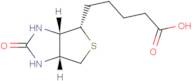
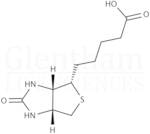
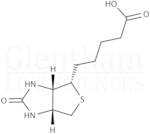
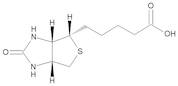
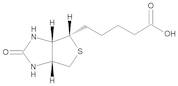
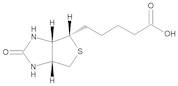
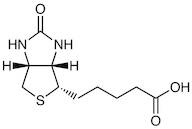
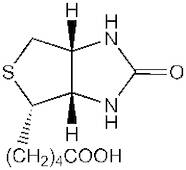
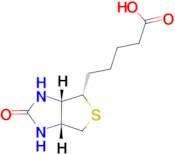
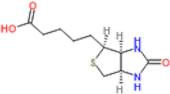
Biotin, auch bekannt als Vitamin B7 oder Vitamin H, ist ein wasserlösliches B-Vitamin, das eine entscheidende Rolle in verschiedenen Stoffwechselprozessen spielt, insbesondere im Stoffwechsel von Kohlenhydraten, Fetten und Proteinen. Es ist essentiell für die Synthese von Fettsäuren und die Produktion von Glukose, was es für den Energiestoffwechsel lebenswichtig macht. Biotin wirkt als Coenzym für mehrere Carboxylase-Enzyme und erleichtert wichtige biochemische Reaktionen. Die Substanz kommt typischerweise in Lebensmitteln wie Eiern, Nüssen, Samen und bestimmten Gemüsesorten vor und ist auch als Nahrungsergänzungsmittel erhältlich. Ein Mangel an Biotin, obwohl selten, kann zu Symptomen wie Haarausfall, Hautausschlägen und neurologischen Problemen führen. In Bezug auf seine chemische Struktur enthält Biotin einen Ureido-Ring, ein Schwefelatom und eine Valeriansäure-Seitenkette, die zu seiner biologischen Aktivität beiträgt. Die CAS-Nummer 58-85-5 identifiziert Biotin eindeutig in chemischen Datenbanken und unterstützt dessen Erkennung und Untersuchung in verschiedenen wissenschaftlichen und medizinischen Kontexten.
Formel:C10H16N2O3S
InChl:InChI=1/C10H16N2O3S/c13-8(14)4-2-1-3-7-9-6(5-16-7)11-10(15)12-9/h6-7,9H,1-5H2,(H,13,14)(H2,11,12,15)/p-1/t6-,7-,9+/m0/s1
InChI Key:InChIKey=YBJHBAHKTGYVGT-ZKWXMUAHSA-N
SMILES:C(CCCC(O)=O)[C@H]1[C@@]2([C@@](NC(=O)N2)(CS1)[H])[H]
Synonyme:- (+)-Biotin
- (+)-cis-Hexahydro-2-oxo-1H-thieno[3,4]imidazole-4-valeric acid
- (3aS,4S,6aR)-Hexahydro-2-oxo-1H-thieno[3,4-d]imidazole-4-pentanoic acid
- 1H-THIENO(3,4-D)IMIDAZOLE-4-PENTANOIC ACID, HEXAHYDRO-2-OXO-, (3AS-(3A,alpha.,4β,6Aα)
- 1H-Thieno[3,4-d]imidazole-4-pentanoic acid, hexahydro-2-oxo-, [3aS-(3aα,4β,6aα)]-
- 5-((3aS,4S,6aR)-2-Oxohexahydro-1H-thieno[3,4-d]imidazol-4-yl)pentanoic acid
- 5-(3AS,4S,5AR)-HEXAHYDRO-2-OXO-1H-THINO(3,4)- DIIMIDAZOL-4-YL) (3aS,4S,6aR)-
- <span class="text-smallcaps">D</span>(+)-Biotin
- Biodermatin
- Bioepiderm
- Bios II
- Biotin, D-
- Biotina
- Biotine
- Coenzyme R
- D(+)-Biotin
- Factor S
- Factor S (vitamin)
- Lutavit H2
- Lutavit H<sub>2</sub>
- Md 1003
- Medebiotin
- Meribin
- Nsc 63865
- Rovimix H 2
- Vitamin B7
- Vitamin B<sub>7</sub>
- Vitamin H
- Vitamin I
- [3aS-(3aα,4β,6aα)]-Hexahydro-2-oxo-1H-thieno[3,4-d]imidazole-4-pentanoic acid
- cis-(+)-Tetrahydro-2-oxothieno[3,4]imidazoline-4-valeric acid
- 5-[(3aR,4S,6aS)-2-oxohexahydro-1H-thieno[3,4-d]imidazol-4-yl]pentanoic acid
- D-Biotin(Vitamin H)
- 5-[(3aR,4S,6aR)-2-oxohexahydro-1H-thieno[3,4-d]imidazol-4-yl]pentanoate
- 5-[(3aR,4S,6aS)-2-oxohexahydro-1H-thieno[3,4-d]imidazol-4-yl]pentanoate
- Hexahydro-2-oxo-1H-thieno[3,4-d]imidazole-4-pentanoic acid
- 5-(2-oxohexahydro-1H-thieno[3,4-d]imidazol-4-yl)pentanoic acid
- Vitamin H (D-Biotin)
- D-biotin(VH)
- VH
- D-Biotin pure
- 5-[(3aS,4S,6aS)-2-oxohexahydro-1H-thieno[3,4-d]imidazol-4-yl]pentanoate
- 5-[(3aS,4S,6aR)-2-oxohexahydro-1H-thieno[3,4-d]imidazol-4-yl]pentanoate
- 1H-Thieno[3,4-d]imidazole-4-pentanoic acid, hexahydro-2-oxo-, (3aS,4S,6aR)-
- BIOS H
- BIOTINUM
- CIS-HEXAHYDRO-2-OXO-1H-THIENE[3,4]IMIDAZOLE-4-VALERIC ACID
- D-CIS-HEXAHYDRO-2-OXO-1H-THIENO[3,4-D]IMIDAZOLE-4-PENTANOIC ACID
- PHOTOPROBE(R) BIOTIN
- BIOTIN(V-H)
- RONACARE(TM) BIOTIN PLUS
- BIOTIN, IMMOBILIZED ON DEXTRAN-LYSINE
- 5-((3AR,6S,6AS)-2-OXO-HEXAHYDRO-THIENO[3,4-D]IMIDAZOL-6-YL)-PENTANOIC ACID
- Weitere Synonyme anzeigen
Filtern nach
Reinheitsanteil
0
100
|
0
|
50
|
90
|
95
|
100
- Niedrigster Preis
- Höchster Preis
- Niedrigste Reinheit
- Höchste Reinheit
- Schnellste Lieferung
Biotin
CAS:Formel:C10H16N2O3SReinheit:>98.0%(T)Farbe und Form:White to Almost white powder to crystalMolekulargewicht:244.31D-(+)-Biotin, 98+%
CAS:Biotin is a form of vitamin B that helps the body to break down fats and carbohydrates. It is used as an alternative medicine to treat or prevent biotin deficiency, which is caused by malnutrition, rapid weight loss, long-term tube feeding and other medical conditions. It is an essential vitamin whiFormel:C10H16N2O3SReinheit:98+%Farbe und Form:White to pale cream, Crystals or powder or crystalline powderMolekulargewicht:244.31D-Biotin
CAS:M02926 - D-Biotin
Formel:C10H16N2O3SReinheit:>98%Farbe und Form:SolidMolekulargewicht:244.31Biotin
CAS:Other vitamins and their derivatives, nesoiFormel:C10H16N2O3SFarbe und Form:White Colorless Crystalline PowderMolekulargewicht:244.088161H-Thieno[3,4-d]imidazole-4-pentanoic acid, hexahydro-2-oxo-, (3aS,4S,6aR)-
CAS:Formel:C10H16N2O3SReinheit:98%Farbe und Form:SolidMolekulargewicht:244.3106Ref: IN-DA00398F
1g20,00€5g28,00€10g31,00€25g50,00€50g73,00€100g107,00€250g200,00€500g352,00€1kg521,00€5kg1.682,00€D-(+)-Biotin
CAS:D-(+)-BiotinFormel:C10H16N2O3SReinheit:98%Farbe und Form:White Solid-PowderMolekulargewicht:244.31064Biotin
CAS:Biotin (Vitamin H) is a water-soluble B-vitamin and is necessary for cell growth, the production of fatty acids, and the metabolism of fats and amino acids.Formel:C10H16N2O3SReinheit:98.02% - ≥98%Farbe und Form:White SolidMolekulargewicht:244.311D-(+)-Biotin, 98%
CAS:Formel:C10H16N2O3SReinheit:(Titration) ≥ 98.0%Farbe und Form:White to off-white powderMolekulargewicht:244.32D(+)-Biotin BioChemica
CAS:D(+)-Biotin BioChemicaFormel:C10H16N2O3SReinheit:Heavy metals (as pb) - (Typical Value in Batch COA)Farbe und Form:SolidMolekulargewicht:244.31064D-(+)-Biotin, USP grade
CAS:Formel:C10H16N2O3SReinheit:(Titration) 97.5 - 100.5 %Farbe und Form:White to off-white powderMolekulargewicht:244.32D-(+)-Biotin, EP, USP grade
CAS:Formel:C10H16N2O3SReinheit:99.0 - 101.0 % (dried basis)Farbe und Form:White to almost white crystalline powderMolekulargewicht:244.32D-Biotin 10 µg/mL in Acetonitrile
CAS:Formel:C10H16N2O3SFarbe und Form:Single SolutionMolekulargewicht:244.31Biotin (Standard)
CAS:Biotin (Standard) is an analytical standard. As Vitamin B7 and a critical coenzyme, it is essential for fatty acid synthesis, gluconeogenesis, and amino acid metabolism; used in nutrition, metabolism, and bioconjugation research.Formel:C10H16N2O3SMolekulargewicht:244.311Biotin
CAS:Applications Biotin is a growth factor present in minute amounts in every living cell. Plays an indispensable role in numerous naturally occurring carboxylation reactions. Occurs mainly bound to proteins or polypeptides. The richest sources are liver, kidney, pancreas, yeast, and milk. The biotin content of cancerous tumors is higher than that of normal tissue.
References du Vigneaud, et al.: J. Biol. Chem., 146, 475 (1942); Traub, et al.: Nature, 178, 649 (1956); Siegel, H., et al.: Experienta, 37, 789 (1981); Vesely, D.L., Science, 216, 1329 (1982); Hugues, M., et al.: Biochemistry, 31, 12 (1992);Formel:C10H16N2O3SFarbe und Form:NeatMolekulargewicht:244.31






![1H-Thieno[3,4-d]imidazole-4-pentanoic acid, hexahydro-2-oxo-, (3aS,4S,6aR)-](https://static.cymitquimica.com/products/IN/thumb/DA00398F.jpg)