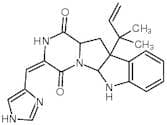
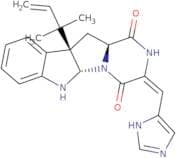
CAS 58735-64-1
:Roquefortin
Beschreibung:
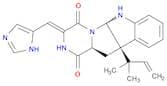
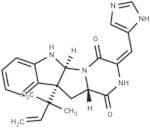
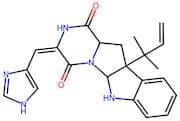
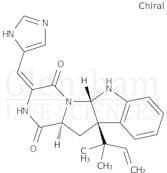
Roquefortin ist ein Mykotoxin, das von bestimmten Pilzarten produziert wird, insbesondere von solchen, die zur Gattung Penicillium gehören, die häufig mit der Reifung von Blauschimmelkäse wie Roquefort assoziiert werden. Diese Verbindung ist durch ihre komplexe molekulare Struktur gekennzeichnet, die ein bicyclisches System und mehrere funktionelle Gruppen umfasst, die zu ihrer biologischen Aktivität beitragen. Roquefortin weist neurotoxische Eigenschaften auf und wurde auf seine potenziellen Auswirkungen auf das zentrale Nervensystem untersucht. Es ist bekannt, dass es antimikrobielle Aktivität hat, die das Wachstum verschiedener Mikroorganismen beeinflussen kann. Die Substanz kommt typischerweise in niedrigen Konzentrationen in kontaminierten Lebensmitteln vor, und ihre Anwesenheit wird aufgrund von Gesundheitsbedenken im Zusammenhang mit Mykotoxinen überwacht. Regulierungsbehörden setzen oft Grenzen für zulässige Gehalte solcher Verbindungen in Lebensmitteln, um die Sicherheit der Verbraucher zu gewährleisten. Insgesamt spielt Roquefortin zwar eine Rolle im Geschmacksprofil bestimmter Käsesorten, jedoch erfordern seine toxikologischen Implikationen eine sorgfältige Berücksichtigung bei der Bewertung der Lebensmittelsicherheit.
Formel:C22H23N5O2
InChl:InChI=1S/C22H23N5O2/c1-4-21(2,3)22-10-17-18(28)25-16(9-13-11-23-12-24-13)19(29)27(17)20(22)26-15-8-6-5-7-14(15)22/h4-9,11-12,17,20,26H,1,10H2,2-3H3,(H,23,24)(H,25,28)/b16-9+/t17-,20-,22+/m0/s1
InChI Key:InChIKey=SPWSUFUPTSJWNG-JJUKSXGLSA-N
SMILES:C(C=C)(C)(C)[C@]12[C@](N3[C@@](C1)(C(=O)N\C(=C\C4=CN=CN4)\C3=O)[H])(NC=5C2=CC=CC5)[H]
Synonyme:- (-)-Roquefortine C
- (3E,5aS,10bR,11aS)-10b-(1,1-Dimethyl-2-propen-1-yl)-6,10b,11,11a-tetrahydro-3-(1H-imidazol-5-ylmethylene)-2H-pyrazino[1′,2′:1,5]pyrrolo[2,3-b]indole-1,4(3H,5aH)-dione
- (3Z)-10b-(1,1-dimethylprop-2-en-1-yl)-3-(1H-imidazol-5-ylmethylidene)-6,10b,11,11a-tetrahydro-2H-pyrazino[1',2':1,5]pyrrolo[2,3-b]indole-1,4(3H,5aH)-dione
- (3Z,5aS,10bR,11aS)-10b-(1,1-dimethylprop-2-en-1-yl)-3-(1H-imidazol-5-ylmethylidene)-6,10b,11,11a-tetrahydro-2H-pyrazino[1',2':1,5]pyrrolo[2,3-b]indole-1,4(3H,5aH)-dione
- 2H-Pyrazino[1′,2′:1,5]pyrrolo[2,3-b]indole-1,4(3H,5aH)-dione, 10b-(1,1-dimethyl-2-propen-1-yl)-6,10b,11,11a-tetrahydro-3-(1H-imidazol-5-ylmethylene)-, (3E,5aS,10bR,11aS)-
- 2H-Pyrazino[1′,2′:1,5]pyrrolo[2,3-b]indole-1,4(3H,5aH)-dione, 10b-(1,1-dimethyl-2-propenyl)-6,10b,11,11a-tetrahydro-3-(1H-imidazol-4-ylmethylene)-, (3E,5aS,10bR,11aS)-
- NSC 292134
- Roquefortin
- Roquefortine
- Rorifone 95%
Sortieren nach
Reinheit (%)
0
100
|
0
|
50
|
90
|
95
|
100
7 Produkte.
Roquefortin C
CAS:Formel:C22H23N5O2Reinheit:93.76%Farbe und Form:Yellowish amorphous solidMolekulargewicht:389.0(3E,5aS,10bR,11aS)-10b-(1,1-Dimethyl-2-propen-1-yl)-6,10b,11,11a-tetrahydro-3-(1H-imidazol-5-ylmethylene)-2H-pyrazino[1′,2′:1,5]pyrrolo[2,3-b]indole-1,4(3H,5aH)-dione
CAS:Formel:C22H23N5O2Reinheit:98%Farbe und Form:SolidMolekulargewicht:389.4503Roquefortine C
CAS:Roquefortine C is a fungal cyclopeptide isolated from Penicillium roquefortii, activates P-gp and also inhibits P450-3A and other haemoproteinsFormel:C22H23N5O2Reinheit:98%Farbe und Form:SolidMolekulargewicht:389.45Roquefortine C
CAS:Roquefortine CFormel:C22H23N5O2Reinheit:By hplc: 98.67% (Typical Value in Batch COA)Farbe und Form: slightly yellow powderMolekulargewicht:389.45g/molRoquefortine C
CAS:Applications Roquefortine C is a potent neurotoxin produced most notably by Penicillium species.
Not a dangerous good if item is equal to or less than 1g/ml and there is less than 100g/ml in the packageFormel:C22H23N5O2Farbe und Form:Off-WhiteMolekulargewicht:389.45Roquefortine C
CAS:Roquefortine C is a mycotoxin, which is a secondary metabolite produced by certain fungal species. It primarily originates from Penicillium fungi, notably within the species used in the production of blue cheeses like Roquefort. As a neurotoxic compound, Roquefortine C functions by inhibiting certain neurotransmitter receptors and ion channels, potentially interfering with normal neuronal communication.
Reinheit:Min. 95%