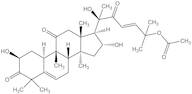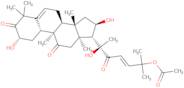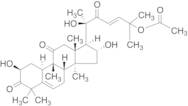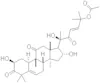
CAS 6199-67-3
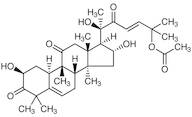
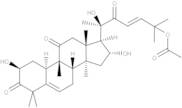
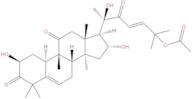
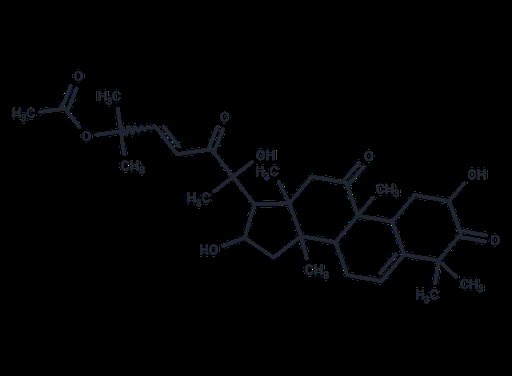
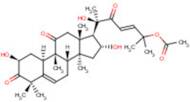
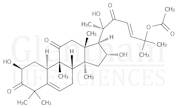
:(+)-Cucurbitacin B
Formel:C32H46O8
InChl:InChI=1S/C32H46O8/c1-17(33)40-27(2,3)13-12-23(36)32(9,39)25-21(35)15-29(6)22-11-10-18-19(14-20(34)26(38)28(18,4)5)31(22,8)24(37)16-30(25,29)7/h10,12-13,19-22,25,34-35,39H,11,14-16H2,1-9H3/b13-12+/t19-,20+,21-,22+,25+,29+,30-,31+,32+/m1/s1
InChI Key:InChIKey=IXQKXEUSCPEQRD-DKRGWESNSA-N
SMILES:C[C@]12[C@@](C)([C@@]([C@@](C(/C=C/C(OC(C)=O)(C)C)=O)(C)O)([C@H](O)C1)[H])CC(=O)[C@]3(C)[C@]2(CC=C4[C@]3(C[C@H](O)C(=O)C4(C)C)[H])[H]
Synonyme:- (23E)-2,16,20-trihydroxy-9,10,14-trimethyl-1,11,22-trioxo-4,9-cyclo-9,10-secocholesta-5,23-dien-25-yl acetate
- (2S,4R,9beta,16alpha)-2,16,20-trihydroxy-9,10,14-trimethyl-1,11,22-trioxo-4,9-cyclo-9,10-secocholesta-5,23-dien-25-yl acetate
- (2S,4R,9beta,16alpha,17xi,23E)-2,16,20-trihydroxy-9,10,14-trimethyl-1,11,22-trioxo-4,9-cyclo-9,10-secocholesta-5,23-dien-25-yl acetate
- (2S,4R,9beta,16alpha,23E)-2,16,20-trihydroxy-9,10,14-trimethyl-1,11,22-trioxo-4,9-cyclo-9,10-secocholesta-5,23-dien-25-yl acetate
- (2β,9β,10α,16α,23E)-25-(Acetyloxy)-2,16,20-trihydroxy-9-methyl-19-norlanosta-5,23-diene-3,11,22-trione
- 19-Nor-9β,10α-lanosta-5,23-diene-3,11,22-trione, 2β,16α,20,25-tetrahydroxy-9-methyl-, 25-acetate
- 19-Norlanosta-5,23-diene-3,11,22-trione, 25-(acetyloxy)-2,16,20-trihydroxy-9-methyl-, (2β,9β,10α,16α,23E)-
- Amarine
- Cucurbitacine B
- Hy-N 0416
- NSC 144154
- NSC 49451
- Weitere Synonyme anzeigen
Sortieren nach
Reinheit (%)
0
100
|
0
|
50
|
90
|
95
|
100
14 Produkte gefunden.
Cucurbitacin B
CAS:Formel:C32H46O8Reinheit:>98.0%(HPLC)Farbe und Form:White to Light yellow powder to crystalMolekulargewicht:558.71Cucurbitacin B
CAS:Cucurbitacin B analytical standard provided with w/w absolute assay, to be used for quantitative titration.Formel:C32H46O8Reinheit:(HPLC) ≥95%Farbe und Form:PowderMolekulargewicht:558.72Cucurbitacin B
CAS:Cucurbitacin B (cucB) is a triterpenoid constituent of Cucurbitaceae vegetables and a promising phytochemical for cancer prevention, cucB induces G(2) arrest and apoptosis through a STAT3-independent but ROS-dependent mechanism in SW480 cells.Formel:C32H46O8Reinheit:95%~99%Farbe und Form:White powderMolekulargewicht:558.712Cucurbitacin B (Standard)
CAS:Cucurbitacin B (Standard) is a reference standard for research and analysis in studies involving Cucurbitacin B. Cucurbitacin B (Cuc B) has profound in vitro and in vivo antiproliferative effects against human pancreatic Y cells. It inhibited AKT signaling activation through up-regulation of PTEN. Cucurbitacin B is an effective inhibitor of HIF-1 and provide new perspectives into the mechanism of its anticancer activity. Cucurbitacin B inhibits proliferation and induces apoptosis via STAT3 pathway inhibition in A549 lung Y cells.Formel:C32H46O8Farbe und Form:SolidMolekulargewicht:558.70Cucurbitacin B
CAS:Cucurbitacin B (Cuc B) has profound in vitro and in vivo antiproliferative effects against human pancreatic Y cells.Formel:C32H46O8Reinheit:97.1% - 99.93%Farbe und Form:White SolidMolekulargewicht:558.70Cucurbitacin B
CAS:Formel:C32H46O8Reinheit:≥ 98.0%Farbe und Form:White to off-white powderMolekulargewicht:558.71Cucurbitacin B
CAS:(R,E)-6-((2S,8S,9R,10R,13R,14S,16R,17R)-2,16-Dihydroxy-4,4,9,13,14-pentamethyl-3,11-dioxo-2,3,4,7,8,9,10,11,12,13,14,15,16,17-tetradecahydro-1H-cyclopenta[a]phenanthren-17-yl)-6-hydroxy-2-methyl-5-oxohept-3-en-2-yl acetateFormel:C32H46O8Reinheit:99%Molekulargewicht:558.7Cucurbitacin B
CAS:Carboxylic acid with additional oxygen functionsFormel:C32H46O8Reinheit:≥ 90.0 % (HPLC)Farbe und Form:PowderMolekulargewicht:558.71Cucurbitacin B
CAS:Kontrolliertes ProduktCucurbitacin B is a triterpenoid compound, which is derived from plants primarily within the Cucurbitaceae family. This compound exhibits its mode of action through the inhibition of the JAK-STAT signaling pathway, effectively disrupting processes that are critical for cell survival and proliferation. As a result, Cucurbitacin B is being extensively studied for its antiproliferative and pro-apoptotic properties, especially in the context of cancer research.Formel:C32H46O8Reinheit:Min. 95%Farbe und Form:White PowderMolekulargewicht:558.7 g/molCucurbitacin B
CAS:Kontrolliertes ProduktApplications Cucurbitacin B is a tetracyclic triterpenoid, which can induce apoptosis in human hepatoma cells. It can also induce DNA damage and autophagy in MCF-7 breast cancer cells.In the wild, watermelons, cucumbers, and muskmelons produce bitter Cucurbitacins to defend against preditors. Humans have bred these fruits to eliminate these compounds thereby yielding fruits that are more appealing to our palate.
Not a dangerous good if item is equal to or less than 1g/ml and there is less than 100g/ml in the package
References Sun, Y., et al.: Eur. J. Pharmacol. 768, 28 (2015); Ren, G., et al.: J. Nat. Med. 69, 522 (2015); C&E News p. 10, Dec. 5, 2016jFormel:C32H46O8Farbe und Form:NeatMolekulargewicht:558.7