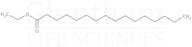
CAS 628-97-7
:Ethylpalmitat
Beschreibung:
Ethylpalmitat, mit der CAS-Nummer 628-97-7, ist ein Ester, der aus der Reaktion von Palmitinsäure und Ethanol gebildet wird. Es ist eine farblose bis blassgelbe Flüssigkeit bei Raumtemperatur, die einen milden, fettigen Geruch aufweist. Ethylpalmitat ist unlöslich in Wasser, aber löslich in organischen Lösungsmitteln wie Ethanol und Ether. Diese Verbindung ist bekannt für ihre emollienten Eigenschaften, was sie zu einer häufigen Zutat in Kosmetika und Körperpflegeprodukten macht, wo sie als hautpflegender Wirkstoff dient. Darüber hinaus wird es in der Lebensmittelindustrie als Aromastoff und in der Formulierung verschiedener Lebensmittelprodukte verwendet. Ethylpalmitat hat ein relativ niedriges Toxizitätsprofil, was zu seiner Sicherheit in Verbraucheranwendungen beiträgt. Seine chemische Struktur besteht aus einer langen Kohlenwasserstoffkette, die zu seinen hydrophoben Eigenschaften beiträgt und sein Verhalten in verschiedenen Umgebungen beeinflusst. Insgesamt wird Ethylpalmitat für seine funktionalen Eigenschaften sowohl in industriellen als auch in Verbraucheranwendungen geschätzt.
Formel:C18H36O2
InChl:InChI=1S/C18H36O2/c1-3-5-6-7-8-9-10-11-12-13-14-15-16-17-18(19)20-4-2/h3-17H2,1-2H3
InChI Key:InChIKey=XIRNKXNNONJFQO-UHFFFAOYSA-N
SMILES:C(CCCCCCCCCCCCC)CC(OCC)=O
Synonyme:- Ethyl Palmitate
- Ethyl hexadecanoate
- Ethylpalmitat
- Nsc 8918
- Palmitate d'ethyle
- Palmitate, Ethyl
- Palmitato De Etilo
- Palmitic acid, ethyl ester
- Palmitinsaeure-Aethylester
- Ethyl palmitate, (Ethyl hexadecanoate
- Palmitic aci
- Weitere Synonyme anzeigen
Sortieren nach
Reinheit (%)
0
100
|
0
|
50
|
90
|
95
|
100
16 Produkte.
Ethyl Palmitate
CAS:Formel:C18H36O2Reinheit:>97.0%(GC)Farbe und Form:White or Colorless to Light yellow powder to lump to clear liquidMolekulargewicht:284.48Ethyl palmitate, 97%
CAS:Ethyl palmitate acts as a lubricant on the skin’s surfaces in order to get a soft and smooth appearance. It increases cytosolic Ca2+ concentration leading to pancreatic acinar cell injury due to excessive consumption of ethanol. This Thermo Scientific Chemicals brand product was originally part of tFormel:CH3(CH2)14CO2CH2CH3Reinheit:97%Farbe und Form:White or clear colorless, Fused solid or liquid as meltMolekulargewicht:284.48Ethyl Palmitate
CAS:Palmitic acid, stearic acid, their salts and estrsFormel:C18H36O2Farbe und Form:SolidMolekulargewicht:284.27153Ethyl Hexadecanoate
CAS:Formel:C18H36O2Reinheit:>99%Farbe und Form:Colorless CrystalsMolekulargewicht:284.48Hexadecanoic acid-ethyl ester
CAS:Kontrolliertes ProduktFormel:C18H36O2Farbe und Form:NeatMolekulargewicht:284.48Ethyl palmitate
CAS:Ethyl palmate (palmitic acid ethyl ester) is a type of fatty acid ethyl ester (FAEE). Ethyl palmate can be used as a hair and skin conditioner.Formel:C18H36O2Reinheit:98.93% - 99.87%Farbe und Form:LiquidMolekulargewicht:284.48Ethyl Palmitate
CAS:Applications A fatty acid found in Amaranth oil; it shows inhibitory activity.
References Fidler, N., et al.: J. Lipid Res., 41, 1376 (2000), Yang, T., et al.: Food Chem., 80, 473 (2003), Gamel, T., et al.: J. Food Lipids, 14, 323 (2007),Formel:C18H36O2Farbe und Form:Off-WhiteMolekulargewicht:284.48Ethyl palmitate
CAS:Ethyl palmitate is a glycol ether that belongs to the group of esters. It has been shown to have biochemical properties and natural compounds such as caproic acid and ethyl palmitate. The liquid form of ethyl palmitate is clear, colorless, and odorless with a density of 1.065 g/mL at 20°C. Ethyl palmitate is soluble in ethanol, diethylether, benzene, chloroform, carbon tetrachloride, acetic acid ethyl ester, acetone, ethyl acetate, dichloromethane, and methanol. Ethyl palmitate can be used as a model system or analytical method for the identification of other lipids in biological samples.Formel:C18H36O2Reinheit:Min. 95%Molekulargewicht:284.48 g/mol