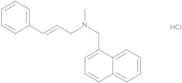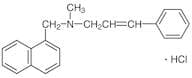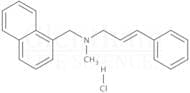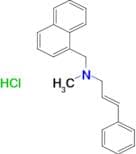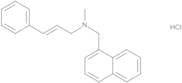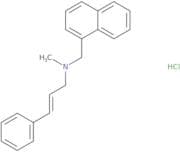
CAS 65473-14-5
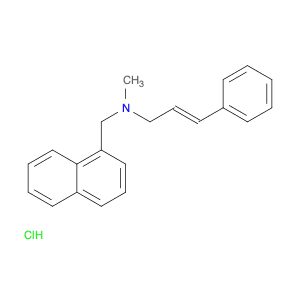
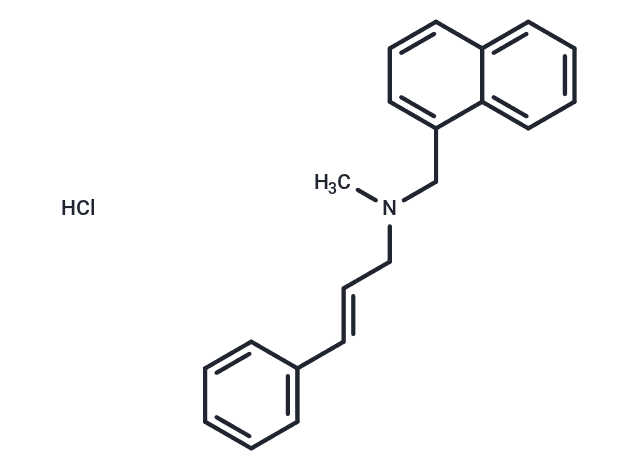
:Naftifin-Hydrochlorid
Beschreibung:
Naftifin-Hydrochlorid ist ein Antimykotikum, das hauptsächlich zur Behandlung von Dermatophyteninfektionen wie Fußpilz und Ringelflechte eingesetzt wird. Es gehört zur Klasse der Allylamine und wirkt, indem es das Enzym Squalenepoxidase hemmt, das für die Biosynthese von Ergosterol, einem wesentlichen Bestandteil der Pilzzellmembranen, entscheidend ist. Diese Störung führt zur Ansammlung von toxischem Squalen und letztendlich zum Zelltod von Pilzen. Naftifin-Hydrochlorid wird typischerweise topisch angewendet, was eine lokale Behandlung mit minimaler systemischer Absorption ermöglicht. Die Verbindung zeichnet sich durch ihre weiße bis cremefarbene kristalline Pulverform aus, mit einer relativ geringen Löslichkeit in Wasser, aber besserer Löslichkeit in organischen Lösungsmitteln. Ihre Pharmakokinetik zeigt eine verlängerte Wirkungsdauer, was sie bei einmal täglicher Anwendung wirksam macht. Sicherheitsprofile zeigen, dass es im Allgemeinen gut vertragen wird, mit wenigen Nebenwirkungen, obwohl bei einigen Patienten lokale Reizungen auftreten können. Insgesamt ist Naftifin-Hydrochlorid eine wertvolle Option in der antimykotischen Therapie, insbesondere bei oberflächlichen Hautinfektionen.
Formel:C21H21N·ClH
InChl:InChI=1S/C21H21N.ClH/c1-22(16-8-11-18-9-3-2-4-10-18)17-20-14-7-13-19-12-5-6-15-21(19)20;/h2-15H,16-17H2,1H3;1H/b11-8+;
InChI Key:InChIKey=OLUNPKFOFGZHRT-YGCVIUNWSA-N
SMILES:C(N(C/C=C/C1=CC=CC=C1)C)C=2C3=C(C=CC2)C=CC=C3.Cl
Synonyme:- (E)-N-Cinnamyl-N-methyl(1-naphthylmethyl)amine hydrochloride
- (E)-N-Cirmamyl-N-mcthyl(1一naphthylmethyl)amine hydrochloridc
- 1-Naphthalenemethanamine, N-methyl-N-(3-phenyl-2-propenyl)-, hydrochloride, (E)-
- 1-Naphthalenemethanamine, N-methyl-N-[(2E)-3-phenyl-2-propen-1-yl]-, hydrochloride (1:1)
- 1-Naphthalenemethanamine, N-methyl-N-[(2E)-3-phenyl-2-propenyl]-, hydrochloride
- Aw 105-843
- Exoderil
- Naftifine HCl
- Naftin
- Sn 105-843
- Naftifine hydrochloride
Sortieren nach
Reinheit (%)
0
100
|
0
|
50
|
90
|
95
|
100
14 Produkte.
Naftifine Hydrochloride
CAS:Aromatic monoamines not elsewhere specified or included and their derivatives, salts therofFormel:C21H21N·HClFarbe und Form:White PowderMolekulargewicht:287.1674Naftifine hydrochloride
CAS:Naftifine HCl: synthetic antifungal; inhibits squalene epoxidase, disrupting fungal cell sterol synthesis.Formel:C21H22ClNReinheit:98.75% - 99.84%Farbe und Form:SolidMolekulargewicht:323.86Naftifine-d3 HCl
CAS:Formel:C21H18D3N·HClFarbe und Form:White To Off-White SolidMolekulargewicht:290.42 36.46Naftifine Hydrochloride
CAS:Formel:C21H21N·HClReinheit:>98.0%(HPLC)Farbe und Form:White to Light yellow powder to crystalMolekulargewicht:323.86Naftifine hydrochloride
CAS:Formel:C21H21N·HClReinheit:≥ 99.0%Farbe und Form:White to off-white powderMolekulargewicht:323.86Naftifine Hydrochloride
CAS:Kontrolliertes ProduktApplications Antimycotic allylamine. An antifungal (topical) agent.
References Georgopoulos, A., et al.: Antimicrob. Ag. Chemother., 19, 386 (1981), Meingassner, J.C., et al.: J. Invest. Dermatol., 77, 444 (1981), Paltauf, F., et al.: Biochim Biophys. Acta, 712, 268 (1982), Aggarwal, D., et al.: J. Pharm. Pharmacol., 56, 1509 (2004),Formel:C21H21N·ClHFarbe und Form:NeatMolekulargewicht:323.86(E)-N-Methyl-N-(3-phenyl-2-propen-1-yl)-1-naphthalenemethanamine hydrochloride
CAS:Naphthalene-1,3-diamine is an antifungal drug that belongs to a class of phenylenediamines. It is active against some bacteria and yeasts, including Candida albicans and Aspergillus niger. Naphthalene-1,3-diamine has been shown to have in vitro activity against mycological pathogens, such as Trichophyton mentagrophytes and Microsporum canis. The drug binds to the enzyme epoxidase in the fungal cell membrane. This binding inhibits the conversion of ergosterol to ergosta-4,6-diene which leads to increased membrane permeability and leakage of cytoplasmic contents. Naphthalene-1,3-diamine also inhibits human polymorphonuclear leukocytes (PMNL) chemotaxis by blocking phosphatidylserine externalization on PMNL membranes. In vitro studies showFormel:C21H22ClNReinheit:Min. 98 Area-%Farbe und Form:White PowderMolekulargewicht:323.86 g/mol