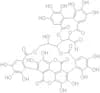
CAS 65995-63-3
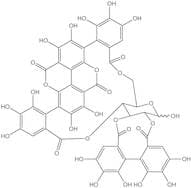
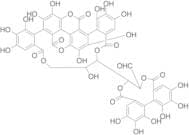
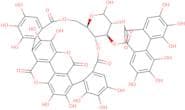
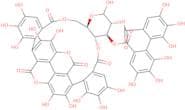
:Punicalagin
Beschreibung:
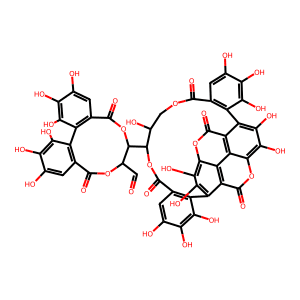
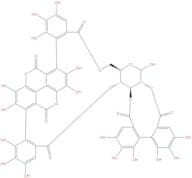
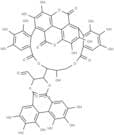
Punicalagin ist eine polyphenolische Verbindung, die hauptsächlich in Granatäpfeln vorkommt, insbesondere in der Schale und dem Saft der Frucht. Sie gehört zu einer Klasse von Verbindungen, die als Ellagitannine bekannt sind, die für ihre antioxidativen Eigenschaften bekannt sind. Punicalagin zeichnet sich durch seine Fähigkeit aus, freie Radikale zu scavengen, und trägt somit zu den gesundheitlichen Vorteilen des Granatapfelkonsums bei, wie entzündungshemmenden und potenziellen krebsbekämpfenden Wirkungen. Die Verbindung ist in Wasser löslich und weist eine komplexe Struktur auf, die mehrere Hydroxylgruppen umfasst, die ihre Reaktivität und biologische Aktivität erhöhen. Punicalagin hat in der ernährungswissenschaftlichen und pharmazeutischen Forschung Interesse geweckt, da es potenzielle therapeutische Anwendungen hat, einschließlich der kardiovaskulären Gesundheit und des Managements des metabolischen Syndroms. Darüber hinaus kann es die Zusammensetzung der Darmmikrobiota beeinflussen, was zu seinen gesundheitsfördernden Effekten beiträgt. Insgesamt ist Punicalagin eine bedeutende bioaktive Verbindung, die die gesundheitlichen Vorteile von Granatäpfeln und deren Derivaten veranschaulicht.
Formel:C48H28O30
InChl:InChI=1S/C48H28O30/c49-5-16-40(76-46(70)9-3-13(52)28(56)32(60)18(9)17-8(44(68)74-16)2-12(51)27(55)31(17)59)39-15(54)6-73-43(67)7-1-11(50)29(57)33(61)19(7)21-25-23-24-26(48(72)78-41(23)37(65)35(21)63)22(36(64)38(66)42(24)77-47(25)71)20-10(45(69)75-39)4-14(53)30(58)34(20)62/h1-5,15-16,39-40,50-66H,6H2
InChI Key:InChIKey=SKNLUADAGHCXKF-UHFFFAOYSA-N
SMILES:O=C1C=2C=3C=4C5=C(C=6C(=CC(O)=C(O)C6O)C(=O)OCC(O)C(OC(=O)C=7C(C2C(O)=C(O)C3OC5=O)=C(O)C(O)=C(O)C7)C8C(C=O)OC(=O)C=9C(C=%10C(C(=O)O8)=CC(O)=C(O)C%10O)=C(O)C(O)=C(O)C9)C(O)=C(O)C4O1
Synonyme:- 1,2,3,11,12,13-Hexahydroxy-5,10-Dioxo-8-[3,4,5,11,17,18,19,22,23,34,35-Undecahydroxy-8,14,26,31-Tetraoxo-9,13,25,32-Tetraoxaheptacyclo[25.8.0.02,7.015,20.021,30.024,29.028,33]Pentatriaconta-1(35),2,4,6,15,17,19,21,23,27,29,33-Dodecaen-10-Yl]-5,7,8,10-Tetrahydrodibenzo[F,H][1,4]Dioxecine-7-Carbaldehyde (Non-Preferred Name)
- 2,20,1,23-(Epoxy[2]propene[1,2]diyl[3]ylidene)-11H,15H-tribenzo[g,i,q][1,5,12]trioxacyclononadecin, <span class="text-smallcaps">D</span>-glucose deriv.
- <span class="text-smallcaps">D</span>-Glucose, cyclic 4,6-[(2S,2′S)-2,2′-(5,10-dihydro-2,3,7,8-tetrahydroxy-5,10-dioxo[1]benzopyrano[5,4,3-cde][1]benzopyran-1,6-diyl)bis[3,4,5-trihydroxybenzoate]] cyclic 2,3-[(1S)-4,4′,5,5′,6,6′-hexahydroxy[1,1′-biphenyl]-2,2′-dicarboxylate]
- <span class="text-smallcaps">D</span>-Glucose, cyclic 4,6-[(S,S)-2,2′-(5,10-dihydro-2,3,7,8-tetrahydroxy-5,10-dioxo[1]benzopyrano[5,4,3-cde][1]benzopyran-1,6-diyl)bis[3,4,5-trihydroxybenzoate]] cyclic 2,3-[(S)-4,4′,5,5′,6,6′-hexahydroxy[1,1′-biphenyl]-2,2′-dicarboxylate]
- <span class="text-smallcaps">D</span>-Glucose, cyclic 4,6-[2,2′-(5,10-dihydro-2,3,7,8-tetrahydroxy-5,10-dioxo[1]benzopyrano[5,4,3-cde][1]benzopyran-1,6-diyl)bis[3,4,5-trihydroxybenzoate]] cyclic 2,3-(4,4′,5,5′,6,6′-hexahydroxy[1,1′-biphenyl]-2,2′-dicarboxylate), [2(S),4(S,S)]-
- D-Glucose, cyclic 4,6-(2,2'-(5,10-dihydro-2,3,7,8-tetrahydroxy-5,10-dioxo(1)benzopyrano(5,4,3-cde)(1)benzopyran-1,6-diyl)bis(3,4,5-trihydroxybenzoate)) cyclic 2,3-(4,4',5,5',6,6'-hexahydroxy(1,1'-biphenyl)-2,2'-dicarboxylate)-, (2(S),4(S,S))-
- Dibenzo[f,h][1,4]dioxecin, <span class="text-smallcaps">D</span>-glucose deriv.
- Pomegranate extract
- Punicalagins
- D-Glucose, cyclic 4,6-[(2S,2′S)-2,2′-(5,10-dihydro-2,3,7,8-tetrahydroxy-5,10-dioxo[1]benzopyrano[5,4,3-cde][1]benzopyran-1,6-diyl)bis[3,4,5-trihydroxybenzoate]] cyclic 2,3-[(1S)-4,4′,5,5′,6,6′-hexahydroxy[1,1′-biphenyl]-2,2′-dicarboxylate]
- Dibenzo[f,h][1,4]dioxecin, D-glucose deriv.
- D-Glucose, cyclic 4,6-[2,2′-(5,10-dihydro-2,3,7,8-tetrahydroxy-5,10-dioxo[1]benzopyrano[5,4,3-cde][1]benzopyran-1,6-diyl)bis[3,4,5-trihydroxybenzoate]] cyclic 2,3-(4,4′,5,5′,6,6′-hexahydroxy[1,1′-biphenyl]-2,2′-dicarboxylate), [2(S),4(S,S)]-
- Punicalagin
- Weitere Synonyme anzeigen
Sortieren nach
Reinheit (%)
0
100
|
0
|
50
|
90
|
95
|
100
11 Produkte.
Punicalagin
CAS:Aromatic heterocyclic compounds with oxygen hetero-atom(s) only, nesoiFormel:C48H28O30Farbe und Form:Green Yellow Light Yellow PowderMolekulargewicht:1084.06654D-Glucose, cyclic4,6-[(2S,2'S)-2,2'-(5,10-dihydro-2,3,7,8-tetrahydroxy-5,10-dioxo[1]benzopyrano[5,4,3-cde][1]benzopyran-1,6-diyl)bis[3,4,5-trihydroxybenzoate]]cyclic2,3-[(S)-4,4',5,5',6,6'-hexahydroxy[1,1'-biphenyl]-2,2'-dicarboxylate]
CAS:Formel:C6H6FNReinheit:98%Farbe und Form:SolidMolekulargewicht:111.1169Punicalagin
CAS:Formel:C48H28O30Reinheit:≥ 98.0%Farbe und Form:Pale yellow to dark yellow powderMolekulargewicht:1084.72Punicalagin
CAS:Punicalagin has antifungal , antiviral, anti-atherosclerotic, hepatoprotective , anti-obesity., antiproliferative, anti-apoptotic, anti-inflammatory, and antioxidant effects. It can suppress the phosphorylation of MAPK including p38, c-JNK, and ERK, it also has potently inhibiting the activity of fatty acid synthase with half-inhibitory concentration values (IC 50 ) of 4.50μM.Formel:C48H28O30Reinheit:95%~99%Molekulargewicht:1084.72Punicalagin
CAS:Punicalagin, an ellagitannin in pomegranates, has antioxidant, anti-inflammatory, anticancer properties, and combats heart issues from high-fat diets.Formel:C48H28O30Reinheit:98% - 99.7%Farbe und Form:White Crystalline PowderMolekulargewicht:1084.72Punicalagin (a + b mixture)
CAS:Natural glycosideFormel:C48H28O30Reinheit:≥ 90.0 % (HPLC)Farbe und Form:PowderMolekulargewicht:1084.73Punicalagin
CAS:Applications Punicalagin is a natural polyphenolic compound extracted from the fruit of Pomegranate and acts as an effective anti-inflammatory and anti-oxidant.
References Xu, X. et al.: Inflamm., 37, 956 (2014); Ordoudi, S. et al.: J. Func. Food., 8, 161 (2014);Formel:C48H28O30Farbe und Form:NeatMolekulargewicht:1084.72Punicalagin - technical
CAS:Kontrolliertes ProduktPunicalagin is a hydrolyzable tannin, which is derived from the peel and seeds of pomegranates (Punica granatum). This compound is one of the primary polyphenols contributing to the fruit’s potent antioxidant capabilities. Structurally, punicalagin is distinguished by its galloyl and ellagic acid moieties, facilitating its remarkable stability and bioavailability.Formel:C48H28O30Reinheit:(%) Min. 40%Farbe und Form:PowderMolekulargewicht:1,084.72 g/molPunicalagin, (mixture of α+β) - 98% min
CAS:Kontrolliertes ProduktPunicalagin (mixture of α+β) - 98% min is a highly pure tannin-derived compound, specifically classified as an ellagitannin, known for its potent antioxidant properties. It is primarily sourced from pomegranate (Punica granatum) and several other plant species. The compound consists of isomeric forms, α and β, collectively contributing to its efficacy.Formel:C48H28O30Reinheit:Min. 98 Area-%Farbe und Form:Off-White PowderMolekulargewicht:1,084.72 g/mol


![D-Glucose, cyclic4,6-[(2S,2'S)-2,2'-(5,10-dihydro-2,3,7,8-tetrahydroxy-5,10-dioxo[1]benzopyrano[5,…](/_next/image/?url=https%3A%2Fstatic.cymitquimica.com%2Fproducts%2FIN%2Fthumb%2FDA00IKLU.jpg&w=3840&q=75)