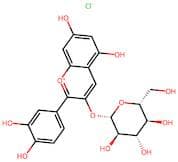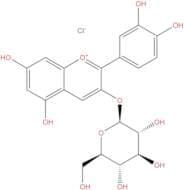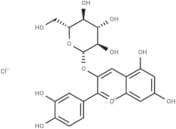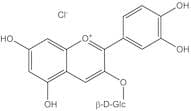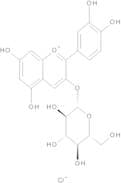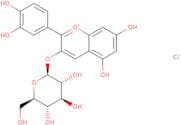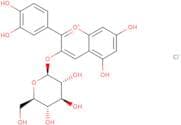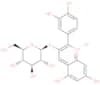
CAS 7084-24-4
:Cyanidin 3-Glucosid
Beschreibung:
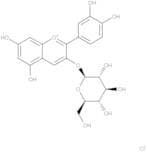
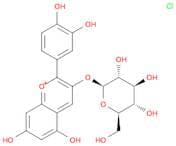
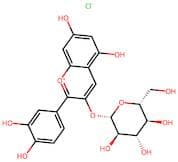
Cyanidin 3-Glucosid ist ein natürlich vorkommendes Anthocyanin, eine Art von Flavonoidpigment, das für die roten, lila und blauen Farben in vielen Früchten und Gemüse verantwortlich ist. Es kommt häufig in Beeren, rotem Kohl und anderen pflanzlichen Quellen vor. Die chemische Formel von Cyanidin 3-Glucosid ist C21H21O11, und es hat ein Molekulargewicht von etwa 449,39 g/mol. Diese Verbindung ist bekannt für ihre antioxidativen Eigenschaften, die helfen können, oxidativen Stress in biologischen Systemen zu bekämpfen. Cyanidin 3-Glucosid zeigt Löslichkeit in Wasser und ist unter sauren Bedingungen stabil, was es zu einer wertvollen Verbindung in Lebensmittel- und Getränkeanwendungen für natürliche Farbstoffe macht. Darüber hinaus wurde es auf seine potenziellen gesundheitlichen Vorteile untersucht, einschließlich entzündungshemmender und krebsbekämpfender Wirkungen. Seine CAS-Nummer, 7084-24-4, ist eine eindeutige Kennung, die bei der Klassifizierung und Regulierung chemischer Substanzen hilft. Insgesamt ist Cyanidin 3-Glucosid nicht nur für seine ästhetischen Beiträge zu Lebensmitteln von Bedeutung, sondern auch für seine potenziell gesundheitsfördernden Eigenschaften.
Formel:C21H21ClO11
InChl:InChI=1/C21H20O11/c22-7-16-17(27)18(28)19(29)21(32-16)31-15-6-10-12(25)4-9(23)5-14(10)30-20(15)8-1-2-11(24)13(26)3-8/h1-6,16-19,21-22,27-29H,7H2,(H3-,23,24,25,26)/p+1/t16-,17-,18+,19-,21-/m1/s1
InChI Key:InChIKey=YTMNONATNXDQJF-UBNZBFALSA-N
SMILES:O(C=1C(=[O+]C2=C(C1)C(O)=CC(O)=C2)C3=CC(O)=C(O)C=C3)[C@@H]4O[C@H](CO)[C@@H](O)[C@H](O)[C@H]4O.[Cl-]
Synonyme:- 1-Benzopyrylium, 2-(3,4-dihydroxyphenyl)-3-(β-<span class="text-smallcaps">D</span>-glucopyranosyloxy)-5,7-dihydroxy-, chloride
- 1-Benzopyrylium, 2-(3,4-dihydroxyphenyl)-3-(β-<span class="text-smallcaps">D</span>-glucopyranosyloxy)-5,7-dihydroxy-, chloride (1:1)
- 1-Benzopyrylium, 2-(3,4-dihydroxyphenyl)-3-(β-D-glucopyranosyloxy)-5,7-dihydroxy-, chloride
- 1-Benzopyrylium, 2-(3,4-dihydroxyphenyl)-3-(β-D-glucopyranosyloxy)-5,7-dihydroxy-, chloride (1:1)
- 2-(3,4-Dihydroxyphenyl)-3-(β-D-glucopyranosyloxy)-5,7-dihydroxy-1-benzopyryliumchlorid
- 2-(3,4-dihydroxyphenyl)-3-(β-D-glucopyranosyloxy)-5,7-dihydroxy-1-benzopyrylium chloride
- 3,3',4',5,7-Pentahydroxyflavylium chloride, 3-glucoside
- 3,3′,4′,5,7-Pentahydroxyflavylium chloride, 3-glucoside
- 3-(β-<span class="text-smallcaps">D</span>-Glucopyranosyloxy)-3′,4′,5,7-tetrahydroxyflavylium chloride
- 3-(β-D-Glucopyranosyloxy)-3',4',5,7-tetrahydroxyflavylium chloride
- 3-O-(β-<span class="text-smallcaps">D</span>-Glucopyranosyl)cyanidin
- 3-O-(β-D-Glucopyranosyl)cyanidin
- Asterin
- Chrysanthemin
- Chrysanthenin
- Chrysontemin
- Cyanidin 3-O-glucoside chloride
- Cyanidin 3-O-β-<span class="text-smallcaps">D</span>-glucopyranoside
- Cyanidin 3-O-β-D-glucopyranoside
- Cyanidin 3-O-β-glucopyranoside
- Cyanidin 3-glucoside chloride
- Cyanidin 3-monoglucoside
- Cyanidin 3-β-<span class="text-smallcaps">D</span>-glucopyranoside
- Cyanidin 3-β-D-glucopyranoside
- Cyanidin 3-β-O-glucoside
- Cyanidin 3-β-glucopyranoside
- Cyanidin 3-β-glucoside
- Cyanidin-3-Glucoside
- Cyanidol 3-glucoside
- Glucocyanidin
- Kuromanin
- Kuromanin Chloride
- Kuromanine
- chlorure de 2-(3,4-dihydroxyphenyl)-3-(β-D-glucopyrannosyloxy)-5,7-dihydroxy-1-benzopyrylium
- cloruro de 2-(3,4-dihidroxifenil)-3-(β-D-glucopiranosiloxi)-5,7-dihidroxi-1-benzopirilio
- CYANIDIN-3-O-BETA-GLUCOPYRANOSIDE
- Cyanidin-3-O-glucoside chloride, froM GlycineMax (L.) Merr.
- cyanidol3-glucoside
- Cyanidin 3-O-β-glucopyranoside chloride
- CYANIDIN3-O-BETA-D-GLUCOSIDE
- CYANIDIN-3-O-GLUCOSIDE CHLORIDE(KUROMANIN CHLORIDE)(RG)
- 2-(3,4-Dihydroxyphenyl)-3-(.beta.-D-glucopyranosyloxy)-5,7-dihydroxy-1-benzopyryliumchloride
- Cyanidin-3-O-
- glucoside chloride
- 1-benzopyrylium,5,7-dihydroxy-2-(3,4-dihydroxyphenyl)-3-(beta-d-glucopyranosyl
- C-3-G
- KUROMANIN CHLORIDE WITH HPLC
- ASTERIN hplc
- Asterin, Chrysanthemin, Cyanidin 3-O-glucoside chloride
- C3G
- KUROMANINE CHLORIDE
- cyanidin3-monoglucoside
- Cyanidin-3-O-glucoside Chloride (15 mg)
- CYANIDIN3-O-BETA-D-GLUCOPYRANOSIDE
- CYANIDIN-3-O-GLUCOSIDE CHLORIDE(KUROMANIN CHLORIDE)(SH)
- CYANIDIN-3-O-GLUCOSIDE CHLORIDE, KuroManin chloride
- cyanidin3-o-glucoside
- cyanidin3-beta-glucoside
- cyanidine3-glucoside
- cyanidin-3-O-glu
- Weitere Synonyme anzeigen
Sortieren nach
Reinheit (%)
0
100
|
0
|
50
|
90
|
95
|
100
14 Produkte.
Kuromanin chloride
CAS:Kuromanin chloride analytical standard provided with w/w absolute assay, to be used for quantitative titration.Formel:C21H21O11ClReinheit:(HPLC) ≥96%Farbe und Form:PowderMolekulargewicht:484.82Cyanidin-3-O-glucoside Chloride
CAS:Other glycosides, natural or reproduced by synthesis, and their salts, ethers, esters and other derivativesFormel:C21H21O11ClFarbe und Form:Dark Violet PowderMolekulargewicht:484.077241-Benzopyrylium, 2-(3,4-dihydroxyphenyl)-3-(β-D-glucopyranosyloxy)-5,7-dihydroxy-, chloride (1:1)
CAS:Formel:C21H21ClO11Reinheit:95%Farbe und Form:SolidMolekulargewicht:484.83782-(3,4-Dihydroxyphenyl)-3-(β-D-glucopyranosyloxy)-5,7-dihydroxy-1-benzopyrylium chloride
CAS:2-(3,4-Dihydroxyphenyl)-3-(β-D-glucopyranosyloxy)-5,7-dihydroxy-1-benzopyrylium chlorideFormel:C21H21O11·ClReinheit:98%Farbe und Form: dark brown powderMolekulargewicht:484.84g/molCyanidin-3-O-glucoside
CAS:Formel:C21H21ClO11Reinheit:≥ 95.0%Farbe und Form:Red to dark red or red-brown powderMolekulargewicht:484.84Cyanidin-3-glucoside chloride
CAS:Cyanidin-3- O -glucoside, is one of the main component of mulberry anthocyanins,has protective effects from blackberry extract against peroxynitrite-induced endothelial dysfunction and vascular failure.Formel:C21H21ClO11Reinheit:95%~99%Farbe und Form:Yellow powderMolekulargewicht:484.838Cyanidin 3-O-Glucoside Chloride (Kuromanin Chloride)
CAS:Formel:C21H21O11·ClMolekulargewicht:449.39 35.45Kuromanin chloride
CAS:Kuromanin chloride (Chrysontemin chloride) is potent antioxidants and free radical scavengers, may act as modulators of gene regulation and signal transductionFormel:C21H21ClO11Reinheit:97.27% - 99.84%Farbe und Form:SolidMolekulargewicht:484.84Ref: TM-T3406
1mg34,00€2mg48,00€5mg78,00€1mL*10mM (DMSO)84,00€10mg104,00€25mg195,00€50mg290,00€100mg434,00€Cyanidin 3-glucoside chloride
CAS:Natural glycosideFormel:C21H21O11ClReinheit:≥ 98.0 % (HPLC)Farbe und Form:PowderMolekulargewicht:484.84Cyanidol 3-Glucoside
CAS:Stability Hygroscopic
Applications Cyanidol 3-Glucoside is a anthocyanin that is naturally occurring in various fruits, vegetable and plants. Cyanidol 3-Glucoside is known to exhibit high antioxidant capacity and neuroprotective effects by triggering mobilization of cellular free sialic acid and utilizing it as an additional biological antioxidant in brain neural cells.
References Damar, I., et al.: Food. Chem., 135, 2910 (2012); Kim, S.M., et al.: Life. Sci., 90, 874 (2012); Asada, T., et al.: J. Agri. Chem., 60, 10634 (2012);Formel:C21H21O11·ClFarbe und Form:NeatMolekulargewicht:484.84Cyanidin-3-O-glucoside chloride
CAS:Cyanidin-3-O-glucoside chloride, also called C3G, Asterin, Chrysanthemin and Kuromanin chloride, is a naturally occurring anthocyanin. C3G is the 3-glucoside of cyanidin, a pigment commonly found in red berries. Cyanidin-3-O-glucoside chloride is found in some plants and fruits and is the major anthocyanin in purple corn. C3G has been investigated for anti-inflammatory properties in inflamed human intestinal epithelial cells and in cancer chemoprevention.Formel:C21H21O11•xClReinheit:Min. 95%Farbe und Form:Red PowderMolekulargewicht:484.852-(3,4-Dihydroxyphenyl)-3-(β-D-glucopyranosyloxy)-5,7-dihydroxy-1-benzopyrylium chloride
CAS:Anthocyanins are a group of pigments responsible for blue, red or purple colors of flowers, leafs and fruits such as blueberries, raspberries and grapes. The color of anthocyanins depends largely on their structure (for example on the position and type of sugars attached), as well as on external factors like pH. Recently, a new blue wine product was invented, which was made adopting anthocyanins and some indole-type compounds in the wine making process. Interestingly, anthocyanins are generally thought to have the function in protecting the plant from excessive sun exposure, and are also considered to be healthy for human consumption.Formel:C21H21ClO11Reinheit:Min. 95.0 Area-%Molekulargewicht:484.84 g/mol