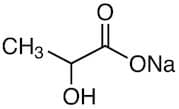
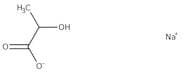
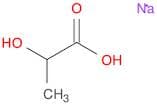
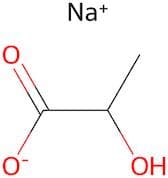
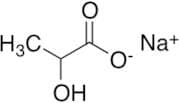
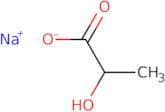
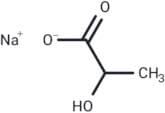
CAS 72-17-3
:Natriumlaktat
- 2-Hydroxypropanoic acid monosodium salt
- Dl-Lactic Acid Sodium
- Dl-Lactic Acid Sodium Salt Solution
- E 325
- Lacolin
- Lactate de sodium
- Lactato De Sodio
- Lactic acid sodium salt
- Lactic acid, monosodium salt
- Monosodium lactate
- Natriumlactat
- Nsc 31718
- Per-glycerin
- Propanoate, 2-Hydroxy-, Monosodium
- Propanoic Acid, 2-Hydroxy-, Sodium Salt (1:1)
- Propanoic acid, 2-hydroxy-, monosodium salt
- Purasal Powder S 98JS
- Purasal S
- Purasal S/HQ 60
- Purasal S/SP 60
- Purasal-Purac Spray 80
- S 98Js
- Sodium 2-Hydroxypropanoate
- Sodium 2-hydroxypropionate
- Sodium <span class="text-smallcaps">DL</span>-lactate
- Sodium DL-lactate
- Sodium DL-lactate solution
- Sodium lactate
- Sodium α-hydroxypropionate
- Weitere Synonyme anzeigen
Sodium DL-Lactate (60% in Water)
CAS:Formel:C3H5NaO3Farbe und Form:Colorless to Almost colorless clear liquidMolekulargewicht:112.06Sodium DL-lactate, 60% w/w aq. soln.
CAS:Useful chiral synthon; building block for depsipeptidesFormel:C3H5NaO3Reinheit:60%Molekulargewicht:112.06Sodium DL-lactate, 60% solution
CAS:Formel:C3H5NaO3Reinheit:58.8 - 61.2 % (w/w)Farbe und Form:Clear, colourless to almost colourless, slightly viscous liquidMolekulargewicht:112.06DL-Lactic acid sodium salt, 60% w/w syrup
CAS:Formel:C3H5NaO3Reinheit:(60% in Water)Farbe und Form:LiquidMolekulargewicht:112.06Sodium DL-Lactate (60% w/w in H2O)
CAS:Applications The sodium salt of lactic acid (L113490). It acts as a preservative, acidity regulator, and bulking agent.
References Kim, Y., et al.: ?Food. Nutr. Res., 10, 588-605 (2019)Formel:C3H5O3·NaFarbe und Form:ColourlessMolekulargewicht:112.06DL-Lactic acid sodium salt, 60% w/w syrup
CAS:Lactic acid is a natural product that has been used for many years as an antimicrobial agent in wastewater treatment. It is also used in the food industry to prevent the growth of bacteria and fungi, and as a preservative. Lactic acid has been shown to have a physiological effect on locomotor activity, which may be due to its ability to convert pyruvate into lactate. Lactic acid also inhibits the growth of some bacterial strains by increasing the disulfide bond formation between two cysteine residues. The sodium salt form of lactic acid is more soluble than the acid form and can be used as an experimental model for studying sodium-lactate interactions. Sodium lactate is used in maternal blood transfusions to increase blood pH levels during labor, and is also added to water vapor for humidification purposes.
Formel:C3H5O3NaFarbe und Form:Colorless Clear LiquidMolekulargewicht:112.06 g/molLactic acid sodium (60% w/w in water)
CAS:Lactic acid (DL-Lactic acid) sodium (60% w/w in water) is an activator of hydroxycarboxylic acid receptor 1 (HCAR1) and an epigenetic regulator that induces lysine residue lactylation. As the end product of glycolysis, it bridges the gap between glycolysis and oxidative phosphorylation. This compound is a tumor metabolite, offering immunoprotective effects of lactate in antitumor immunity. Additionally, it possesses antimicrobial properties and can be used as a food preservative.Formel:C3H5NaO3Farbe und Form:SolidMolekulargewicht:112.06