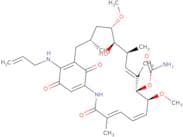
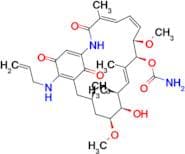
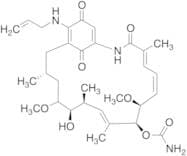
CAS 75747-14-7
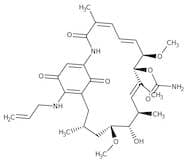
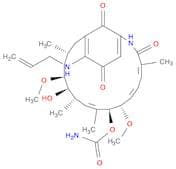
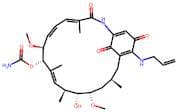
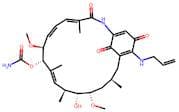
:Tanespimycin
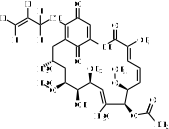
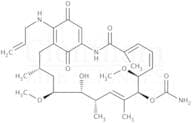
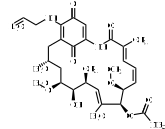
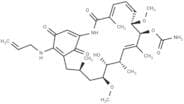
- (4Z,6E,10E)-13-hydroxy-8,14-dimethoxy-4,10,12,16-tetramethyl-3,20,22-trioxo-19-(prop-2-en-1-ylamino)-2-azabicyclo[16.3.1]docosa-1(21),4,6,10,18-pentaen-9-yl carbamate
- (8R,9R,12R,13S,14R,16R)-13-hydroxy-8,14-dimethoxy-4,10,12,16-tetramethyl-3,20,22-trioxo-19-(prop-2-en-1-ylamino)-2-azabicyclo[16.3.1]docosa-1(21),4,6,10,18-pentaen-9-yl carbamate
- (8S,9S,12S,13R,14S,16R)-13-hydroxy-8,14-dimethoxy-4,10,12,16-tetramethyl-3,20,22-trioxo-19-(prop-2-en-1-ylamino)-2-azabicyclo[16.3.1]docosa-1(21),4,6,10,18-pentaen-9-yl carbamate
- 17-(Allylamino)-17-demethoxygeldanamycin
- 17-(Allylamino)-17-desmethylgeldanamycin
- 17-(Allylamino)geldanamycin
- 17-Allylaminodemethoxygeldanamycin
- 17-Allylaminogeldanamycin
- 17-Demethoxy-17-(2-propenylamino)geldanamycin
- 17-Demethoxy-17-allylaminogeldanamycin
- 17-N-Allylamino-17-demethoxygeldanamycin
- 17Aag
- 2-Azabicyclo[16.3.1]docosane, geldanamycin deriv.
- A 8476
- Bms 722782
- Cp 127374
- Geldanamycin, 17-demethoxy-17-(2-propenylamino)-
- Kos 953
- NSC 330507
- Tanespimycin
- CP127374,NSC-330507
- Gld-36
- 17-AAG (TanespiMycin)
- 17AAG (17-(AllylaMino)-17-deMethoxy-geldanaMycin)
- 17-DEMETHOXY-17-ALLYLAMINO GELDANAMYCIN
- 17-demethoxy-17-(2-propenylamino)-[(3R,5R,6S,7R,8E,10R,11R,12Z,14E)-6-Hydroxy-5,11,21-trimethoxy-3,7,9,15-tetramethyl-16,20,22-trioxo-17-azabicyclo[16.3.1]docosa-1(21),8,12,14,18-pentaen-10-yl] carbamate
- 17-AAG (KOS953)
- Telatinib/ 17-AAG
- 17-(ALLYLAMINO)-17-DIMETHOXYGELDANAMYCIN
- 17-AAG, CP 127374
- 17-AAG
- 17-ALLYLAMINO-17-DIMETHOXYGELDANAMYCIN (17-AAG)
- 17-AAG(GeldanaMycin)
- Geldanamycin, 17-allylamino-17-demethoxy-
- Telatinib
- ALLYLAMINOGELDANAMYCIN
- 17-(Allylamino)geldanamycin, 17-AAG, 17-Demethoxy-17-allylamino geldanamycin, CP 127374, Geldanamycin,17-demethoxy-17-(2-propenylamino)-, NSC 330507
- 17-(ALLYLAMINO)-17-DESMETHOXYGELDANAMYCIN
- TELATINIB
- 17-AG
- 17-AGG
- 17-ALLYLAMINO-17-DEMETHOXYGELDANAMYCIN (17-AAG)
- 17-AAG,17AAG
- Geldanamycin, des-o-methyl-17-allylamino-
- Weitere Synonyme anzeigen
17-(Allylamino)-17-demethoxygeldanamycin, 99%
CAS:17-(Allylamino)-17-demethoxygeldanamycin (17-AAG) inhibits heat shock protein 90 (Hsp90), the expression of heat shock factor-1, and the activity of oncogenic proteins such as N-ras, Ki-ras, c-Akt, and p185erB2. In addition to its anti-tumor effects, 17-AAG also induces apoptosis. This Thermo ScientFormel:C31H43N3O8Reinheit:99%Farbe und Form:Red to dark red, PowderMolekulargewicht:585.7017-(Allylamino)-17-demethoxygeldanamycin
CAS:17-(Allylamino)-17-demethoxygeldanamycinFormel:C31H43N3O8Reinheit:98% (Typical Value in Batch COA)Farbe und Form: brown solidMolekulargewicht:585.69g/molTelatinib
CAS:Formel:C31H43N3O8Reinheit:≥ 98%Farbe und Form:Red to dark red powderMolekulargewicht:585.69Tanespimycin
CAS:Tanespimycin (KOS 953) is an Hsp90 inhibitor (IC50=5 nM) and is selective. Tanespimycin depletes intracellular STK38/NDR1. High-Quality, Low-Cost!Formel:C31H43N3O8Reinheit:98.24% - 99.83%Farbe und Form:Dark Purple SolidMolekulargewicht:585.6917-Allylaminogeldanamycin
CAS:17-AAG is the first clinically tested hsp90 inhibitor that exhibits antitumor activity. Its antitumor effects are documented in vivo for various animal models, including erbB2-dependent breast cancer, prostate cancer models, and melanoma.
Formel:C31H43N3O8Reinheit:Min. 95%Farbe und Form:PowderMolekulargewicht:585.69 g/mol17-(Allylamino) Geldanamycin
CAS:Applications Potent inhibitor of heat shock protein 90 (Hsp90). 17-AAG is a less toxic analog than Geldanamycin. It induces apoptosis and displays antitumor effects. 17-AAG inhibits the activity of oncogenic proteins such as N-ras, Ki-ras, c-Akt, and p185erB2.
References Schnur, R.C., et al.: J. Med. Chem., 38, 3806 (1995), Nimmanapalli, R., et al.: Cancer Res., 61, 1799 (2001), Basso, A.D., et al.: Oncogene, 21, 1159 (2002),Formel:C31H43N3O8Farbe und Form:NeatMolekulargewicht:585.6917-(Allylamino-d5) Geldanamycin
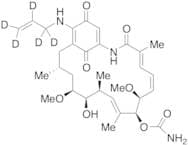
CAS:Kontrolliertes ProduktApplications Potent inhibitor of heat shock protein 90 (Hsp90). 17-AAG is a less toxic analog than Geldanamycin. It induces apoptosis and displays antitumor effects. 17-AAG inhibits the activity of oncogenic proteins such as N-ras, Ki-ras, c-Akt, and p185erB2.
References Schnur, R.C., et al.: J. Med. Chem., 38, 3806 (1995), Nimmanapalli, R., et al.: Cancer Res., 61, 1799 (2001), Basso, A.D., et al.: Oncogene, 21, 1159 (2002),Formel:C31D5H38N3O8Farbe und Form:NeatMolekulargewicht:590.719