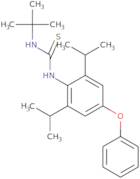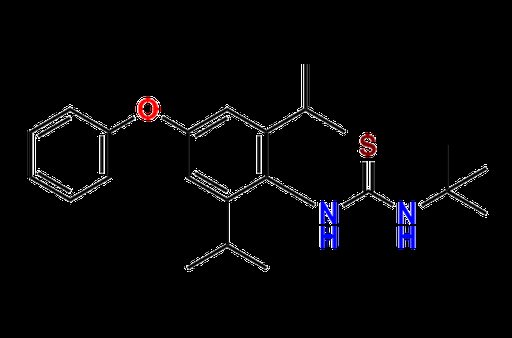
CAS 80060-09-9
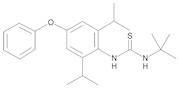
:Diafenthiuron
Beschreibung:
Diafenthiuron ist eine chemische Verbindung, die als Thiourea-Derivat klassifiziert ist und hauptsächlich als Insektizid und Akarizid in der Landwirtschaft eingesetzt wird. Es wirkt, indem es die normalen physiologischen Prozesse von Schädlingen stört, was zu deren Mortalität führt. Diafenthiuron zeichnet sich durch seine relativ geringe Toxizität für Säugetiere und Vögel aus, was es zu einer bevorzugten Wahl für das integrierte Schädlingsmanagement macht. Die Verbindung wird typischerweise in Formulierungen angewendet, die eine effektive Penetration und Wirksamkeit gegen eine Vielzahl von landwirtschaftlichen Schädlingen ermöglichen, insbesondere in Kulturen wie Obst und Gemüse. Sein Wirkungsmechanismus beinhaltet die Beeinträchtigung des Nervensystems des Insekts, wobei gezielt die Neurotransmitterwege angesprochen werden. Darüber hinaus zeigt Diafenthiuron eine moderate Persistenz in der Umwelt, was eine sorgfältige Handhabung erfordert, um potenzielle ökologische Auswirkungen zu minimieren. Die Verbindung wird im Allgemeinen als sicher angesehen, wenn sie gemäß den empfohlenen Richtlinien verwendet wird, erfordert jedoch wie alle Pestizide eine ordnungsgemäße Handhabung und Anwendung, um Risiken für Nichtzielorganismen und die Umwelt zu minimieren.
Formel:C23H32N2OS
InChl:InChI=1S/C23H32N2OS/c1-15(2)19-13-18(26-17-11-9-8-10-12-17)14-20(16(3)4)21(19)24-22(27)25-23(5,6)7/h8-16H,1-7H3,(H2,24,25,27)
InChI Key:InChIKey=WOWBFOBYOAGEEA-UHFFFAOYSA-N
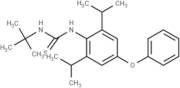
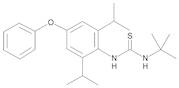
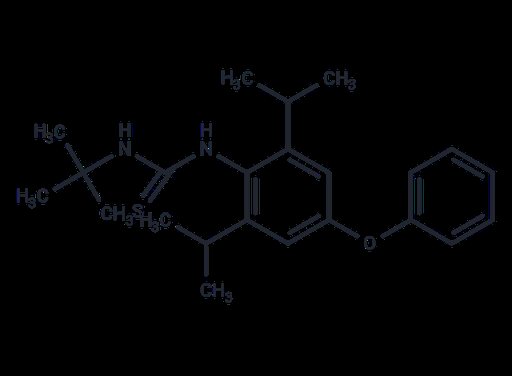
SMILES:N(C(NC(C)(C)C)=S)C1=C(C(C)C)C=C(OC2=CC=CC=C2)C=C1C(C)C
Synonyme:- 1-Tert-Buty1-3(2,6-Di-Isopropy1-4-Phenoxyphenyl)Thiourea
- 1-Tert-Butyl-3-(2,6-Di-Isopropyl-4-Phenoxyphenyl)Thiourea
- 1-Tert-Butyl-3-(2,6-Diisopropyl-4-Phenoxyphenyl)Thiourea
- 1-[2,6-Bis(1-Methylethyl)-4-Phenoxyphenyl]-3-Tert-Butylthiourea
- 3-(2,6-Diisopropyl-4-Phenoxyphenyl)-1-Tert-Butyl-Thiourea
- Cga 106630
- Cga106630
- Diafenthiuron (Bsi, Draft E-Iso)
- Diafenthiuron Pestanal, 250 Mg
- Dingminiao
- Gamba
- N-(2,6-Bis(1-Methylethyl)-4-Phenoxyphenyl)-N'-(1,1-Dimethylethyl)-Thioure
- Pegasus
- Pegasus (pesticide)
- Phoenix
- Phoenix (thiourea insecticide)
- Polo
- Polo 500
- Polo 500 SC
- Thiourea, N-[2,6-bis(1-methylethyl)-4-phenoxyphenyl]-N′-(1,1-dimethylethyl)-
- n-(2,6-bis(1-methylethyl)-4-phenoxyphenyl)-n'-(1,1-dimethylethyl)thiourea
- Weitere Synonyme anzeigen
Sortieren nach
Reinheit (%)
0
100
|
0
|
50
|
90
|
95
|
100
15 Produkte gefunden.
Diafenthiuron
CAS:Formel:C23H32N2OSReinheit:>98.0%(T)(HPLC)Farbe und Form:White to Light yellow to Light orange powder to crystalMolekulargewicht:384.58Diafenthiuron
CAS:Diafenthiuron is a widely utilized thiourea-based pesticide that effectively hinders mitochondrial activity in insect pests.Formel:C23H32N2OSFarbe und Form:SolidMolekulargewicht:384.58Diafenthiuron (Standard)
CAS:Diafenthiuron (Standard) is the standard substance of Diafenthiuron, and it is applicable for quantitative analysis, quality control, and related research in biochemical experiments. Diafenthiuron is a widely utilized thiourea-based pesticide that effectively hinders mitochondrial activity in insect pests.Formel:C23H32N2OSFarbe und Form:SolidMolekulargewicht:384.58Diafenthiuron 100 µg/mL in Acetonitrile
CAS:Formel:C23H32N2OSFarbe und Form:Single SolutionMolekulargewicht:384.58Diafenthiuron
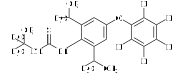
CAS:Kontrolliertes ProduktApplications Diafenthiuron is an insecticide.
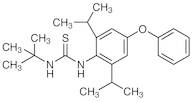
References Delbeke, F., et al.: Entomophaga, 42, 349 (1997); Mezcua, M., et al.: Anal. Chem., 81, 913 (2009);Formel:C23H32N2OSFarbe und Form:NeatMolekulargewicht:384.581- tert-Butyl-3-[4-phenoxy-2,5-di(propan-2 -yl)phenyl]thiourea
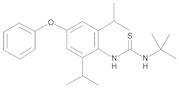
CAS:Kontrolliertes ProduktApplications 1- tert-Butyl-3-[4-phenoxy-2,5-di(propan-2 -yl)phenyl]thiourea is an isomer of Diafenthiuron (D310550), an insecticide.
References Delbeke, F., et al.: Entomophaga, 42, 349 (1997); Mezcua, M., et al.: Anal. Chem., 81, 913 (2009);Formel:C23H32N2OSFarbe und Form:NeatMolekulargewicht:384.58Diafenthiuron
CAS:Diafenthiuron is a potent inhibitor that has shown significant anticancer activity in various studies. It induces apoptosis, or programmed cell death, in cancer cells by inhibiting the activity of specific proteins involved in cell cycle regulation. Diafenthiuron is commonly used in traditional Chinese medicine to treat cancer and has been found to be effective against human cancer cell lines. In addition, recent studies have shown that diafenthiuron can enhance the anticancer effects of other drugs such as betamethasone. This compound has also been found in urine samples from patients with tumors, suggesting its potential use as a diagnostic marker for certain cancers. Overall, diafenthiuron holds great promise as an effective inhibitor for the treatment of various types of cancer.Formel:C23H32N2OSReinheit:Min. 95%Molekulargewicht:384.6 g/mol








![1- tert-Butyl-3-[4-phenoxy-2,5-di(propan-2 -yl)phenyl]thiourea](https://static.cymitquimica.com/products/TR/thumb/B810236.jpg)