CAS 85233-19-8
:BAPTA
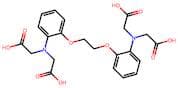
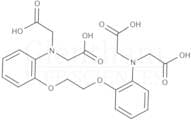
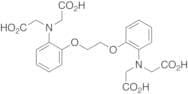
- 1,2-Bis(o-aminophenoxy)ethane-N,N,N′,N′-tetraacetic acid
- 2,2',2'',2'''-[Ethane-1,2-Diylbis(Oxybenzene-2,1-Diylnitrilo)]Tetraacetate
- 2,2',2'',2'''-[Ethane-1,2-Diylbis(Oxybenzene-2,1-Diylnitrilo)]Tetraacetic Acid
- 2-[2-[2-[2-[Bis(carboxymethyl)amino]phenoxy]ethoxy]-N-(carboxymethyl)anilino]acetic acid
- Bapta
- Glycine, N,N′-[1,2-ethanediylbis(oxy-2,1-phenylene)]bis[N-(carboxymethyl)-
- N,N′-[1,2-Ethanediylbis(oxy-2,1-phenylene)]bis[N-(carboxymethyl)glycine]
- 1,2-Bis(2-aminophenoxy)ethane-N,N,N′,N′-tetraacetic acid
- 1,2-Bis(2-aminophenoxy)ethane-N,N,N',N'-tetraacetic Acid
BAPTA, 97%
CAS:Acts as a calcium chelatorBAPTA is used as a selective calcium chelating reagent. It is suitable for the spectrophotometric monitoring of calcium levels. It is a lipophilic diesters of the chelating agent used for the inhibition of proteolytic activities of certain metalloproteinases, calpain and tr
Formel:C22H24N2O10Reinheit:97%Farbe und Form:White to pale cream to pale yellow, PowderMolekulargewicht:476.44Glycine,N,N'-[1,2-ethanediylbis(oxy-2,1-phenylene)]bis[N-(carboxymethyl)-
CAS:Formel:C22H24N2O10Reinheit:97%Farbe und Form:SolidMolekulargewicht:476.43341,2-Bis(2-aminophenoxy)ethane-N,N,N',N'-tetraacetic acid
CAS:1,2-Bis(2-aminophenoxy)ethane-N,N,N',N'-tetraacetic acidFormel:C22H24N2O10Reinheit:97%Farbe und Form: pale yellow solidMolekulargewicht:476.43335g/mol1,2-Bis(2-aminophenoxy)ethane-N,N,N'',N''-tetraacetic acid
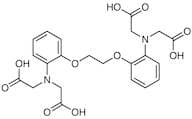
CAS:Formel:C22H24N2O10Reinheit:≥ 97.0%Farbe und Form:White to off-white or faint beige powderMolekulargewicht:476.44BAPTA (1,2-bis(o-Aminophenoxy)ethane-N,N,N',N'-tetra-Acetic Acid)
CAS:Formel:C22H24N2O10Molekulargewicht:476.44BAPTA
CAS:BAPTA is a neuroprotective agent in cerebral ischemia, acting as an intercellular Ca2+ chelator.Formel:C22H24N2O10Reinheit:97.21% - ≥95%Farbe und Form:White SolidMolekulargewicht:476.43BAPTA
CAS:Kontrolliertes ProduktApplications BAPTA is a highly selective calcium chelating reagent. Lipophilic diesters of the chelating agent 1,2-Bis(2 aminophenoxy)ethane-N,N,N',N'-tetraacetic acid (BAPTA) are used for inhibition of proteolytic activities of certain metalloproteinases, calpain and TACE.
References Tsien, R.Y., Biochemistry, 19, 2396 (1980), Wu, S.Y., et al.: J. Neurophysiology, 74, 2600 (1995), Venant, A., et al.: Biol. Cell, 85, 197 (1995), Tucker, T., et al.: Neuron, 15, 1323 (1995)Formel:C22H24N2O10Farbe und Form:NeatMolekulargewicht:476.43BAPTA
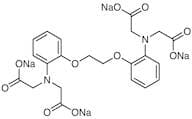
CAS:BAPTA is a fluorescent probe that binds to cytosolic calcium and can be used to measure intracellular calcium levels. It can also be used as a fluorescence probe for the measurement of mitochondrial membrane potential. BAPTA is a potent inhibitor of neuronal death induced by excess cytosolic calcium, which leads to activation of calcium-dependent proteases and cell lysis. The mechanism by which BAPTA inhibits neuronal death is unclear, but it may be due to its ability to modulate mitochondrial membrane potential or regulate Ca2+ release from intracellular stores. BAPTA has been shown to inhibit the polymerase chain reaction (PCR) in cells and tissues and can also inhibit the transcriptional activity of nuclear DNA. In addition, BAPTA can inhibit the function of ryanodine receptors in cells, leading to an increase in cytosolic Ca2+.Formel:C22H24N2O10Reinheit:Min. 97 Area-%Farbe und Form:White PowderMolekulargewicht:476.43 g/molTetrasodium 1,2-Bis(2-aminophenoxy)ethane-N,N,N',N'-tetraacetate
CAS:Formel:C22H20N2Na4O10Reinheit:>98.0%(T)Farbe und Form:White to Almost white powder to crystalMolekulargewicht:564.371,2-Bis(2-aminophenoxy)ethane-N,N,N',N'-tetraacetic Acid
CAS:Formel:C22H24N2O10Reinheit:>97.0%(HPLC)Farbe und Form:White to Almost white powder to crystalMolekulargewicht:476.44
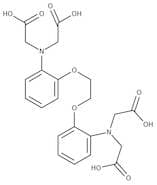

![Glycine,N,N'-[1,2-ethanediylbis(oxy-2,1-phenylene)]bis[N-(carboxymethyl)-](/_next/image/?url=https%3A%2Fstatic.cymitquimica.com%2Fproducts%2FIN%2Fthumb%2FDA00IDLE.jpg&w=3840&q=75)