CAS 9005-38-3
:Natriumalginat
Beschreibung:
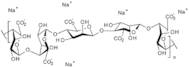
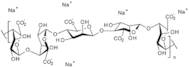
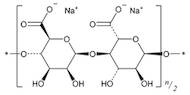
Natriumalginat ist ein natürlich vorkommendes Polysaccharid, das aus Braunalgen gewonnen wird und hauptsächlich aus manuronischen und guluronischen Säureeinheiten besteht. Es ist ein weißes bis gelbliches Pulver, das in Wasser löslich ist und beim Hydratisieren ein viskoses Gel bildet. Dieses Biopolymer ist bekannt für seine Fähigkeit, in Anwesenheit von zweiwertigen Kationen, wie Calciumionen, Gele zu bilden, was es in der Lebensmittel-, Pharma- und Biomedizintechnik wertvoll macht. Natriumalginat wird häufig als Verdickungsmittel, Stabilisator und Emulgator in verschiedenen Lebensmitteln, einschließlich Eiscreme und Salatdressings, verwendet. In der Pharmaindustrie dient es als Arzneimittelabgabemittel und wird aufgrund seiner Biokompatibilität und seiner Fähigkeit, eine feuchte Umgebung aufrechtzuerhalten, in Wundverbänden eingesetzt. Darüber hinaus ist Natriumalginat für seine geringe Toxizität bekannt und wird allgemein als sicher für den Verzehr angesehen. Seine einzigartigen Eigenschaften, wie die Gelbildung und Viskosität, machen es zu einer vielseitigen Zutat in zahlreichen industriellen Anwendungen.
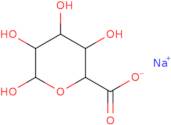
Formel:C5H7O4COONa
InChl:InChI=1/C6H10O7.Na/c7-1-2(8)4(5(10)11)13-6(12)3(1)9;/h1-4,6-9,12H,(H,10,11);/q;+1/p-1/t1-,2-,3-,4-,6+;/m0./s1
SMILES:C1(C(C(C(=O)O)OC(C1O)O)O)O.[Na]
Synonyme:- 1-3F
- Algecolloid
- Algin
- Alloid
- Alman
- Alroid-G
- Alto
- Amnucol
- Ascophyllum
- EHV
- Flavicam
- GMB
- Gos-Lyi
- Halltex
- Kelcosol
- Kelgin
- Kelset
- Kelsize
- Keltex
- Keltone
- Kelvis
- Kimitex
- Lamitex
- MV
- Manucol
- Minus
- Mosanon
- Natriumalginat
- Nouralgine
- Nspll
- Pectalgine
- Proctin
- Pronova
- Protanal
- Protatek
- Seacor
- Skat-Ulv
- Skat-Uvl
- Solgin
- Sorugin
- Stipine
- Tagat
- Tragaya
- Kelgin F
- Alginic acid, sodium salt
- Cohasal IH
- sodium 3,4,5,6-tetrahydroxytetrahydro-2H-pyran-2-carboxylate (non-preferred name)
- alginic acid sodium
- Polymannuronic acid sodium salt
- Sodium alginate
- SODIUM ALIGINATE
- sodium (2S,3S,4S,5S,6R)-3,4,5,6-tetrahydroxytetrahydro-2H-pyran-2-carboxylate (non-preferred name)
- daridqh
- antimigrantc45
- ALGINIC SODIUM
- cecalginetbv
- algin(polysaccharide)
- algiponl-1168
- algiline
- Alginic acid monosodium salt
- SODIUM ALGINATE 500-600
- SODIUM ALGINATE 80-120
- SODIUM ALGINATE 300-400
- alginatekmf
- FEMA 2015
- Weitere Synonyme anzeigen
Sortieren nach
Reinheit (%)
0
100
|
0
|
50
|
90
|
95
|
100
Sodium alginate, viscosity 250 - 350 mPa.s
CAS:Sodium alginate is a natural polysaccharide that is extracted from seaweed and used as an emulsifier, thickener, and stabilizer in food products. It is also used to create a gel with water or other liquids. The viscosity of sodium alginate can be modified by adding sugar, glycosylation, or methylation. Click modification is used to introduce fluorine atoms into the polymer backbone. Sodium alginate may be modified by adding oligosaccharides or monosaccharides for use as a bio-sorbent in wastewater treatment plants.Farbe und Form:PowderSodium alginate, high viscosity
CAS:Sodium salt of a polysaccharide obtained from the brown seaweeds (e.g. Laminaria hyperborea, Fucus vesiculosus, Ascophyllum nodosum). The chemical structure consists of blocks of (1,4) linked-β-D-polymannuronic acid (poly M), (1,4) linked-α-L-polyguluronic acid (poly G) and alternating blocks of the two uronic acids (poly MG). Alginates form strong gels with divalent metal cations and the egg box model has been used to describe this form of gelation. The main use for alginate is in textile printing as a thickener in the printing of cottons with reactive dyes. In the food industry it is used as a thickener and gelling agent. Recently, it has been shown that ternary mixtures of Konjac glucomannan, Xanthan gum and Sodium alginate can form a non-covalently linked complex which exhibits enhanced rheological properties of value in, for example, functional foods. The image was kindly provided by Prof Mike Guiry from Cork who runs ‘The Seaweed Site’.High viscosity (500-500mPa.s).Reinheit:Min. 95%Farbe und Form:White PowderSodium alginate, Laminaria Hyperborea
CAS:Sodium alginate is a biocompatible polymer that is used in the treatment of wastewater. It is a water-soluble substance that forms a viscous solution when dissolved in water. Sodium alginate has been shown to inhibit the growth of bacteria and fungi, as well as to reduce the number of coliforms and other microorganisms in water. The potential for an alginate to be biocompatible depends on its chemical structure, with Laminaria Hyperborea being the most biocompatible. Alginates have been shown to have surface properties that are similar to those of natural tissue, making them useful for wound dressings.Viscosity: 10-20 mPa.sFormel:C6H9NAO7Farbe und Form:PowderMolekulargewicht:216.12 g/molSodium alginate, low viscosity
CAS:Sodium salt of a polysaccharide obtained from the brown seaweeds (e.g. Laminaria hyperborea, Fucus vesiculosus, Ascophyllum nodosum). The chemical structure consists of blocks of (1,4) linked-β-D-polymannuronic acid (poly M), (1,4) linked-α-L-polyguluronic acid (poly G) and alternating blocks of the two uronic acids (poly MG). Alginates form strong gels with divalent metal cations and the egg box model has been used to describe this form of gelation. The main use for alginate is in textile printing as a thickener in the printing of cottons with reactive dyes. In the food industry it is used as a thickener and gelling agent. Recently, it has been shown that ternary mixtures of Konjac glucomannan, Xanthan gum and Sodium alginate can form a non-covalently linked complex which exhibits enhanced rheological properties of value in, for example, functional foods. The image was kindly provided by Prof Mike Guiry from Cork who runs ‘The Seaweed Site’.Viscosity: min 50 mPa.sFarbe und Form:White PowderSodium Alginate LV extrapure, 4-12cps, 30mesh
CAS:Farbe und Form:White to Beige and Faint Brown to Light Brown, PowderSodium alginate, viscosity 300 - 600 mPa.s
CAS:Sodium alginate is the sodium salt of a polysaccharide obtained from brown seaweeds. The main use for alginate is in textile printing as a thickener in the printing of cottons with reactive dyes. In the food industry it is used as a thickener and gelling agent. The chemical structure consists of blocks of (1,4) linked-β-D-polymannuronic acid (poly M), (1,4) linked-α-L-polyguluronic acid (poly G) and alternating blocks of the two uronic acids (poly MG).Farbe und Form:PowderSodium alginate, viscosity 100 - 150 mPa.s
CAS:Sodium alginate is a soluble fiber that is extracted from brown seaweed. It is a natural carbohydrate that can be modified to create a variety of sugar-based derivatives, such as Oligosaccharides, Monosaccharides, and Custom Synthesis. Sodium alginate has been modified with Fluorination, Methylation, Glycosylation, and Click Modification to create high-purity products for various applications.Reinheit:90.8 To 106.0%Farbe und Form:Powder