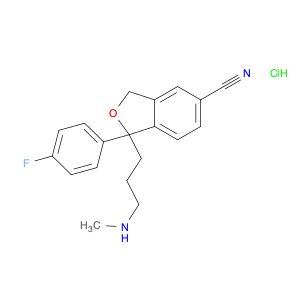
CAS 97743-99-2
:Formel:C19H20ClFN2O
InChl:InChI=1S/C19H19FN2O.ClH/c1-22-10-2-9-19(16-4-6-17(20)7-5-16)18-8-3-14(12-21)11-15(18)13-23-19;/h3-8,11,22H,2,9-10,13H2,1H3;1H
InChI Key:DYIZNULSIBGJPJ-UHFFFAOYSA-N
SMILES:CNCCCC1(C2=C(CO1)C=C(C=C2)C#N)C3=CC=C(C=C3)F.Cl
Filtern nach
Reinheitsanteil
0
100
|
0
|
50
|
90
|
95
|
100
14 Produkte gefunden.
- Niedrigster Preis
- Höchster Preis
- Niedrigste Reinheit
- Höchste Reinheit
- Schnellste Lieferung
CITALOPRAM FOR SYSTEM SUITABILITY CRS
CAS:CITALOPRAM FOR SYSTEM SUITABILITY CRSFormel:C20H22BrFN2OMolekulargewicht:405.3039Citalopram Related Compound D
CAS:Aromatic heterocyclic compounds with oxygen hetero-atom(s) only, nesoiFormel:C19H19FN2O·HClFarbe und Form:White PowderMolekulargewicht:346.12482rac Desmethyl Citalopram Hydrochloride
CAS:rac Desmethyl Citalopram HydrochlorideFormel:C19H20ClFN2OReinheit:99%Molekulargewicht:346.83rac Desmethyl Citalopram Hydrochloride
CAS:rac Desmethyl Citalopram Hydrochloride is a 5-hydroxy tryptamine uptake inhibitor with IC50 value of 0.013 μM.Formel:C19H20ClFN2OReinheit:99.24%Farbe und Form:Yellow SolidMolekulargewicht:346.826N-Desmethylcitalopram.HCl, 1mg/ml in Methanol (as free base)
CAS:Formel:C19H19FN2O·ClHFarbe und Form:ColourlessMolekulargewicht:346.83Desmethylcitalopram Hydrochloride 1.0 mg/ml in Methanol (as free base)
CAS:Formel:C19H19FN2O·ClHFarbe und Form:ColourlessMolekulargewicht:346.83N-Desmethylcitalopram.HCl
CAS:Formel:C19H19FN2O·ClHFarbe und Form:Light YellowMolekulargewicht:346.83(1RS)-1-(4-Fluorophenyl)-1-[3-(methylamino)propyl]-1,3-dihydroisobenzofuran-5-carbonitrile Hydrochloride (Desmethylcitalopram Hydrochloride)
CAS:Formel:C19H19FN2O·ClHFarbe und Form:NeatMolekulargewicht:346.83rac Desmethyl Citalopram Hydrochloride
CAS:Formel:C19H20ClFN2OReinheit:95%Farbe und Form:SolidMolekulargewicht:346.8263rac Desmethyl Citalopram Hydrochloride
CAS:Stability Hygroscopic
Applications A metabolite of Citalopram, an inhibitor of serotonin (5-HT) uptake. Used as an antidepressant.
References Gnerre, C., et al.: J. Pharm. Pharmacol., 53, 1125 (2001), Hagg, S., et al.: Br. J. Clin. Pharmacol., 51, 169 ( 2001), von Moltke, L., et al.: Drug Metab. Dispos., 29, 1102 (2001), Reis, M., et al.: Ther. Drug Monit., 27, 469 (2005),Formel:C19H19FN2O·ClHFarbe und Form:NeatMolekulargewicht:346.831-(4-Fluorophenyl)-1-(3-(methylamino)propyl)-1,3-dihydroisobenzofuran-5-carbonitrile hydrochloride
CAS:1-(4-Fluorophenyl)-1-(3-(methylamino)propyl)-1,3-dihydroisobenzofuran-5-carbonitrile hydrochlorideFormel:C19H20ClFN2OReinheit:99%Molekulargewicht:346.831-(4-Fluorophenyl)-1,3-dihydro-1-[3-(methylamino)propyl]-5-isobenzofurancarbonitrile hydrochloride
CAS:1-(4-Fluorophenyl)-1,3-dihydro-1-[3-(methylamino)propyl]-5-isobenzofurancarbonitrile hydrochloride is a fluorescent probe that has been extensively studied as a potential diagnostic agent. It has been shown to be a potent inhibitor of human serum and porcine alkaline phosphatase. The optimum flow rate for the assay is 0.2 mL/min. A quinidine binding assay is used to measure the inhibitory potency of 1-(4-fluorophenyl)-1,3-dihydro-1-[3-(methylamino)propyl]-5-isobenzofurancarbonitrile hydrochloride. This method can be carried out using a UV spectrophotometer or an HPLC system with fluorescence detection. The reagent should be deionized water and acetonitrile in equal parts for the chromFormel:C19H19FN2O•HClReinheit:Min. 95%Farbe und Form:Off-White To Light (Or Pale) Yellow SolidMolekulargewicht:346.83 g/mol