CymitQuimica logo

CAS 98102-34-2

:

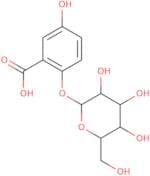
2-(β-D-Glucopyranosyloxy)-5-hydroxybenzoesäure

Beschreibung:
2-(β-D-Glucopyranosyloxy)-5-hydroxybenzoesäure, auch bekannt als Salicylsäureglucosid, ist ein glykosyliertes Derivat der Salicylsäure. Diese Verbindung weist eine β-D-Glucopyranosylgruppe auf, die an die Hydroxylgruppe der Salicylsäurestruktur gebunden ist, was zu ihrer Löslichkeit und biologischen Aktivität beiträgt. Sie erscheint typischerweise als weißer bis schwach weißer Feststoff und ist aufgrund der Anwesenheit der Glucopyranosylgruppe in Wasser löslich. Die Verbindung zeigt antioxidative Eigenschaften und könnte potenzielle Anwendungen in der Pharmazie und Kosmetik haben, insbesondere aufgrund ihrer entzündungshemmenden und hautberuhigenden Wirkungen. Ihre Struktur ermöglicht Wechselwirkungen mit verschiedenen biologischen Systemen, was sie für die Forschung im Bereich der Pflanzenbiochemie und der medizinischen Chemie von Interesse macht. Darüber hinaus könnte sie an den Abwehrmechanismen von Pflanzen beteiligt sein und wurde auf ihre potenziellen gesundheitlichen Vorteile für den Menschen untersucht. Wie viele phenolische Verbindungen könnte sie auch antimikrobielle Aktivität zeigen.
Formel:C13H16O9
InChl:InChI=1S/C13H16O9/c14-4-8-9(16)10(17)11(18)13(22-8)21-7-2-1-5(15)3-6(7)12(19)20/h1-3,8-11,13-18H,4H2,(H,19,20)/t8-,9-,10+,11-,13-/m1/s1
InChI Key:InChIKey=GEZJVEGHJRPQEX-BZNQNGANSA-N
SMILES:O(C1=C(C(O)=O)C=C(O)C=C1)[C@@H]2O[C@H](CO)[C@@H](O)[C@H](O)[C@H]2O
Synonyme:
  • Orbicularin
  • Benzoic acid, 2-(β-D-glucopyranosyloxy)-5-hydroxy-
  • 2-(β-D-Glucopyranosyloxy)-5-hydroxybenzoic acid
Sortieren nach

Reinheit (%)
0
100
|
0
|
50
|
90
|
95
|
100
1 Produkte.
  • 2-O-β-4C1-Glucopyranoside-2,5-dihydroxybenzoic acid

    CAS:
    <p>2-O-beta-4C1-Glucopyranoside-2,5-dihydroxybenzoic acid is a glycoside compound, which is a type of structural derivative where a sugar moiety is bonded to a non-carbohydrate functional group or aglycone. It is derived from specific plant or microbial sources through biochemical synthesis or extraction. The mode of action involves the hydrolysis of the glycosidic bond, mediated by specific enzymes, which releases the aglycone and the sugar component. This feature is crucial for its role in metabolic pathways where sugars are utilized or modified.<br><br>In scientific research, this compound is used in studying carbohydrate metabolism and enzyme activity, particularly those involving glycosidases. Due to its structural characteristics, it may serve as a model compound in understanding glycoside biosynthesis and degradation processes. Additionally, its potential applications in pharmaceuticals are being explored, especially in designing drugs that target enzymatic pathways. The compound's unique structure and reactivity make it a valuable tool in the field of biochemistry and molecular biology, offering insights into glycosidic bond interactions and transformations.</p>
    Formel:C13H16O9
    Reinheit:Min. 95%
    Molekulargewicht:316.26 g/mol

    Ref: 3D-XG177981

    Ausgelaufenes produkt