CAS 99-87-6
:p-Cymol
Beschreibung:
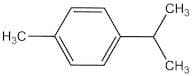
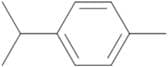
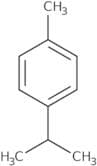
p-Cymol, auch bekannt als Para-Cymen, ist ein aromatischer Kohlenwasserstoff mit der chemischen Formel C10H14. Es ist eine farblose Flüssigkeit mit einem angenehmen, zitrusartigen Geruch, die häufig in ätherischen Ölen vorkommt, insbesondere in Thymian und Kreuzkümmel. p-Cymol zeichnet sich durch seine geringe Löslichkeit in Wasser, aber hohe Löslichkeit in organischen Lösungsmitteln aus, was es in verschiedenen Anwendungen nützlich macht. Es hat einen Siedepunkt von etwa 176 °C und einen Schmelzpunkt von etwa -48 °C. Diese Verbindung ist bekannt für ihre antimikrobiellen und antioxidativen Eigenschaften, die zu ihrer Verwendung in der Lebensmittelkonservierung und in Kosmetika beitragen. Darüber hinaus wird p-Cymol als Lösungsmittel in chemischen Reaktionen und als Zwischenprodukt bei der Synthese anderer organischer Verbindungen verwendet. Seine Struktur weist eine Methylgruppe und eine Isopropylgruppe auf, die an einen Benzolring gebunden sind, was zu seiner Reaktivität und Vielseitigkeit in der organischen Chemie beiträgt. Sicherheitsdaten zeigen, dass p-Cymol in niedrigen Konzentrationen allgemein als sicher gilt, jedoch mit Vorsicht behandelt werden sollte, da potenzielle Reizwirkungen bestehen.
Formel:C10H14
InChl:InChI=1/C10H14/c1-8(2)10-6-4-9(3)5-7-10/h4-8H,1-3H3
InChI Key:InChIKey=HFPZCAJZSCWRBC-UHFFFAOYSA-N
SMILES:C(C)(C)C1=CC=C(C)C=C1
Synonyme:- 1-Isopropyl-4-methylbenzene
- 1-Methyl-4-(1-methylethyl)benzene
- 1-Methyl-4-(propan-2-yl)benzene
- 1-Methyl-4-isopropylbenzene
- 2-p-Tolylpropane
- 4-Cymene
- 4-Isopropyl-1-methylbenzene
- 4-Isopropyltoluene
- 4-Methylisopropylbenzene
- Benzene, 1-methyl-4-(1-methylethyl)-
- Camphogen
- Dolcymene
- Nsc 4162
- P-Cimeno
- Para-Cymene
- Toluene, 4-(1-Methylethyl)-
- p-Cymol
- p-Isopropyltoluene
- p-Methylcumene
- p-Methylisopropylbenzene
- p-Cymene
- METHYL(1-METHYLETHYL)BENZENE
- Methyl isopropyl benzene
- PARA-CYMENE 97
- CYMENE PARA
- 1-methyl-4-(1-methylethyl)-benzen
- FEMA 2356
- P-METHYLPROPYLBENZENE
- 1-(1-methylethyl)-4-methylbenzene
- CYMENE, 4-
- Weitere Synonyme anzeigen
Sortieren nach
Reinheit (%)
0
100
|
0
|
50
|
90
|
95
|
100
EPA Method 8260 VOC Mixture 3 2000 µg/mL in Methanol
CAS:Kontrolliertes Produkt- 100-41-4
- 100-42-5
- 10061-01-5
- 10061-02-6
- 103-65-1
- 104-51-8
- 106-42-3
- 106-43-4
- 106-46-7
- 106-93-4
- 107-06-2
- 108-38-3
- 108-67-8
- 108-86-1
- 108-88-3
- 108-90-7
- 120-82-1
- 124-48-1
- 127-18-4
- 135-98-8
- 142-28-9
- 156-59-2
- 156-60-5
- 541-73-1
- 56-23-5
- 563-58-6
- 594-20-7
- 630-20-6
- 67-66-3
- 71-43-2
- 71-55-6
- 74-95-3
- 74-97-5
- 75-09-2
- 75-25-2
- 75-27-4
- 75-34-3
- 75-35-4
- 78-87-5
- 79-00-5
- 79-01-6
- 79-34-5
- 87-61-6
- 87-68-3
- 91-20-3
- 95-47-6
- 95-49-8
- 95-50-1
- 95-63-6
- 96-12-8
- 96-18-4
- 98-06-6
- 98-82-8
- 99-87-6
Formel:C2H2Cl4Farbe und Form:MixtureMolekulargewicht:167.85P-cymene
CAS:Aromatic hydrocarbonFormel:C10H14Reinheit:≥ 95.0 % (GC)Farbe und Form:LiquidMolekulargewicht:134.22p-Cymene
CAS:<p>Applications p-Cymene is a naturally occurring organic compound that is known as an essential oil and is found in many plants. p-Cymene is also used in the synthesis of ruthenium and osmium complexes as a ligand.<br> Not a dangerous good if item is equal to or less than 1g/ml and there is less than 100g/ml in the package<br>References Bennet, M.A., et al.: Inorganic Syntheses, 21, 74-78 (1982)<br></p>Formel:C10H14Farbe und Form:NeatMolekulargewicht:134.22p-Cymene
CAS:<p>p-Cymene is a natural product that has been shown to be active against a number of human pathogens, including bacteria and fungi. It is a metabolite of cymene, which is a naturally occurring hydrocarbon found in the essential oils of many plants. p-Cymene inhibits bacterial growth by interfering with signal pathways that are important for bacterial cell division. This inhibition leads to an increase in the mitochondrial membrane potential and mitochondrial functions, which are vital for energy metabolism. The antimicrobial properties of p-cymene have been shown through its ability to inhibit the growth of bacteria at low concentrations and kill them at high concentrations. It also demonstrates anti-inflammatory properties due to its ability to inhibit prostaglandin synthesis.</p>Formel:C10H14Reinheit:Min. 95%Farbe und Form:Clear LiquidMolekulargewicht:134.22 g/mol