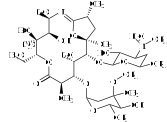
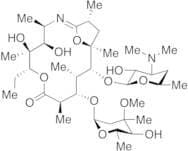
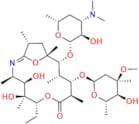
CAS 99290-97-8
:(1Z,3R,4R,5S,6R,9R,10S,11S,12R,13R,15R)-10-[(2,6-Didesoxy-3-C-methyl-3-O-methyl-α-L-ribo-hexopyranosyl)oxy]-6-ethyl-4,5-dihydroxy-3,5,9,11,13,15-hexamethyl-12-[[3,4,6-tridesoxy-3-(dimethylamino)-β-D-xylo-hexopyranosyl]oxy]-7,16-dioxa-2-azabicyclo[11.2.1]hexadec-1-en-8-on
Beschreibung:
Die chemische Substanz mit dem Namen "(1Z,3R,4R,5S,6R,9R,10S,11S,12R,13R,15R)-10-[(2,6-Didesoxy-3-C-methyl-3-O-methyl-α-L-ribo-hexopyranosyl)oxy]-6-ethyl-4,5-dihydroxy-3,5,9,11,13,15-hexamethyl-12-[[3,4,6-tridesoxy-3-(dimethylamino)-β-D-xylo-hexopyranosyl]oxy]-7,16-dioxa-2-azabicyclo[11.2.1]hexadec-1-en-8-on" und der CAS-Nummer "99290-97-8" ist ein komplexes organisches Molekül, das durch seine komplizierte Stereochemie und mehrere funktionelle Gruppen gekennzeichnet ist. Es weist eine bicyclische Struktur auf, die zu seiner einzigartigen dreidimensionalen Konformation beiträgt. Das Vorhandensein mehrerer Hydroxylgruppen weist auf ein Potenzial für Wasserstoffbrückenbindungen hin, was seine Löslichkeit und Reaktivität beeinflusst. Das Molekül enthält auch Zuckeranteile, was darauf hindeutet, dass es biologische Aktivität zeigen könnte, möglicherweise durch Interaktion mit spezifischen Enzymen oder Rezeptoren. Die Dimethylamino-Gruppe könnte seine pharmakologischen Eigenschaften verbessern und möglicherweise seine Wechselwirkung mit biologischen Systemen beeinflussen. Insgesamt macht die strukturelle Komplexität und funktionale Vielfalt dieser Verbindung sie zu einem interessanten Thema in der medizinischen Chemie und Biochemie, insbesondere im Kontext der Arzneimittelentwicklung und therapeutischen Anwendungen.
Formel:C37H66N2O12
InChl:InChI=1S/C37H66N2O12/c1-14-25-37(10,44)29(41)22(6)38-32-18(2)16-36(9,51-32)31(50-34-27(40)24(39(11)12)15-19(3)46-34)20(4)28(21(5)33(43)48-25)49-26-17-35(8,45-13)30(42)23(7)47-26/h18-31,34,40-42,44H,14-17H2,1-13H3/b38-32-/t18-,19-,20+,21-,22-,23+,24+,25-,26+,27-,28+,29-,30+,31-,34+,35-,36-,37-/m1/s1
InChI Key:InChIKey=BPENQAXMHXRNMD-ULJZSMOKSA-N
SMILES:O([C@H]1[C@]2(C)O/C(/[C@H](C)C2)=N\[C@H](C)[C@@H](O)[C@](C)(O)[C@@H](CC)OC(=O)[C@H](C)[C@@H](O[C@H]3C[C@](OC)(C)[C@@H](O)[C@H](C)O3)[C@@H]1C)[C@H]4[C@H](O)[C@@H](N(C)C)C[C@@H](C)O4
Synonyme:- (1Z,3R,4R,5S,6R,9R,10S,11S,12R,13R,15R)-10-[(2,6-Dideoxy-3-C-methyl-3-O-methyl-α-L-ribo-hexopyranosyl)oxy]-6-ethyl-4,5-dihydroxy-3,5,9,11,13,15-hexamethyl-12-[[3,4,6-trideoxy-3-(dimethylamino)-β-D-xylo-hexopyranosyl]oxy]-7,16-dioxa-2-azabicyclo[11.2.1]hexadec-1-en-8-one
- 7,16-Dioxa-2-azabicyclo[11.2.1]hexadec-1-en-8-one, 10-[(2,6-dideoxy-3-C-methyl-3-O-methyl-α-L-ribo-hexopyranosyl)oxy]-6-ethyl-4,5-dihydroxy-3,5,9,11,13,15-hexamethyl-12-[[3,4,6-trideoxy-3-(dimethylamino)-β-D-xylo-hexopyranosyl]oxy]-, [3R-(3R*,4R*,5S*,6R*,9R*,10S*,11S*,12R*,13R*,15R*)]-
- 7,16-Dioxa-2-azabicyclo[11.2.1]hexadec-1-en-8-one, 10-[(2,6-dideoxy-3-C-methyl-3-O-methyl-α-L-ribo-hexopyranosyl)oxy]-6-ethyl-4,5-dihydroxy-3,5,9,11,13,15-hexamethyl-12-[[3,4,6-trideoxy-3-(dimethylamino)-β-D-xylo-hexopyranosyl]oxy]-, (1Z,3R,4R,5S,6R,9R,10S,11S,12R,13R,15R)-
Sortieren nach
Reinheit (%)
0
100
|
0
|
50
|
90
|
95
|
100
5 Produkte.
Erythromycin A (6,9-Imino Ether)
CAS:Formel:C37H66N2O12Farbe und Form:White To Off-White SolidMolekulargewicht:730.94Erythromycin A 6,9-Imino Ether
CAS:Stability Hygroscopic
Applications An impurity in the synthesis of Erythromycin (E649950). An antibacterial.
References Zhang, L. et al.: J. Antibio., 64, 243 (2011); Koch, W.L., et al.: Anal. Profiles Drug Subs., 8, 157 (1979),Formel:C37H66N2O12Farbe und Form:White To Off-WhiteMolekulargewicht:730.93Erythromycin A 6,9-imino ether
CAS:Erythromycin is a macrolide antibiotic that inhibits bacterial growth by binding to the 50S ribosomal subunit. It has been shown to have antibacterial activity against both staphylococci and streptococci. Erythromycin binds to the 23S ribosomal RNA, which prevents protein synthesis and cell division. The drug is used for the treatment of infections caused by bacteria susceptible to erythromycin, such as Group P2 (Streptococcus pneumoniae) and Group A (Staphylococcus aureus). Erythromycin also inhibits the biosynthesis of macrolactones, which are antibiotics related to erythromycin. These compounds are found in Streptomyces spp., Actinomycetes spp., and Mycobacterium smegmatis.Formel:C37H66N2O12Reinheit:Min. 95%Farbe und Form:White To Off-White SolidMolekulargewicht:730.93 g/mol