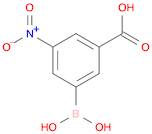
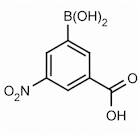
CAS 101084-81-5
:Ácido (3-carboxi-5-nitrofenil)borónico
Fórmula:C7H6BNO6
InChI:InChI=1/C7H6BNO6/c10-7(11)4-1-5(8(12)13)3-6(2-4)9(14)15/h1-3,12-13H,(H,10,11)
Clave InChI:WNIFCLWDGNHGMX-UHFFFAOYSA-N
SMILES:c1c(cc(cc1B(O)O)N(=O)=O)C(=O)O
Sinónimos:- 3-Borono-5-nitrobenzoic acid
- 3-(Dihydroxyboranyl)-5-Nitrobenzoic Acid
- 3-Carboxy-5-nitrophenylboronic acid
Filtrar por
Porcentaje de pureza
0
100
|
0
|
50
|
90
|
95
|
100
Se han encontrado 9 productos.
- Precio más bajo
- Precio más alto
- Pureza más baja
- Pureza más alta
- Entrega estimada más rápida
3-Carboxy-5-nitrophenylboronic Acid (contains varying amounts of Anhydride)
CAS:Fórmula:C7H6BNO6Pureza:97.0 to 109.0 %Forma y color:White to Light yellow powder to crystalPeso molecular:210.943-Carboxy-5-nitrobenzeneboronic acid, 97%
CAS:This Thermo Scientific Chemicals brand product was originally part of the Alfa Aesar product portfolio. Some documentation and label information may refer to the legacy brand. The original Alfa Aesar product / item code or SKU reference has not changed as a part of the brand transition to Thermo SciFórmula:C7H6BNO6Pureza:97%Forma y color:White to pale cream, PowderPeso molecular:210.943-Borono-5-nitrobenzoic acid
CAS:Fórmula:C7H6BNO6Pureza:96%Forma y color:SolidPeso molecular:210.93663-Borono-5-nitrobenzoic acid
CAS:3-Borono-5-nitrobenzoic acidFórmula:C7H6BNO6Pureza:97%Peso molecular:210.943-Carboxy-5-nitrobenzeneboronic acid
CAS:3-Carboxy-5-nitrobenzeneboronic acidFórmula:C7H6BNO6Pureza:98%Forma y color:Solid-PowderPeso molecular:210.936633-Carboxy-5-nitrophenylboronic acid
CAS:Fórmula:C7H6BNO6Pureza:96%Forma y color:SolidPeso molecular:210.943-Carboxy-5-nitrophenylboronic acid
CAS:3-Carboxy-5-nitrophenylboronic acid is a linker molecule that reacts with the active site of enzymes by reversible binding. It can be used in the design of micelles, which are spherical nanoparticles consisting of a hydrophilic shell and a hydrophobic core. 3-Carboxy-5-nitrophenylboronic acid has been shown to be an effective inhibitor of tumor growth by inhibiting cancer cell proliferation and inducing apoptosis. This compound was also shown to inhibit the growth of human colon tumor cells in culture. The ester linkages in this molecule are cleaved by water molecules, releasing nitro groups and generating reactive species that react with boronic acids to form covalent bonds. This process is called transesterification, which is an important reaction for making polymers.Fórmula:C7H6BNO6Pureza:Min. 95%Peso molecular:210.94 g/molRef: 3D-FC37899
Producto descatalogado