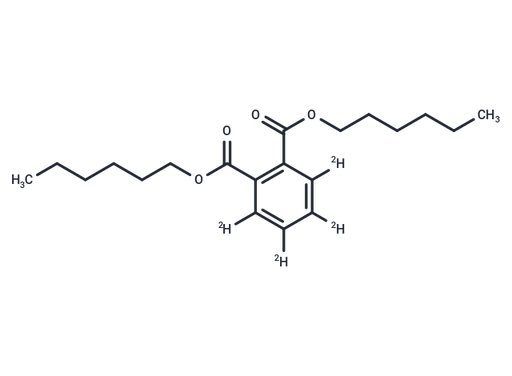
CAS 1015854-55-3
:Fórmula:C20H30O4
InChI:InChI=1S/C20H30O4/c1-3-5-7-11-15-23-19(21)17-13-9-10-14-18(17)20(22)24-16-12-8-6-4-2/h9-10,13-14H,3-8,11-12,15-16H2,1-2H3/i9D,10D,13D,14D
Clave InChI:KCXZNSGUUQJJTR-LSQQNFJSSA-N
SMILES:[2H]C1=C(C(=C(C(=C1[2H])C(=O)OCCCCCC)C(=O)OCCCCCC)[2H])[2H]
Filtrar por
Porcentaje de pureza
0
100
|
0
|
50
|
90
|
95
|
100
Se han encontrado 9 productos.
- Precio más bajo
- Precio más alto
- Pureza más baja
- Pureza más alta
- Entrega estimada más rápida
Dihexyl Phthalate-3, 4, 5, 6-d4
CAS:Dihexyl Phthalate-3, 4, 5, 6-d4Fórmula:C20H26D4O4Pureza:≥98%,≥98 atom% DPeso molecular:338.47Dihexyl phthalate-3,4,5,6-D4
CAS:Dihexyl phthalate-3,4,5,6-D4 is the deuterated form of Dihexyl phthalate-3,4,5,6. Dihexyl phthalate (TN7019) is a phthalate commonly used in various plastics and consumer products. It is classified as a priority pollutant and an endocrine disruptor. Dihexyl phthalate (TN7019) can induce the accumulation of reactive oxygen species (ROS), promote inflammation, and lead to a significant increase in apoptosis and inflammation-related gene expression levels. Additionally, Dihexyl phthalate (TN7019) can cause testicular atrophy and is recognized as a reproductive toxicant.Fórmula:C20H30O4Peso molecular:338.4744Dihexyl phthalate-3,4,5,6-D4 (Standard)
CAS:Dihexyl phthalate-3,4,5,6-D4 (Standard) is a reference standard of Dihexyl phthalate-3,4,5,6-D4 intended for quantitative analysis, quality control, and related biochemical research applications.Fórmula:C20H30O4Forma y color:SolidPeso molecular:338.4744Di-n-hexyl Phthalate-3,4,5,6-d4
CAS:Producto controladoFórmula:C6D4COO(CH2)5CH3Pureza:99 atom % DForma y color:Colorless Liquid.Peso molecular:209.14796Phthalic acid, bis-hexyl ester D4
CAS:Producto controladoFórmula:C20D4H26O4Forma y color:NeatPeso molecular:338.4744Dihexylphthalate-D4
CAS:Producto controladoApplications Dihexylphthalate-d4 is an labeled analog of Dihexylphthalate (B185430), which is a phthalic ester, which is used as a plasticizers for vinyl plastics. Phthalates may be associated with reproductive toxicity in humans and animals.
References Saido, K., et al.: ?J. Am. Oil Chem. Soc 61, 945 (1984); Foghmoes, S., et al.: J. Eur. Ceram. Soc. 36, 3441 (2016); Przybyli?ska, P. A. and Wyszkowski, M.: Ecol. Chem. Eng., S 23,347 (2016)Fórmula:C20D4H26O4Forma y color:NeatPeso molecular:338.4744