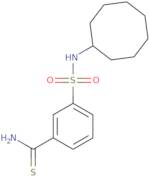
CAS 1036619-17-6
:Fórmula:C15H22N2O2S2
InChI:InChI=1S/C15H22N2O2S2/c16-15(20)12-7-6-10-14(11-12)21(18,19)17-13-8-4-2-1-3-5-9-13/h6-7,10-11,13,17H,1-5,8-9H2,(H2,16,20)
Clave InChI:NZFRNKMAAVEDPP-UHFFFAOYSA-N
SMILES:C1CCCC(CCC1)NS(=O)(=O)C2=CC=CC(=C2)C(=S)N
Filtrar por
Porcentaje de pureza
0
100
|
0
|
50
|
90
|
95
|
100
Se han encontrado 1 productos.
- Precio más bajo
- Precio más alto
- Pureza más baja
- Pureza más alta
- Entrega estimada más rápida
3-(Cyclooctylsulfamoyl)benzene-1-carbothioamide
CAS:3-(Cyclooctylsulfamoyl)benzene-1-carbothioamide is a research tool. It is an activator of ion channels, which are pores in the cell membrane that allow electrically charged particles to enter and leave the cell. 3-(Cyclooctylsulfamoyl)benzene-1-carbothioamide has been shown to activate potassium ion channels, leading to increased potassium efflux and decreased sodium influx. This effect may be due to its ability to inhibit protein interactions with the channel. 3-(Cyclooctylsulfamoyl)benzene-1-carbothioamide also acts as a ligand for receptor proteins, which are located on the outside of cells and bind with other molecules, such as hormones or neurotransmitters. This compound has been shown to act as a ligand for GABA receptors, binding with these proteins and inducing an inhibitory effect on neurons in theFórmula:C15H22N2O2S2Pureza:Min. 95%Peso molecular:326.5 g/mol