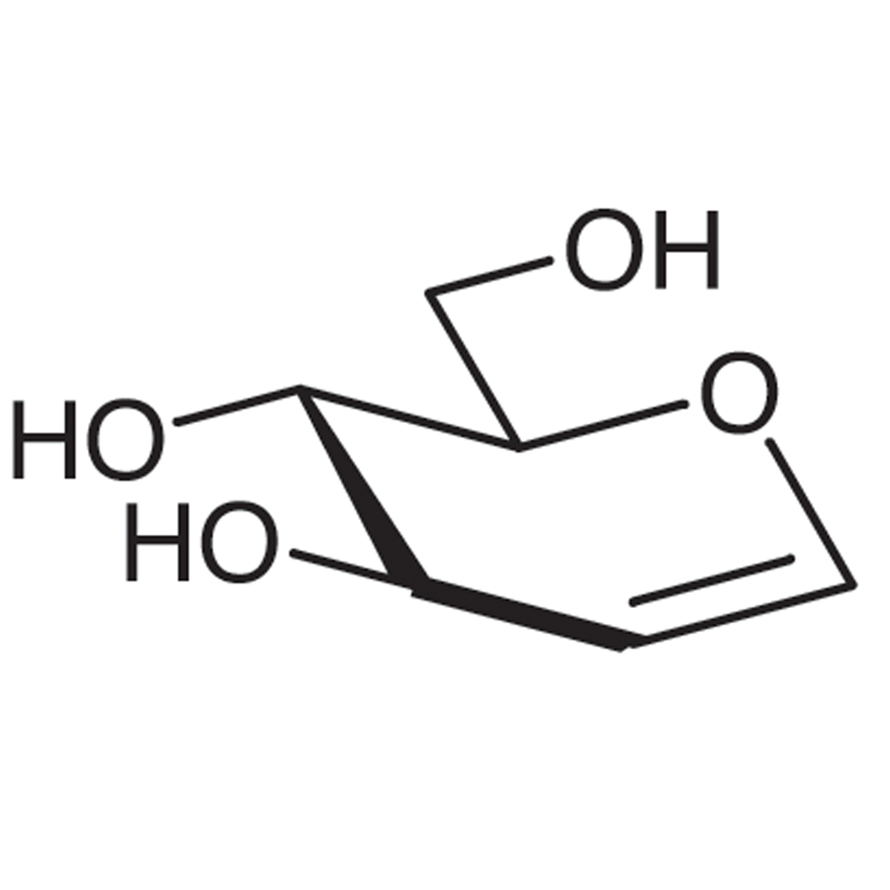
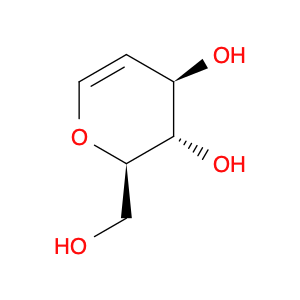
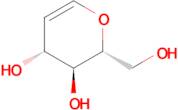
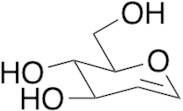
CAS 13265-84-4
:D-glucal
Descripción:
D-glucal, con el número CAS 13265-84-4, es un compuesto orgánico clasificado como un aldohexosa y es un derivado de la glucosa. Se caracteriza por su estructura de cadena abierta, que presenta un grupo carbonilo (aldehído) en un extremo y múltiples grupos hidroxilo a lo largo de la cadena de carbono. D-glucal es típicamente un sólido blanco a blanco sucio y es soluble en agua debido a sus grupos funcionales polares. Este compuesto es conocido por su reactividad, particularmente en reacciones de glicosilación, lo que lo hace valioso en la síntesis orgánica y la química de carbohidratos. D-glucal puede sufrir varias transformaciones, incluyendo oxidación y reducción, y puede participar en reacciones de ciclado para formar glicosidos. Sus características estructurales contribuyen a su importancia biológica, ya que puede servir como precursor de carbohidratos más complejos. Además, las propiedades de D-glucal lo convierten en un tema de interés en la investigación relacionada con glicoproteínas y otras biomoléculas.
Fórmula:C6H10O4
InChI:InChI=1/C6H10O4/c7-3-5-6(9)4(8)1-2-10-5/h1-2,4-9H,3H2/t4-,5-,6+/m1/s1
Clave InChI:InChIKey=YVECGMZCTULTIS-PBXRRBTRSA-N
SMILES:C(O)[C@@H]1[C@@H](O)[C@H](O)C=CO1
Sinónimos:- (4xi)-1,5-anhydro-2-deoxy-D-threo-hex-1-enitol
- 1,5-Anhydro-2-deoxy-<span class="text-smallcaps">D</span>-arabino-hex-1-enitol
- 1,5-Anhydro-2-deoxy-D-arabino-hex-1-enitol
- <span class="text-smallcaps">D</span>-(+)-Glucal
- <span class="text-smallcaps">D</span>-arabino-Hex-1-enitol, 1,5-anhydro-2-deoxy-
- <span class="text-smallcaps">D</span>-arabino-Hex-1-enopyranose, 1,2-dideoxy-
- D-arabino-Hex-1-enitol, 1,5-anhydro-2-deoxy-
- Glucal
- D-Glucal
- D-arabino-Hex-1-enopyranose, 1,2-dideoxy-
- (2R,3S,4R)-2-(hydroxymethyl)-3,4-dihydro-2H-pyran-3,4-diol
- (2R)-3β,4α-Dihydroxy-3,4-dihydro-2H-pyran-2α-methanol
- (2R)-3,4-Dihydro-2α-(hydroxymethyl)-2H-pyran-3β,4α-diol
- 1,2-Didehydro-1,2-dideoxy-D-glucopyranose
- P-GLUCAL
- 1,5-Anhydro-2-deoxy-D-arabino-hexa-1-enitol
- 1,5-anhydro-2-deoxy-d-arabino-hex-1-enito
- Ver más sinónimos
Filtrar por
Porcentaje de pureza
0
100
|
0
|
50
|
90
|
95
|
100
Se han encontrado 9 productos.
- Precio más bajo
- Precio más alto
- Pureza más baja
- Pureza más alta
- Entrega estimada más rápida
D-Glucal
CAS:Fórmula:C6H10O4Pureza:>97.0%(GC)Forma y color:White to Almost white powder to crystalPeso molecular:146.14D-Glucal
CAS:D-Glucal is an organic compound belonging to the family of aldohexoses, which are monosaccharides containing an aldehyde functional group. It features a six-carbon structure and is derived from glucose by oxidizing the primary alcohol group at carbon 1 to an aldehyde group. D-Glucal appears as a white crystalline solid, soluble in water, and has a sweet taste. It serves as a crucial intermediate in the chemical synthesis of various compounds, including pharmaceuticals, agrochemicals, and natural products. D-Glucal can be converted into other carbohydrate derivatives, such as glycosides, glycoconjugates, and amino sugars. Additionally, it plays a role in carbohydrate chemistry research and is used as a chiral component for synthesizing complex structures.Fórmula:C6H10O4Peso molecular:146.1412D-Glucal
CAS:Fórmula:C6H10O4Pureza:≥ 98.0%Forma y color:White to off-white or beige powderPeso molecular:146.14D-Glucal
CAS:D-Glucal is a protonated d-glucal, which is a simple sugar. It reacts with the electron acceptor oxygen to form an oxidized product. This product can be reduced back to the original molecule by using a reducing agent, such as sodium borohydride or sodium dithionite. D-Glucal has been shown to inhibit the growth of tumor cells in mice that are resistant to other anticancer drugs. D-Glucal inhibits transcription and replication of DNA by binding to the DNA-dependent RNA polymerase and blocking its ability to transcribe messenger RNA (mRNA). The enzyme is also inhibited by glycosidic bond architectures that prevent it from binding to the DNA template strand. D-Glucal also has an effect on protein synthesis because it binds to proteins and prevents them from performing their normal functions. D-Glucal has been used as a model system for studying cellular processes in mammalian cells, such as oxidationFórmula:C6H10O4Pureza:Min. 98 Area-%Forma y color:White Off-White PowderPeso molecular:146.14 g/mol(2R,3S,4R)-2-(Hydroxymethyl)-3,4-dihydro-2H-pyran-3,4-diol
CAS:Fórmula:C6H10O4Pureza:98%Forma y color:SolidPeso molecular:146.142D-Glucal
CAS:(2R,3S,4R)-2-(Hydroxymethyl)-3,4-dihydro-2H-pyran-3,4-diolFórmula:C6H10O4Pureza:98%Peso molecular:146.14D-Glucal
CAS:Producto controladoApplications D-Glucal is an important building block for both solution- and solid-phase synthesis of oligosaccharides.
References Gilkes, N., et al.: J. Biol. Chem., 259, 10455 (1984), Street, I., et al.: Biochemistry, 31, 9970 (1992), Crout, D., et al.: Curr. Opin. Chem. Biol., 2, 98 (1998),Fórmula:C6H10O4Forma y color:NeatPeso molecular:146.14