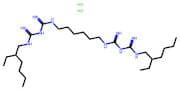
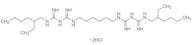
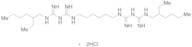
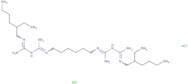
CAS 1715-30-6
:Dihidrocloruro de alexidina
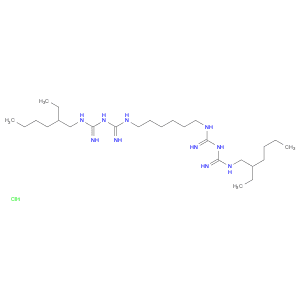
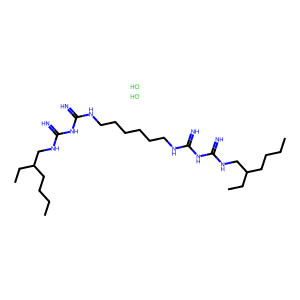
- 1,6-Bis(2-ethylhexylbiguanido)hexane dihydrochloride
- 2,4,11,13-Tetraazatetradecanediimidamide, N,N''-bis(2-ethylhexyl)-3,12-diimino-, dihydrochloride
- 2,4,11,13-Tetraazatetradecanediimidamide, N1,N14-bis(2-ethylhexyl)-3,12-diimino-, hydrochloride (1:2)
- 2,4,11,13-Tetraazatetradecanediimidamide, N<sup>1</sup>,N<sup>14</sup>-bis(2-ethylhexyl)-3,12-diimino-, hydrochloride (1:2)
- Alexidine dihydrochloride
- Alexidine hydrochloride
- Biguanide, 1,1′-hexamethylenebis[5-(2-ethylhexyl)-, dihydrochloride
- Hexamethylenebis(2-ethylhexyl)biguanide dihydrochloride
- N'',N''''''-hexane-1,6-diylbis[N'''-(2-ethylhexyl)(imidodicarbonimidic diamide)] dihydrochloride
- N,N''-Bis(2-ethylhexyl)-3,12-diimino-2,4,11,13-tetraazatetradecanediamidine dihydrochloride
- WIN-21904
- Alexidine dihydrochloride, N,N''''-Hexane-1,6-diylbis[N'-(2-ethylhex-1-yl)(imidodicarbonimidic diamide)] dihydrochloride
- N,N''-Bis(2-ethylhexyl)-3,12-diiMino-2,4,11,13-tetraazatetradecanediiMidaMide
- Bisguanidine
- Bisguadine
- 1,1'-Hexamethylenebis[5-(2-ethylhex-1-yl)]biguanide dihydrochloride
- N,N''-Bis(2-ethylhexyl)-3,12-diimino-2,4,11,13-tetraazatetradecanediimidamidedihydrochloride
- Compound-904
- Sterwin 904
- Ver más sinónimos
N,N''-bis(2-ethylhexyl)-3,12-diimino-2,4,11,13-tetraazatetradecanediamidine dihydrochloride
CAS:Fórmula:C26H58Cl2N10Pureza:98%Forma y color:SolidPeso molecular:581.7117Alexidine dihydrochloride
CAS:Alexidine dihydrochloride: antifungal, antibiofilm, targets PTPMT1 for mitochondrial apoptosis, potential cancer treatment.Fórmula:C26H58Cl2N10Pureza:99.32% - 99.81%Forma y color:SolidPeso molecular:581.71Alexidine dihydrochloride
CAS:Fórmula:C26H56N10·2HClForma y color:White to off-white powderPeso molecular:581.711,1'-Hexamethylenebis[5-(2-ethylhex-1-yl)]biguanide dihydrochloride
CAS:1,1'-Hexamethylenebis[5-(2-ethylhex-1-yl)]biguanide dihydrochlorideFórmula:C26H56N10·2ClHPureza:≥95%Forma y color: off-white solidPeso molecular:581.71g/molAlexidine dihydrochloride
CAS:Alexidine dihydrochlorideFórmula:C26H56N10·2ClHPureza:By hplc: 99.5% (Typical Value in Batch COA)Forma y color: off-white powderPeso molecular:581.71g/molAlexidine Dihydrochloride
CAS:Fórmula:C26H56N10·2HClPureza:>98.0%(HPLC)(N)Forma y color:White to Almost white powder to crystalinePeso molecular:581.72Alexidine Dihydrochloride
CAS:Producto controladoApplications Alexidine Dihydrochloride has antibacterial, antiplaque properties against Streptococcus mutans, Actinomyces ciscosus, and Actinomyces naesludii.
References Coburn, R.A., et al.: J. Med. Chem., 21, 8, 829 (1978), Takayama, K., et al.: J. Biol. Chem., 269, 2241 (1994), Faure, P., et al.: Biochimie, 86, 411 (2004),Fórmula:C26H56N10·2ClHForma y color:NeatPeso molecular:581.71Alexidine Dihydrochloride extrapure, 96%
CAS:Fórmula:C25H58C12N10Pureza:min.96%Forma y color:White to off-white, PowderPeso molecular:581.73Alexidine dihydrochloride
CAS:Alexidine dihydrochloride is a metabolic agent that belongs to the group of antimicrobial agents. It is used in the treatment of cervical cancer, which is caused by human papilloma virus. Alexidine dihydrochloride inhibits the growth of cancer cells and has been shown to induce cell death in squamous cancer cells. It also inhibits microbial infection when combined with polymyxin B. This compound binds to microbial membranes, disrupting their function and inhibiting bacterial growth. Alexidine dihydrochloride has been shown to inhibit the synthesis of DNA, RNA, and protein by binding to specific sites on cellular ribosomes.
Fórmula:C26H56N10·2HClPureza:Min. 95%Forma y color:PowderPeso molecular:581.71 g/mol




![1,1'-Hexamethylenebis[5-(2-ethylhex-1-yl)]biguanide dihydrochloride](/_next/image/?url=https%3A%2Fstatic.cymitquimica.com%2Fproducts%2F54%2Fthumb%2FOR2503.jpg&w=3840&q=75)