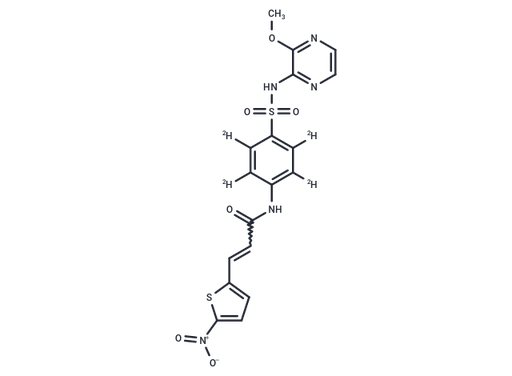
CAS 1795144-22-7
:Fórmula:C18H15N5O6S2
InChI:InChI=1S/C18H15N5O6S2/c1-29-18-17(19-10-11-20-18)22-31(27,28)14-6-2-12(3-7-14)21-15(24)8-4-13-5-9-16(30-13)23(25)26/h2-11H,1H3,(H,19,22)(H,21,24)/b8-4+/i2D,3D,6D,7D
Clave InChI:FNPPHVLYVGMZMZ-GTQWLDGCSA-N
SMILES:[2H]C1=C(C(=C(C(=C1NC(=O)/C=C/C2=CC=C(S2)[N+](=O)[O-])[2H])[2H])S(=O)(=O)NC3=NC=CN=C3OC)[2H]
Filtrar por
Porcentaje de pureza
0
100
|
0
|
50
|
90
|
95
|
100
Se han encontrado 4 productos.
- Precio más bajo
- Precio más alto
- Pureza más baja
- Pureza más alta
- Entrega estimada más rápida
Necrosulfonamide-D4
CAS:Necrosulfonamide-D4 is the deuterated form of Necrosulfonamide. Necrosulfonamide (T6904) acts as a necroptosis inhibitor by selectively targeting (MLKL). It hinders the interaction between the MLKL-RIP1-RIP3 necrosome complex and its downstream effectors. MLKL serves as a crucial substrate of RIP3 in the necrosis induction process.Fórmula:C18H15N5O6S2Peso molecular:465.50Necrosulfonamide-d4
CAS:Producto controladoApplications Labelled Necrosulfonamide. Necrosulfonamide specifically blocks necrosis downstream of receptor-interacting serine-threonine kinase 3 (RIP3) activation. RIP3 is a key signalling molecule in the programmed necrosis (necroptosis) pathway.
References Sun, L. et al.: Cell, 148, 213 (2012);Fórmula:C18H11D4N5O6S2Forma y color:NeatPeso molecular:465.5Necrosulfonamide-d4
CAS:Necrosulfonamide-d4 is a compound that plays a crucial role in various biological processes. It acts as a growth factor and is involved in the metabolism of fatty acids and glutamate. Additionally, it contributes to the synthesis of biomass and is utilized in the production of methanol. Necrosulfonamide-d4 also interacts with basic proteins and has been found to have an impact on ticagrelor, chamomile extract, acetyltransferase, xylose, sulfadiazine, chemokines, industrial applications, cellulose production, and Life Sciences research. Its diverse range of applications makes it a valuable component in many fields.Fórmula:C18H15N5O6S2Pureza:Min. 95%Peso molecular:465.5 g/mol